Dakshina kannada receives excess rainfall

[email protected] (CD Network)
July 6, 2016

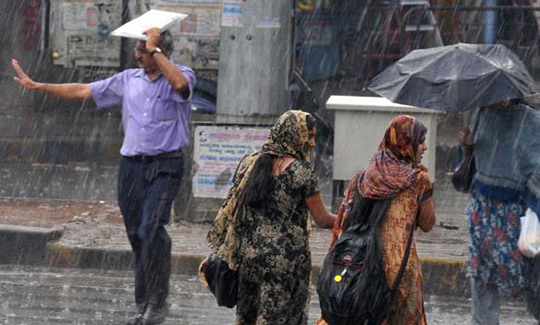
Mangaluru, Jul 6: The coastal district of Dakshina Kannada has received excess rainfall than the normal in June this year.

rain

Kumar, additional deputy commissioner, said during a meeting with officials here that as against the normal average rainfall of 942 mm, the district has received 944 mm rainfall in June.

The disrict and the coastal belt has been witnessing heavy downpour for the past few days.

The district has received 124.4 cms of rains from January to July this year as against the 109.8 cms recorded last year during the same period, he added.

Comments

Add new comment

  • Coastaldigest.com reserves the right to delete or block any comments.
  • Coastaldigset.com is not responsible for its readers’ comments.
  • Comments that are abusive, incendiary or irrelevant are strictly prohibited.
  • Please use a genuine email ID and provide your name to avoid reject.
News Network
May 29,2020

Bengaluru, May 29: A cost-effective state of the art glove box testing booth for swab collection was inaugurated by Karnataka Medical Education Minister Dr K Sudhakar at Victoria hospital.

Inaugurating the specially designed booth for safer, easier and quicker testing, Medical Education Minister Dr Sudhakar said that the portable booths can be used at border check posts and hot spots.

"The testing method involves the collection of samples from inside a box of aluminium and glass. The suspected corona virus-infected individual, whose samples are being taken, has to walk up to the booth and stand in front of the glass exterior. The healthcare worker inside the kiosk collects the sample and then, follows the sanitisation process before proceeding to take the next sample. The collection process, fully contactless, gets over in five minutes," the Minister said.

Dr Sudhakar also said: "This booth significantly reduces manpower requirement and the need for PPE kits. The main advantages of this procedure are that it needs fewer healthcare workers and strictly adheres to the norms of social distancing. 

The booth is low-cost. Each model costs about Rs 15,000-20,000."
It is also portable and can be mounted on a vehicle and transported to any location.

It can be particularly useful for collecting samples in hot spots and border checkpoints, he added. 

Comments

Add new comment

  • Coastaldigest.com reserves the right to delete or block any comments.
  • Coastaldigset.com is not responsible for its readers’ comments.
  • Comments that are abusive, incendiary or irrelevant are strictly prohibited.
  • Please use a genuine email ID and provide your name to avoid reject.
News Network
June 26,2020

Bengaluru, Jun 26: The National Restaurant Association of India (NRAI) on Thursday came up with a Standard Operating Procedure (SOP) for restaurants whereby among other physical distancing norms, it has suggested a 2-metre gap between tables.

Formulated in partnership with Releski, a Bengaluru based skill-tech company, the SoP suggests that in case of back-to-back seating, people sitting with their backs towards each other will have their seats divided by 'Plexiglass' divider raised up to 2 meters from the ground.

"In a typical restaurant, the improvised seating plan should have a minimum distance of 2 metres between tables. The distance of 2 metres (6 feet) between tables should measure from one edge of the table to the other table's edge," it said.

In case of loose or free seating such as in banquet style or food court style seating, a minimum 2 meters of distance should be maintained between tables.

The guidelines noted that, to encourage physical distancing, restaurants have to sacrifice their seating capacity, to promote health and safety, and also to gain trust from their patrons.

"In order to perform this, divide your restaurants under different sectors. Pull out your restaurant's floor plan and colour code different sections red and yellow. Red sections are potential areas where maximum footfall or traffic is observed. Yellow sections are areas where the footfalls are average," it said.

All the red sections are encircled or bordered by placing barricades or Q manager and will open at specific points to access the yellow section and all the opening points will have hand sanitisers and sprays, and every guest who walks from red zones to yellow zones will sanitise himself/herself to reduce the chances of contamination.

For air conditioning, the guidelines of CPWD shall be followed which inter alia emphasises that the temperature setting of all air conditioning devices should be in the range of 24-30 degree Celsius, relative humidity should be in the range of 40- 65 per cent, intake of fresh air should be as much as possible and cross ventilation should be adequate, the guidelines suggested.

The industry body has also suggested appointment of a COVID-free Ambassador who would operate as the Chief Health Officer within the restaurant team, preferably from the management team in each shift.

The ambassador's would put the new daily work routines into practice, to monitor compliance with good practice and to lead the preventative measures, adapt to health & safety recommendations and requirements of the restaurant and oversee the implementation of the norms.

Anurag Katriar, President of NRAI and CEO & Executive Director of deGustibus Hospitality, said: "Every restaurant cutting across formats is facing the harsh reality of subdued to shut business volumes in the present and the uncertainty of business environment in the future. One thing is certain that hygiene and safety will be a key differentiator in the post-pandemic restaurant operations."


Comments

Add new comment

  • Coastaldigest.com reserves the right to delete or block any comments.
  • Coastaldigset.com is not responsible for its readers’ comments.
  • Comments that are abusive, incendiary or irrelevant are strictly prohibited.
  • Please use a genuine email ID and provide your name to avoid reject.
News Network
July 16,2020

Mangaluru, Jul 16: Streets in Mangaluru wore a deserted look as the city woke up to the first morning of the seven-day lockdown on Thursday.

The lockdown is being observed after the state government announced it as a necessary step to combat the spread of COVID-19.

The week-long total shutdown came into effect in the Karnataka's Dakshina Kannada district from 8 pm on July 15 till 5 am on July 22.

The state government allowed relaxation between 8am to 11 am for purchasing of essential commodities. A slight rush was observed during the hours of the relaxation.

Karnataka has so far reported 47,253 positive COVID-19 cases, including 27,859 active cases and 18,466 recoveries.

So far, 928 people have lost their lives due to the infectious virus in the state.

Comments

Add new comment

  • Coastaldigest.com reserves the right to delete or block any comments.
  • Coastaldigset.com is not responsible for its readers’ comments.
  • Comments that are abusive, incendiary or irrelevant are strictly prohibited.
  • Please use a genuine email ID and provide your name to avoid reject.