Dawood Ibrahim depressed after his only son becomes a devout Muslim, opposes illegal activities

coastaldigest.com web desk
November 26, 2017

India’s most-wanted gangster Dawood Ibrahim Kaskar is reported to be suffering from depression as his 31-year-old son Moin Nawaz D Kaskar has started following Islamic teachings that prohibits him from illegal activities. 

According to reliable sources, Moin, the third child and only son of don, has completely turned his back on the "family business" and has become a devout Muslim, who follows Islamic principles. 

"Moin is understood to be deadly against his father's illegal activities which have given the entire family a notorious reputation worldwide and made many of them wanted fugitives everywhere," Thane Anti-Extortion Cell head Pradeep Sharma said. 

He said this and other nuggets of an internal strife in the family tumbled out in bits and pieces during the ongoing interrogation of Iqbal Ibrahim Kaskar, Dawood's younger brother, who was nabbed in three extortion cases last September by the Thane AEC.  

Iqbal Kaskar has informed the investigators that a deeply worried Dawood is afflicted by bouts of despondency over who would look after and handle his vast underworld empire in the future. 

More so, as his other brother Anees Ibrahim Kaskar is now ageing and reportedly not in robust health, other brothers are deceased and no reliable close relatives available to take over the reins of the empire. 

"His son is practically estranged from the family and all its businesses since the past few years, but it is not clear if he is on speaking terms with his father," said Sharma, a former "encounter specialist" dreaded by the mafia, with many scalps of dreaded criminals under his belt. 

Iqbal Kaskar told the investigators that his nephew Moin is now a respected and qualified Maulana, who is a 'Hafiz-e-Quran', having memorized the entire Holy Quran which comprises 6,236 verses. 

Besides, he has discarded the comforts of the family's palatial bungalow in the fashionable Clifton area in the posh Saddar suburb of Karachi and opted to live a mendicant's life in a mosque adjacent to their home. 

However, his wife Saniya and their three minor children have not abandoned him and are living with him in the small quarters provided by the mosque management. 

Moin's main activities comprise teaching Holy Quran and Islamic preachings to young children, leading the call of prayers and congregation of 'namaz' at various occasions and other social-religious responsibilities associated with a cleric. 

"It’s clear that Moin, who could have inherited his father's vast legal and illegal business empires, has decided to become a man of Islam and completely shunned a life of luxury which was at his command," Sharma said. 

Earlier, Moin, who is a business management graduate, used to help out his father in some of his line of works, but gradually drifted away to the "divine call of Allah". 

A handsome young man, in September 2011, he settled down in life and married a wealthy Karchi businessman's daughter, Saniya Shaikh, who helps out in her family businesses in Pakistan and Britain. 

Of Moin's siblings, Mahrukh got married in 2006 to Junaid, the son of Pakistani star cricketer Javed Miandad, and middle sister Mahreen tied the knot with a US-based businessman's son in early 2011. 

Comments

Mohammed
 - 
Tuesday, 28 Nov 2017

One Question, why dont media have Dawood's present pic with them? They get so many news about dawood's hide-outs & things. Even long back it happened same with Muthappa Rai, media or govt., did not have his pic too. Media is filled with fools who make & break people's life for no reason. Everything for Media is breaking News.

Abdullah
 - 
Monday, 27 Nov 2017

That is the Real Power of Islam. Subhanallah.

Add new comment

  • Coastaldigest.com reserves the right to delete or block any comments.
  • Coastaldigset.com is not responsible for its readers’ comments.
  • Comments that are abusive, incendiary or irrelevant are strictly prohibited.
  • Please use a genuine email ID and provide your name to avoid reject.
News Network
May 8,2020

New Delhi, May 8: After deadly styrene gas leak in Visakhapatnam, Union Chemicals and Fertilisers Minister D V Sadananda Gowda urged all public and private chemical makers to exercise caution and care while reopening their plants.

Union Environment Ministry and State Pollution Control Boards have also issued separate directives to all companies to take extreme precaution while restarting their units that remained suspended due to the lockdown imposed to contain the spread of COVID-19 in the country, he said.

There was a gas leak from LG Polymers plant at Visakhapatnam in the early hours on Thursday, causing 10 deaths and hundreds of people getting hospitalised.

"LG Polymers does not come under direct control of our ministry. However, we have asked all public and private chemicals manufacturers to exercise caution and care while reopening their plants," Gowda told PTI.

The minister said his officers are coordinating with the Andhra Pradesh government.

He further said LG Polymers, a multinational chemical company, had kept its unit ready for reopening after one and half month of lockdown. The unit started leaking at around 3.40 am on Thursday due to pressure.

"The toxic gas leak has affected both people and animals. Around 850 people have been hospitalised," Gowda said, adding that measures have been taken to control the situation at the plant site and final updates are awaited.

At present, Indian chemicals market size is about USD 163 billion, which is only three per cent of the global chemical industry of USD 5 trillion, as per the official data.

Comments

Add new comment

  • Coastaldigest.com reserves the right to delete or block any comments.
  • Coastaldigset.com is not responsible for its readers’ comments.
  • Comments that are abusive, incendiary or irrelevant are strictly prohibited.
  • Please use a genuine email ID and provide your name to avoid reject.
News Network
June 7,2020

Bengaluru, Jun 7: An eminent scientist on Sunday suggested a shift system in schools to prevent spread of the coronavirus and continuing with online classes with focus on project-based learning in a big way to promote creativity.

Former Director General of the Defence Research and Development Organisation (DRDO) V K Saraswat supported the idea of online teaching in the absence of regular classes in view of closure of schools due to the COVID-19 pandemic.

But, he said it should be organised in far better and more interactive ways so that delivery of knowledge can be better. The NITI Aayog member stressed the need for schools to have a strategy when they reopen keeping in mind the safety of students.

May be they will have to organise shifts so that within the same space they can handle the students; May be they will have to employ more teachers, and they can run two shifts. "May be half the strength in a class can come in the morning and others in the afternoon.

Or students of first to sixth standard can come in the morning and seventh to tenth can come in the afternoon, Saraswat told PTI. Reopening strategy will have to be worked out by the education department, added the former Chief Scientific Advisor to the Defence Minister.

Along with normal classes, online education should be continued as a regular system in future, and promoted in a big way because that is the way technology is going to help delivery of knowledge, he added. Saraswat also raised the pitch for reforms in the education sector, saying India is facing the problem of rote learning.

Rote learning has to give way for more project-based teaching, he underlined. Children should be made to work on projects at home and that can be done online. That will also support the changeover from rote learning to creative learning.

I personally believe the education delivery system -- primary, secondary and college levels -- has to be completely changed because creativity in India is less and creativity would come only if we replace rote learning with project-based learning, Saraswat said.

On some academics holding the view that the marks-based model is killing the education system in India as it does not promote creativity, he said evaluation of any outcome is important. Even when we perform in our normal way, evaluation cannot be replaced.

Otherwise, you cant find out how much you have succeeded in delivery. Certainly evaluation cannot be dispensed with. He did not agree with some experts, who favoured a single, uniform system for school education in India by dispensing with CBSE, ICSE and state boards. I am not for normalising everything in life.

I personally believe variety should be there. This concept of one kind of a system is okay for a Communist society, society which was trying to drive everybody like a herd, he said.

Creativity comes with variety, and there is nothing wrong in having different kinds of education system, but one thing which is important is we have to integrate vocational training as part of the education curriculum," Saraswat said. Vocational part cannot be kept away from the education system, he added.

Comments

Add new comment

  • Coastaldigest.com reserves the right to delete or block any comments.
  • Coastaldigset.com is not responsible for its readers’ comments.
  • Comments that are abusive, incendiary or irrelevant are strictly prohibited.
  • Please use a genuine email ID and provide your name to avoid reject.
Agencies
July 30,2020

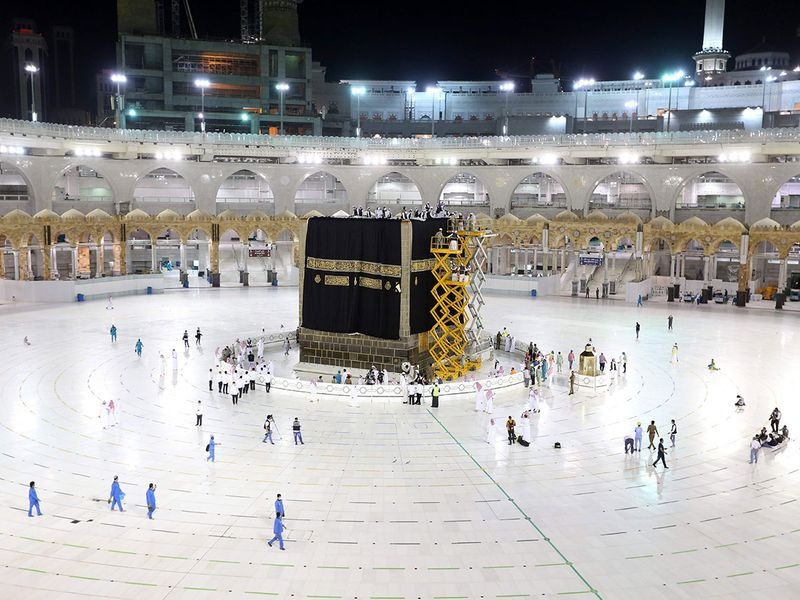
Makkah, July 30: Like every year, the Kiswa (black cloth) of holy Kaaba was replaced on Wednesday night, a process administered by the staff of the General Presidency for the Affairs of the Two Holy Mosques in accordance with the annual tradition, the Saudi Press Agency reported.

Ahmed Bin Mohammed Al-Mansouri, deputy head of the General Presidency for the Affairs of the Two Holy Mosques and director-general of the King Abdul Aziz Complex for the Kaaba, said in a statement that the Holy Kaaba was donned with a new Kiswa, constituted of four sides and a sitar (curtain) for the door.

Each of the four parts of the Kiswa was separately raised, in preparation for stretching it on the old side. The side was consolidated from above by tying it and dropping at the other end after the old side’s ropes were untied by moving the new side up and down.

Then, the old side was removed from the bottom and the new side remained, and the process was repeated four times for each section until the operation was complete and the belt was sewn in a line, straight with the four sides, Al-Mansouri said.

Al-Mansouri added: “The process began from the side of the Hateem (a semi-circular wall opposite the northwest wall of the Kaaba), because Al-Mizab (a rainwater spout made of gold) requires a special opening at the top. After consolidating all the sides, the corners were fixed by sewing them from the top of the cloth to the bottom.

Then, the curtain that required more time and hard work was installed by making a small opening with an approximate width of 3.30 meters. Three other holes were made in the black cloth to put the curtain in place under the cloth, and the sides were sewn in the black cloth of the dress, Al-Mansouri said, adding that the Kaaba cloth is made of 670 kg of high-quality silk, 120 kg of gold threads, and 100 kg of silver threads.

As many as 200 Saudi craftsmen are engaged in producing the black curtain at the King Abdul Aziz Complex for Holy Kaaba Kiswa, Al-Mansouri said.

Comments

Add new comment

  • Coastaldigest.com reserves the right to delete or block any comments.
  • Coastaldigset.com is not responsible for its readers’ comments.
  • Comments that are abusive, incendiary or irrelevant are strictly prohibited.
  • Please use a genuine email ID and provide your name to avoid reject.