


Debt-ridden businessman shoots himself after writing 4 suicide notes

[email protected] (CD Network)
June 10, 2014

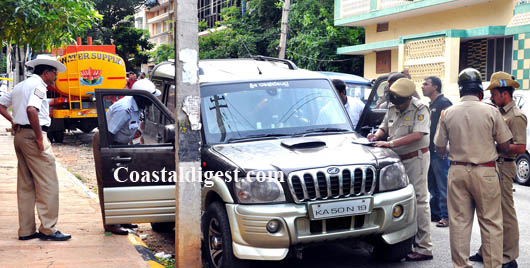
Bangalore, Jun 10: A debt-ridden businessman ended his life by shooting himself in the chest in front of Taralabalu Kendra in R?T?Nagar police limits on Monday afternoon in Bangalore.

The deceased is Raghavendra (33), the eldest son of V Ramaiah, who retired as Deputy Commissioner of Police (Public Relations), Bangalore City, a year ago.

It is believed that he took the extreme step as he had suffered losses in business. He owned two trucks and operated them to transport sand. He was a partner in real estate and cement business with some of his friends.

Raghavendra pumped a single bullet into his chest with his father 's licensed revolver sitting in his car and died on the spot, police said. He would always carry his father 's revolver whenever he went to his farmhouse. Nobody in the family suspected when he went out with the weapon on Monday, as it was a routine affair.

Raghavendra had left four suicide notes addressed to his father, mother, wife and the RT?Nagar police inspector. In the letter to the inspector, he held himself responsible for the act and pleaded not to harass his family members for his act. He said he decided to take the extreme step due to a financial crisis, police said.

“It is a clear-cut case of suicide and there is no foul play,” DCP?(North) Sandeep Patil told Deccan Herald. A CCTV camera installed at the Taralabalu Kendra building captured the act.?The police would analyse the footage to ascertain how the incident took place, he said.

In the second letter addressed to his father, Raghavendra has apologised for his act.

He had borrowed Rs four lakh for his friend Umesh and Rs two lakh for himself. He found it difficult to repay the loans as his business did not progress as expected.

Two other letters were personal in nature as they were addressed to his mother and wife. Hence, the police did not open them and handed them over to the women, the DCP said.

All the four letters were word documents typed on a computer. He had given them to his car driver Manju, saying that the letters would be collected later. Manju handed over the letters to the police after the incident.

Raghavendra was married to Meena seven years ago and has two daughters. Earlier in the day, Raghavendra dressed up his daughters and sent them to school.

Clad in half-pants, he went out, informing Meena that he was going to a saloon. He sent a message to his friend?Madhu, using WhatsApp and requesting him to come near Taralabalu Kendra at 11 am.

He sent another message some time later, requesting him to be there by noon as he wanted to discuss a business issue.

He sent similar messages to a couple of his friends, said Raghavendra 's business partner.

“I called him up, but there was no reply. I contacted Madhu and we went there and noticed his car from a distance. It was parked on the roadside and his number was not reachable when we called,” he said.

They noticed him in the driver 's seat, leaning on the door. They grew suspicious as the doors were locked from inside. They then forced open the door. “We were shocked to see him in a pool of blood with injury marks on the chest. We rushed him to the hospital where he was declared brought dead,“ he said.

suicide

Comments

Lashonda
 - 
Wednesday, 23 Mar 2016

Hello, I believe your blog may be having internet browser compatibility problems.
When I look at your website in Safari, it looks fiune however, when opening in I.E., it has some overlapping issues.
I merepy wanted to give you a quick head up! Other than that, great website!

my homepage ...hard work (Jestine: http://metin3-game.com/wiki/index.php/Utilisateur:NydiaDasilva82)

Add new comment

  • Coastaldigest.com reserves the right to delete or block any comments.
  • Coastaldigset.com is not responsible for its readers’ comments.
  • Comments that are abusive, incendiary or irrelevant are strictly prohibited.
  • Please use a genuine email ID and provide your name to avoid reject.
News Network
April 17,2020

Bengaluru, Apr 17: The Karnataka government on Friday asked Information Technology, biotechnology and allied companies not to go for closure or layoffs citing lack of work orders due to COVID-19 lockdown and instead consider measures like cutting salaries among other things.

It said IT/BT companies in the state can resume operations with 50 per cent from their office space after April 20.

Deputy chief minister C N Ashwath Narayan, who is also in charge of IT & BT department, held video consultation with the captains of the industry in light of the disruption caused due to the lockdown, and discussed on the way forward - both for effective implementation of the lockdown as well as the future course to deal with the unique circumstances.

"Immediately we are going to permit 50 per cent, but it doesn't mean that they will be able to mobilise 50 per cent immediately. It will take few weeks for them to do so. Gradually percentage will increase and it will start getting back to normalcy," Ashwath Narayan told reporters.

Stating that there were discussions regarding layoffs, he said, companies should not go for layoffs, instead of that gradation or deduction in the salary should be taken up, so that it doesn't affect the functioning of companies also that are facing less orders.

"On handling such financial crisis they (industry) wanted government consideration with mutual cooperation and understanding the concerns," he added.

Pointing out that concerns were also expressed regarding measures or protocol that needs to be followed if any positive cases are reported in any of the office spaces, Ashwath Narayan said, certain guidelines will be issued in consultation with the Health Department.

"Once the relaxation is given this may become the usual phenomena, as cases will be reported here and there... so in that scenario how we need to work and handle the situation is important, so we will be working on protocols how to handle the situation. So far we have planned for residential areas and not for work spaces," he said.

The deputy chief minister said the IT and BT industry leaders are extremely happy with regard to the support system or backup given by the government of Karnataka, particularly IT/BT department.

Even during this crisis period in the entire world, Karnataka and Bengaluru were able to get a good reputation and become reliable partner, as IT/BT service providers in both the city and the state were able to provide excellent quality services to their clients without any interruption, he said.

If you compare with any state or country, we have done extremely well, and hope that this would get more business, he added.

Biocon chief Kiran Mazumdar Shaw, Infosys co-founder Kris Gopalakrishnan, who is also the Chairman of Vision Group IT, were among others present at the video conferencing.

Noting that concerns expressed by the industry regarding passes for employees to commute to office, Ashwath Narayan said, the government would make necessary arrangements in this regard, considering measures that need to be taken after April 20.

Regarding providing transport facility, they can seek for services from public transport Bangalore Metropolitan Transport Corporation (BMTC) on a contract basis, he said, adding that "We will be ready to facilitate BMTC."

The minister said the industry leaders wanted internet services to continue with the same quality and without any interruption.

Comments

Add new comment

  • Coastaldigest.com reserves the right to delete or block any comments.
  • Coastaldigset.com is not responsible for its readers’ comments.
  • Comments that are abusive, incendiary or irrelevant are strictly prohibited.
  • Please use a genuine email ID and provide your name to avoid reject.
Ram Puniyani
February 10,2020

Noam Chomsky is one of the leading peace workers in the world. In the wake of America’s attack on Vietnam, he brought out his classic formulation, ‘manufacturing consent’. The phrase explains the state manipulating public opinion to have the public approve of it policies—in this case, the attack of the American state on Vietnam, which was then struggling to free itself from French colonial rule.

In India, we are witness to manufactured hate against religious minorities. This hatred serves to enhance polarisation in society, which undermines India’s democracy and Constitution and promotes support for a Hindu nation. Hate is being manufactured through multiple mechanisms. For example, it manifests in violence against religious minorities. Some recent ghastly expressions of this manufactured hate was the massive communal violence witnessed in Mumbai (1992-93), Gujarat (2002), Kandhamal (2008) and Muzaffarnagar (2013). Its other manifestation was in the form of lynching of those accused of having killed a cow or consumed beef. A parallel phenomenon is the brutal flogging, often to death, of Dalits who deal with animal carcasses or leather.

Yet another form of this was seen when Shambhulal Regar, indoctrinated by the propaganda of Hindu nationalists, burned alive Afrazul Khan and shot the video of the heinous act. For his brutality, he was praised by many. Regar was incited into the act by the propaganda around love jihad. Lately, we have the same phenomenon of manufactured hate taking on even more dastardly proportions as youth related to Hindu nationalist organisations have been caught using pistols, while police authorities look on.

Anurag Thakur, a BJP minster in the central government recently incited a crowd in Delhi to complete his chant of what should happen to ‘traitors of the country...” with a “they should be shot”. Just two days later, a youth brought a pistol to the site of a protest at Jamia Millia Islamia university and shouted “take Azaadi!” and fired it. One bullet hit a student of Jamia. This happened on 30 January, the day Nathuram Godse had shot Mahatma Gandhi in 1948. A few days later, another youth fired near the site of protests against the CAA and NRC at Shaheen Bagh. Soon after, he said that in India, “only Hindus will rule”.

What is very obvious is that the shootings by those associated with Hindu nationalist organisations are the culmination of a long campaign of spreading hate against religious minorities in India in general and against Muslims in particular. The present phase is the outcome of a long and sustained hate campaign, the beginning of which lies in nationalism in the name of religion; Muslim nationalism and Hindu nationalism. This sectarian nationalism picked up the communal view of history and the communal historiography which the British introduced in order to pursue their ‘divide and rule’ policy.

In India what became part of “social common sense” was that Muslim kings had destroyed Hindu temples, that Islam was spread by force, and that it is a foreign religion, and so on. Campaigns, such as the one for a temple dedicated to the Hindu god Rama to be built at the site where the Babri masjid once stood, further deepened the idea of a Muslim as a “temple-destroyer”. Aurangzeb, Tipu Sultan and other Muslim kings were tarnished as the ones who spread Islam by force in the subcontinent. The tragic Partition, which was primarily due to British policies, and was well-supported by communal streams also, was entirely attributed to Muslims. The Kashmir conflict, which is the outcome of regional, ethnic and other historical issues, coupled with the American policy of supporting Pakistan’s ambitions of regional hegemony, (which also fostered the birth of Al-Qaeda), was also attributed to the Muslims.

With recurring incidents of communal violence, these falsehoods went on going deeper into the social thinking. Violence itself led to ghettoisation of Muslims and further broke inter-community social bonds. On the one hand, a ghettoised community is cut off from others and on the other hand the victims come to be presented as culprits. The percolation of this hate through word-of-mouth propaganda, media and re-writing of school curricula, had a strong impact on social attitudes towards the minorities.

In the last couple of decades, the process of manufacturing hate has been intensified by the social media platforms which are being cleverly used by the communal forces. Swati Chaturvedi’s book, I Am a Troll: Inside the Secret World of the BJP’s Digital Army, tells us how the BJP used social media to spread hate. Whatapp University became the source of understanding for large sections of society and hate for the ‘Other’, went up by leaps and bounds. To add on to this process, the phenomenon of fake news was shrewdly deployed to intensify divisiveness.

Currently, the Shaheen Bagh movement is a big uniting force for the country; but it is being demonised as a gathering of ‘anti-nationals’. Another BJP leader has said that these protesters will indulge in crimes like rape. This has intensified the prevalent hate.

While there is a general dominance of hate, the likes of Shambhulal Regar and the Jamia shooter do get taken in by the incitement and act out the violence that is constantly hinted at. The deeper issue involved is the prevalence of hate, misconceptions and biases, which have become the part of social thinking.

These misconceptions are undoing the amity between different religious communities which was built during the freedom movement. They are undoing the fraternity which emerged with the process of India as a nation in the making. The processes which brought these communities together broadly drew from Gandhi, Bhagat Singh and Ambedkar. It is these values which need to be rooted again in the society. The communal forces have resorted to false propaganda against the minorities, and that needs to be undone with sincerity.

Combating those foundational misconceptions which create hatred is a massive task which needs to be taken up by the social organisations and political parties which have faith in the Indian Constitution and values of freedom movement. It needs to be done right away as a priority issue in with a focus on cultivating Indian fraternity yet again.

Comments

Add new comment

  • Coastaldigest.com reserves the right to delete or block any comments.
  • Coastaldigset.com is not responsible for its readers’ comments.
  • Comments that are abusive, incendiary or irrelevant are strictly prohibited.
  • Please use a genuine email ID and provide your name to avoid reject.
News Network
January 30,2020

Bengaluru, Jan 30: A kidnap case in Bengaluru has proved that crime-based series on TV channels can inspire youth to commit crimes. 21-year-old Chirag R Mehta, who kidnapped a schoolboy and got arrested within an hour after demanding Rs 5 lakh ransom, has told police that he thought of abducting the boy after watching Crime Patrol, a popular Hindi crime anthology series created by Subramanian S. lyer for Sony TV. The kidnapped schoolboy was rescued by the police and reunited with his parents. Son of a gift shop owner from Basavanagudi area in Bengaluru, Chirag has reportedly told police that decided to make some quick money to spend on cricket betting and gambling after learning kidnap tricks from the ‘Crime Patrol’. According to police, Chirag reached a private school around 3pm on Tuesday on a Bounce rental bike and zeroed in on a fourth standard student who was walking out of school. He told the boy he was his father's friend and that he required help to search for a relative who had gone missing. The boy believed Chirag and rode pillion on the bike. Chirag then engaged the boy in conversation and learnt about his father's business and got his mobile phone number. He then made a call to the boy's father, demanded Rs 5 lakh and warned him against approaching cops. However, the boy's father alerted Cottonpet police and special teams were formed to crack the case. While Cottonpet inspector Venkatesh TC's squad verified CCTV footage in and around the school, Chamarajpet inspector BG Kumaraswamy's team started tracking the suspect's mobile phone movements. An hour later, the suspect's location was traced to a hotel on the Lavelle Road-St Mark's Road stretch. Police rushed there, rescued the boy and arrested Chirag.

Comments

Add new comment

  • Coastaldigest.com reserves the right to delete or block any comments.
  • Coastaldigset.com is not responsible for its readers’ comments.
  • Comments that are abusive, incendiary or irrelevant are strictly prohibited.
  • Please use a genuine email ID and provide your name to avoid reject.