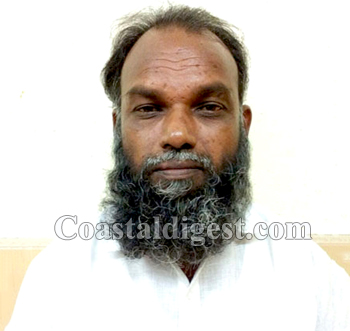
Deendar Channabasaveshwara terror case: Beggar arrested after 16 years

[email protected] (CD Network)
August 10, 2016

Bengaluru, Aug 10: Sixteen years after Karnataka faced serial bombings by Deendar Channabasaveshwara Anjuman, the Criminal Investigation Department (CID) sleuths have arrested Sheikh Amir Ali, a beggar and prime suspect in the case.

AmirAliPolice sources said that for the past couple of years, Ali had been living a mendicant's life and surviving on alms

The 50-year-old beggar is wanted in four blast cases in Karnataka and Maharashtra, police said. The Karnataka CID team picked him up from a hideout in Nalagonda, Andhra Pradesh.

The Ist Additional Chief Metropolitan Magistrate (ACMM) court in Bengaluru had issued a non-bailable warrant against Ali. The blasts were triggered by men owing allegiance to Deendar Channabasaveshwara Anjuman, a terror outfit banned in 1948.

The explosion in Bengaluru occurred in a church in JJ Nagar on the night of July 9, 2000, damaging it partly. Twenty-nine persons were arrested and the court convicted 23 of them. Eleven convicts were awarded death sentence, while 12 were sentenced to life imprisonment.

Similar blasts were triggered in Hubballi and Wadi around the same time and investigations proved the involvement of Ali and others. Of the seven fugitives, five are settled in Pakistan and one is absconding.

According to police sources, Ali had supplied explosive material to Hashim Ali from Andhra Pradesh, who assembled it to prepare the bombs.

Deendar Anjuman

Deendar Anjuman or Deendar Channabasaveshwara Anjuman was founded by Hazrath Moulana Siddique - alias Deendar Channabasaveshwara - at Bellampet, Gulbarga district, in 1924. Its head office was at Asif Nagar, Hyderabad. Though the organisation operated behind the façade of establishing religious equality, it had a hidden terror agenda, which is widely condemned by Muslims.

Terror track

1. On June 8, 2000, two crude bombs were set off at Saint Anne's Church in Wadi, Gulbarga District. The church was damaged and two persons were injured.

2. On July 9, 2000, bombs were set off at St Peter Paul Church in Jagajeevanaramnagar, Bengaluru.

3. On July 8, 2000, the group triggered off bombs blasts at the St John Luthern Church in Hubli. Sixteen persons faced trial in the case.

4. The final blast occurred when a bomb went off accidentally while the terrorists were transporting them in a Maruti van on July 9.

Comments

Satyameva jayate
 - 
Thursday, 11 Aug 2016

Viren go helpGO maataas dying.....and stinking....will God's stink after dying an need human help to be buried.....

Zakir
 - 
Wednesday, 10 Aug 2016

Muslims should know what exactly Holy Quran & Authentic Hadees says. Rather start following WRONG religious leaders though their life style or preaching against Quran & Hadees. Eventually innocent people loose their life and muslim community name gets spoiled bcoz of some BLACK SHEEP in the community.

Viren Kotian
 - 
Wednesday, 10 Aug 2016

Looks like CD editor's desperate bid to give saffron tinge to Muslim terror. poor fellow.

Add new comment

  • Coastaldigest.com reserves the right to delete or block any comments.
  • Coastaldigset.com is not responsible for its readers’ comments.
  • Comments that are abusive, incendiary or irrelevant are strictly prohibited.
  • Please use a genuine email ID and provide your name to avoid reject.
News Network
July 24,2020

Bengaluru, Jul 24: The Bruhat Bengaluru Mahanagara Palike (BBMP) commissioner on Thursday issued a public apology after "local staff" sealed the doors of two apartments with metal sheets in a building where a positive case of COVID-19 was reported in Dommalur.

Earlier on Thursday, BBMP sealed doors of two flats near Dommalur, in a building wherein a COVID-19 case was reported. A woman with two children, along with an elderly couple stayed in those flats. After the woman tweeted about the incident, BBMP officials removed steel sheets from doors.

Taking the matter into consideration, BBMP Commissioner N Manjunatha Prasad, took to Twitter to express an apology for "over-enthusiasm" of his officials.

He tweeted, "We are committed to address any issues that result in stigma. Apologies for the over enthusiasm of the local staff."

He also said the BBMP is committed to treating all citizens with dignity. "I have ensured removing of these barricades immediately. We are committed to treat all persons with dignity.

The purpose of containment is to protect the infected and to ensure uninfected are safe," he tweeted.

Comments

Add new comment

  • Coastaldigest.com reserves the right to delete or block any comments.
  • Coastaldigset.com is not responsible for its readers’ comments.
  • Comments that are abusive, incendiary or irrelevant are strictly prohibited.
  • Please use a genuine email ID and provide your name to avoid reject.
Media Release
March 11,2020

Mangalore, Mar 11: There everybody busy in hailing ‘Padmashree’ Harekala Hajabba. They wondered how an orange seller turned into an educationist with his grit and high objectives. However, the center of attraction- Harekala Hajabba was thinking how to transfer a cheque of rupees one lakh to a current account of his school!

Dakshina Kannada District Kannada and Culture Department had an interaction program with Harekala Hajabba at Ravindra Kalabhavana of University College Mangaluru on Wednesday. The department, as well as Dakshina Kannada District Bus Owners’ Association felicitated the achiever. They also honored Hajabba with a cash of rupees one lakh. Instantly, the man decided to utilize the amount for his school! 

In his address, Guruvappa N T Balepuni, who introduced Harekala Hajabba to society opined that with his simplicity, humbleness, moreover his service without any expectation, Hajabba is being respected everywhere. Though he is an illiterate, three universities have made his life as lessons for students. “He has kept around Rs 50-55 lakh, including his award money for the development of school. January 25, the day on which ‘Padmashree’ award has been declared to Hajabba is a memorable day for me too,” he added. 

Dakshina Kannada District Bus Owners’ Association President Dinram Alva and former president Jayaram Shekha opined that there is lot to learn from Hajabba and he is a model for the society. Recalling his old- harsher days, Hajabba said, “Parents should make mind to save government schools. A literate can achieve anything, he can lead the society,” he said and called upon for the communal harmony. 

Presiding over the function, Principal Dr. Uday Kumar M A said that Harekala Hajabba is best example how a pure-hearted man achieves any height, simplicity can make someone so rich. In his welcome speech District Kannada and Culture Department Deputy director Rajesh G, depicted Hajabba as ‘modern time Mahatma Gandhi’. Economics PG Coordinator Dr. Jayavantha Nayak and M.Com Coordinator Dr. Abobakkar Siddiq were present on the occasion.


Comments

Add new comment

  • Coastaldigest.com reserves the right to delete or block any comments.
  • Coastaldigset.com is not responsible for its readers’ comments.
  • Comments that are abusive, incendiary or irrelevant are strictly prohibited.
  • Please use a genuine email ID and provide your name to avoid reject.
Ram Puniyani
January 14,2020

In the beginning of January 2020 two very disturbing events were reported from Pakistan. One was the attack on Nankana Sahib, the holy shrine where Sant Guru Nanak was born. While one report said that the place has been desecrated, the other stated that it was a fight between two Muslim groups. Prime Minister of Pakistan Imran Khan condemned the incident and the main accused Imran Chisti was arrested. The matter related to abduction and conversion of a Sikh girl Jagjit Kaur, daughter of Pathi (One who reads Holy Guru Granth Sahib in Gurudwara) of the Gurudwara. In another incident one Sikh youth Ravinder Singh, who was out on shopping for his marriage, was shot dead in Peshawar.

While these condemnable attacks took place on the Sikh minority in Pakistan, BJP was quick enough to jump to state that it is events like this which justify the Citizenship Amendment Act (CAA). Incidentally CAA is the Act which is discriminatory and relates to citizenship with Religion, which is not as per the norms of Indian constitution. There are constant debates and propaganda that population of Hindus has come down drastically in Pakistan and Bangla Desh. Amit Shah, the Home minister stated that in Pakistan the population of Hindus has come down from 23% at the time of partition to 3.7% at present. And in Bangla Desh it has come down from 22% to present 8%.

While not denying the fact that the religious minorities are getting a rough deal in both these countries, the figures which are presented are totally off the mark. These figures don’t take into consideration the painful migrations, which took place at the time of partition and formation of Bangla Desh later. Pakistan census figures tell a different tale. Their first census was held in 1951. As per this census the overall percentage of Non Muslim in Pakistan (East and West together) was 14.2%, of this in West Pakistan (Now Pakistan) it was 3.44 and in Eat Pakistan it was 23.2. In the census held in Pakistan 1998 it became 3.72%. As far as Bangla Desh is concerned the share of Non Muslims has gone down from 23.2 (1951) to 9.6% in 2011.

The largest minority of Pakistan is Ahmadis, (https://minorityrights.org/country/pakistan/) who are close to 4 Million and are not recognised as Muslims in Pakistan. In Bangla Desh the major migrations of Hindus from Bangla Desh took place in the backdrop of Pakistan army’s atrocities in the then East Pakistan.

As far as UN data on refugees in India it went up by 17% between 2016-2019 and largest numbers were from Tibet and Sri Lanka.  (https://www.un.org/en/development/desa/population/migration/publication…)

The state of minorities is in a way the index of strength of democracy. Most South Asian Countries have not been able to sustain democratic values properly. In Pakistan, the Republic began with Jinnah’s classic speech where secularism was to be central credo of Pakistan. This 11th August speech was in a way what the state policy should be, as per which people of all faiths are free to practice their religion. Soon enough the logic of ‘Two Nation theory” and formation of Pakistan, a separate state for Muslim took over. Army stepped in and dictatorship was to reign there intermittently. Democratic elements were suppressed and the worst came when Zia Ul Haq Islamized the state in collusion with Maulanas. The army was already a strong presence in Pakistan. The popular formulation for Pakistan was that it is ruled by three A’s, Army, America and Allah (Mullah).

Bangla Desh had a different trajectory. Its very formation was a nail in the coffin of ‘two nation theory’; that religion can be the basis of a state. Bangla Desh did begin as a secular republic but communal forces and secular forces kept struggling for their dominance and in 1988 it also became Islamic republic. At another level Myanmar, in the grip of military dictatorship, with democratic elements trying to retain their presence is also seeing a hard battle. Democracy or not, the army and Sanghas (Buddhist Sang has) are strong, in Myanmar as well. The most visible result is persecution of Rohingya Muslims.

Similar phenomenon is dominating in Sri Lanka also where Budhhist Sanghas and army have strong say in the political affairs, irrespective of which Government is ruling. Muslim and Christian minorities are a big victim there, while Tamils (Hindus, Christians etc.) suffered the biggest damage as ethnic and religious minorities. India had the best prospect of democracy, pluralism and secularism flourishing here. The secular constitution, the outcome of India’s freedom struggle, the leadership of Gandhi and Nehru did ensure the rooting of democracy and secularism in a strong way.

India so far had best democratic credentials amongst all the south Asian countries. Despite that though the population of minorities rose mainly due to poverty and illiteracy, their overall marginalisation was order of the day, it went on worsening with the rise of communal forces, with communal forces resorting to identity issues, and indulging in propaganda against minorities.

While other South Asian countries should had followed India to focus more on infrastructure and political culture of liberalism, today India is following the footsteps of Pakistan. The retrograde march of India is most visible in the issues which have dominated the political space during last few years. Issues like Ram Temple, Ghar Wapasi, Love Jihad, Beef-Cow are now finding their peak in CAA.

India’s reversal towards a polity with religion’s identity dominating the political scene was nicely presented by the late Pakistani poetess Fahmida Riaz in her poem, Tum bhi Hum Jaise Nikle (You also turned out to be like us). While trying to resist communal forces has been an arduous task, it is becoming more difficult by the day. This phenomenon has been variously called, Fundamentalism, Communalism or religious nationalism among others. Surely it has nothing to do with the religion as practiced by the great Saint and Sufi traditions of India; it resorts mainly to political mobilization by using religion as a tool.


Comments

Ashi
 - 
Tuesday, 14 Jan 2020

If Malaysia implement similar NRC/CAA, India and China are the loser.

Add new comment

  • Coastaldigest.com reserves the right to delete or block any comments.
  • Coastaldigset.com is not responsible for its readers’ comments.
  • Comments that are abusive, incendiary or irrelevant are strictly prohibited.
  • Please use a genuine email ID and provide your name to avoid reject.