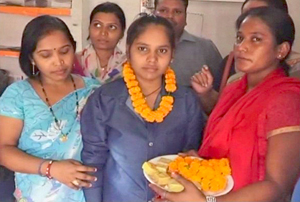
Defeating cancer, girl scored 81 percent in 10th Boards exam

Agencies
June 11, 2017

Gorakhpur, Jun 11: If there is courage and determination, we can overcome the biggest obstacle.girlboard

Though Supriya is fighting with a disease that makes people tremble and lose confidence, she managed to score 81 percent marks in the 10th Boards exam.

Not only has she made her parents proud, but also has given thousands of people a message who get disappointed with life because of any difficulty - despite suffering from blood cancer.

Supriya has been suffering from blood cancer for the past three years and her parents, Digvijay Bharati and Rupa Devi, who lived near Jatpur Kali temple, have put millions of rupees in her treatment and now, they have nothing left with them.

Supriya learned to live her life and decided to become an inspiration for others.

She continued to study hard and achieved what she deserved - though, she was disappointed that she could not fulfill her father's dream of her being a topper.

Her parents are also to be congratulated, as they kept her motivated to defeat this disease.

Meanwhile, another wonder was seen in Muzaffarnagar where a girl secured second place in the district in 12th Boards exam by memorising and writing on the walls and doors of her house with stones due to financial disability in her family since her childhood.

Meenakshi Sharma studied under the street lights as there was no electricity as well.

Her father used to earn and raise the family through providing rickshaw service, but in the meantime, due to an illness, he died because of lack of treatment.

After the death of her father, the family lost all hopes.

"I was happy to secure 90.8 percent, but I missed my father. When my two English papers were left, my father expired. Despite my family's financial hardship, my mother supported me and never let me feel that we were financially unstable," Meenakshi said.

She added she wants to become a Professor in Chemistry as it is her favourite subject and she scored the maximum marks in it.

These girls have proved that daughters are no less than sons - a lesson the entire nation needs to learn.

Comments

Add new comment

  • Coastaldigest.com reserves the right to delete or block any comments.
  • Coastaldigset.com is not responsible for its readers’ comments.
  • Comments that are abusive, incendiary or irrelevant are strictly prohibited.
  • Please use a genuine email ID and provide your name to avoid reject.
News Network
June 30,2020

New Delhi, Jun 30: The Home Ministry on Monday issued guidelines for 'Unlock 2.0' phase across country between July 1 and July 31. The report stated that COVID-19 lockdown shall continue to remain in force in containment zones till July 31. In containment zones, only essential activities to be allowed. The government's guidelines come on a day when Maharashtra and Tamil Nadu extended lockdowns in their respective states to July 31.

Unlock 2.0 Guidelines:

•   Schools, colleges, educational institutes wil remain closed till July 31. Online/distance learning shall continue to be permitted and shall be encouraged

•   Lockdown shall continue to remain in force in containment zones till July 31st.  In containment zones, only essential activities to be allowed.

•   Night Curfew shall continue to remain in force, between 10:00 pm and 5:00 am, except for essential activities and other relaxations.

•   Social/ political/ sports/ entertainment/ academic/ cultural/ religious functions and other large congregations remain prohibited.

•   International air travel, except as allowed by MHA, will also remain barred.

•   Shops depending upon their area, can have more than 5 persons at a time. However, they have to maintain adequate physical distance.

•   Training institutions of the central and state governments will be allowed to function with effect from July 15 and SOP in this regard will be issued by the Department of Personnel and Training.

Meanwhile, Union Home Secretary Ajay Bhalla wrote to Chief Secretaries of all states and UTs, urging them to ensure compliance of Unlock 2 guidelines and direct all concerned authorities for their strict implementation.

Comments

Add new comment

  • Coastaldigest.com reserves the right to delete or block any comments.
  • Coastaldigset.com is not responsible for its readers’ comments.
  • Comments that are abusive, incendiary or irrelevant are strictly prohibited.
  • Please use a genuine email ID and provide your name to avoid reject.
coastaldigest.com web desk
June 16,2020

New Delhi, Jun 16: Despite Prime Minister Narendra Modi led government’s attempt to downplay the border dispute with China, matters have heated up unprecedentedly along the Line of Actual Control (LAC)- the effective Sino-India border in Eastern Ladakh. 

The country has lost three precious lives – an army officer and two soldiers. The last time blood was spilled on the LAC, before the latest episode, was 45 years ago when the Chinese ambushed an Assam Rifles patrol in Tulung La.

India had lost four soldiers on October 20, 1975 in Tulung La, the last time bullets were fired on the India-China border though both the countries witnessed bitter stand-offs later at Sumdorong Chu valley in 1987, Depsang in 2013, Chumar in 2014 and Doklam in 2017.

Between 1962 and 1975, the biggest clash between India and China took place in Nathu La pass in 1967 when reports suggest that around 80 Indian soldiers were killed and many more Chinese personnel.

While three soldiers, including a Commanding Officer, were killed in the latest episode in Galwan Valley, the government describes it as a "violent clash" and does not mention opening fire.

New Delhi described the locality where the 1975 incident took place as "well within" its territory only to be rebuffed by Beijing as "sheer reversal of black and white and confusion of right and wrong".

The Ministry of External Affairs had then said that the Chinese had crossed the LAC and ambushed the soldiers while Beijing claimed the Indians entered their territory and did not return despite warnings.

The Indian government maintained that the ambush on the Assam Rifles' patrol in 1975 took place "500 metres south of Tulung" on the border between India and Tibet and "therefore in Indian territory". It said Chinese soldiers "penetrating" Indian territory implied a "change in China's position" on the border question but the Chinese denied this and blamed India for the incident.

The US diplomatic cables quoted an Indian military intelligence officer saying that the Chinese had erected stone walls on the Indian side of Tulung La and from these positions fired several hundred rounds at the Indian patrol.

"Four of the Indians had gone into a leading position while two (the ones who escaped) remained behind. The senior military intelligence officer emphasised that the soldiers on the Indian patrol were from the area and had patrolled that same region many times before," the cable said.

One of the US cables showed that former US Secretary of State and National Security Adviser Henry Kissinger sought details of the October 1975 clash "without approaching the host governments on actual location of October 20 incident". He also wanted to know what ground rules were followed regarding the proximity of LAC by border patrols.

A cable sent from the US mission in India on November 4, 1975 appeared to have doubts about the Chinese account saying it was "highly defensive".

"Given the unsettled situation on the sub-continent, particularly in Bangladesh, both Chinese and Indian authorities have authorised stepped up patrols along the disputed border. The clash may well have ensued when two such patrols unexpectedly encountered each other," it said.

Another cable from China on the same day quoted another October 1974 cable, which spoke about Chinese officials being concerned for long that "some hotheaded person on the PRC (People's Republic of China) might provoke an incident that could lead to renewed Sino-Indian hostilities. It went on to say that this clash suggested that "such concerns and apprehensions are not unwarranted".

According to the United States diplomatic cables, Chinese Foreign Ministry on November 3, 1975 disputed the statement of the MEA spokesperson, who said the incident took place inside Indian territory.

The Chinese had said "sheer reversal of black and white and confusion of right and wrong". In its version of the 1975 incident, they said Indian troops crossed the LAC at 1:30 PM at Tulung Pass on the Eastern Sector and "intruded" into their territory when personnel at the Civilian Checkpost at Chuna in Tibet warned them to withdraw.

Ignoring this, they claimed, Indian soldiers made "continual provocation and even opened fire at the Chinese civilian checkpost personnel, posing a grave threat to the life of the latter. The Chinese civilian checkpost personnel were obliged to fire back in self defence."

The Chinese Foreign Ministry spokesperson had also said they told the Indian side that they could collect the bodies "anytime" and on October 28, collected the bodies, weapons and ammunition and "signed a receipt".

The US cables from the then USSR suggested that the official media carried reports from Delhi on the October 1975 incident and they cited only Indian accounts of the incident "ridiculing alleged Chinese claims that the Indians crossed the line and opened fire first".


Comments

Add new comment

  • Coastaldigest.com reserves the right to delete or block any comments.
  • Coastaldigset.com is not responsible for its readers’ comments.
  • Comments that are abusive, incendiary or irrelevant are strictly prohibited.
  • Please use a genuine email ID and provide your name to avoid reject.
News Network
January 14,2020

New Delhi, Jan 14: The curative petitions of Vinay Sharma and Mukesh, who were sentenced to death in the Nirbhaya gang rape and murder case, was on Tuesday rejected by a five-judge Supreme Court Bench led by Justice N.V. Ramana.

In a three-page order, the Bench concluded, after an in chamber consideration that began about 1.45 p.m., that there was no merit in their pleas to spare them from the gallows.

“We have gone through the curative petitions and relevant documents. In our opinion, no case is made out within the parameters indicated in the decision of this Court in Rupa Ashok Hurra versus Ashok Hurra. Hence, the curative petitions are dismissed,” the court held.

Curative is a rare remedy devised by a Constitution Bench of the Supreme Court in its judgment in the Rupa Ashok Hurra case in 2002. A party can take only two limited grounds in a curative petition - one, he was not heard by the court before the adverse judgment was passed, and two, the judge was biased. A curative plea, which follows the dismissal of review petition, is the last legal avenue open for convicts in the Supreme Court. Sharma was the first among the four convicts to file a curative.

The Bench also rejected their pleas to stay the execution of their death sentence and for oral hearing in open court.

Besides Justice Ramana, the Bench comprised Arun Mishra, Rohinton Nariman, R. Banumathi and Ashok Bhushan.

Curative petitions were filed in the Supreme Court by both convicts on January 9. The petitions had come just days after a Delhi sessions court schedulled the execution of all the four convicts in Tihar jail on January 22.

Sharma and Mukesh, in separate curative petitions, argued that there was a “sea change” in the death penalty jurisprudence since their convictions. Carrying out the death sentence on such changed circumstances would be a “gross miscarriage of justice”.

In his plea, Sharma said the Court had commuted the death penalty in several rape and murder cases since 2017, when it first confirmed the death penalty to the Nirbhaya convicts.

“fter the pronouncement of judgment in 2017, there have been as many as 17 cases involving rape and murder in which various three-judge Benches of the Supreme Court have commuted the sentence of death,” the petition contended.

The Supreme Court recently dismissed a review petition filed by Akshay Singh, another of the four four condemned men, to review its May 5, 2017 judgment confirming the death penalty. It also refused his plea to grant him three weeks' time to file a mercy petition before the President of India.

A Bench led by Justice R. Banumathi had said it was open for the Nirbhaya case convicts to avail whatever time the law prescribes for the purpose of filing a mercy plea.

Akshay (33), Mukesh (30), Pawan Gupta (23) and Sharma (24) had brutally gang-raped a 23-year-old paramedical student in a moving bus on the intervening night of December 16-17, 2012. She died of her injuries a few days later.

The case shocked the nation and led to the tightening of anti-rape laws. Rape, especially gang rape, is now a capital crime.

One of the accused in the case, Ram Singh, allegedly committed suicide in the Tihar jail. A juvenile, who was among the accused, was convicted by a juvenile justice board. He was released from a reformation home after serving a three-year term.

Comments

Add new comment

  • Coastaldigest.com reserves the right to delete or block any comments.
  • Coastaldigset.com is not responsible for its readers’ comments.
  • Comments that are abusive, incendiary or irrelevant are strictly prohibited.
  • Please use a genuine email ID and provide your name to avoid reject.