


Demonetisation: Banks to use indelible ink while exchanging notes

November 15, 2016

New Delhi, Nov 15: A small mark of indelible ink, used mostly during elections to prevent multiple voting, will be put on the right hand finger of those exchanging banned 500 and 1,000 rupee notes for new ones from tomorrow to prevent crowding at banks by repeat exchangers.Untitled-1
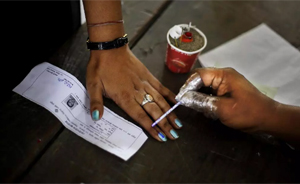
As per the assessment of Finance Ministry, bank counters are getting overcrowded due to same people turning up again and again to exchange old notes. "Ideally, the ink mark should have been put on the left hand as is done when a person casts his vote. But with by-elections due in some states, an ink mark for exchange or withdrawal of currency note on the left hand will lead to unnecessary difficulties. So it has been decided that the ink mark would be put on right hand," an official said.

The ink manufactured at the Mysore Paints and Varnish Ltd - the firm that has supplied indelible ink to the Election Commission since 1962 to mark voters, will be made available to banks and post offices from tonight.

Banks in major cities will start marking note exchangers with the ink, the official said.
Also, an expert committee comprising of officers from the Department of Economic Affairs and the Department of Financial Services are preparing standard operating procedure (SoPs) for ink marking as well as additional steps to be taken to manage the crowds.

The move comes amid long, unending queue at banks even after a week of Prime Minister Narendra Modi announcing withdrawal of old Rs 500/1000 notes in biggest crackdown on black money, corruption and counterfeit currency. The notes withdrawn accounted for 86 per cent of the cash circulating in the Asia's third-largest economy.

The source said the use of indelible ink would prevent "unscrupulous persons" from use conduits for exchanging notes. A persons, as per the revised guideline, is allowed to exchange old notes totalling up to 4,500 on a single day.

Earlier in the day, Economic Affairs Secretary Shaktikanta Das said it was noticed that the same people were coming back again and again to exchange notes, causing the long queues and creating hassles for genuine people to get their cash.

By-elections for four Lok Sabha seats - Cooch Behar and Tamluk in Purba Medinipur district in West Bengal, Shahdol in Madhya Pradesh and Lakhimpur in Assam will be held on November 19.

As many as 8 Assembly seats in Assam, Arunachal Pradesh, Madhya Pradesh, West Bengal, Tamil Nadu, Tripura and Puducherry will go to polls on the same day.

Comments

MARK
 - 
Tuesday, 15 Nov 2016

Dictatorship.... is in india... and that too its Worst ... Keeping the PUBLIC in trouble.

Instead of riding Ambani and adani .. cheddis are deceiving the people of india..

STILL bakhts did not understand this deception...

Add new comment

  • Coastaldigest.com reserves the right to delete or block any comments.
  • Coastaldigset.com is not responsible for its readers’ comments.
  • Comments that are abusive, incendiary or irrelevant are strictly prohibited.
  • Please use a genuine email ID and provide your name to avoid reject.
coastaldigest.com news network
May 25,2020

Benglauru, May 25: Nearly one thousand people in the capital city of Karnataka have lost several crores of rupees to online fraudsters during the two months of covid-19 lockdown.

According to official sources, 962 cases of online frauds have been registered in various police stations across Bengaluru March 23 to May 19. 

On an average, 18 cases were reported every day. However, this number isn’t unusually high compared to normal times, according to police. The highest number of cases was registered in west division (227). 

What baffles the cops is the brazenness with which fraudsters attacked. Many fraudsters duped people in the name of providing jobs, insurance money, Employees’ Provident Fund, renewal of credit/debit cards. 
Many people lost money while procuring groceries, alcohol, masks and hand sanitisers delivered at the doorstep. Olx and Facebook scams thrived during the prolonged lockdown. 

Police said malicious links were shared on mobile phones asking recipients to download the Aarogya Setu app and seeking banking information, all targeted at stealing phone data. 

An officer said many were glued to their phones, and cybercriminals took advantage of this, sometimes pretending to be bank representatives wanting to issue/ renew credit/debit cards.

Comments

Add new comment

  • Coastaldigest.com reserves the right to delete or block any comments.
  • Coastaldigset.com is not responsible for its readers’ comments.
  • Comments that are abusive, incendiary or irrelevant are strictly prohibited.
  • Please use a genuine email ID and provide your name to avoid reject.
News Network
January 20,2020

New Delhi, Jan 20: Security has been beefed up at airports across the country after a suspicious bag was found at the Mangaluru airport on Monday.

According to Central Industrial Security Force (CISF), which guards the airports in the country, a man was captured in the CCTV dropping the bag inside Mangaluru airport.

According to the CISF DIG Anil Pandey, traces of improvised explosive device (IED) have been found from the bag.

"According to CCTV footage, a suspect kept the bag at Mangaluru airport and was then seen leaving in auto while concealing his face. The suspected object was detected timely and local bomb disposal team is working on its disposal," DIG Pandey told media.

"We have found traces of IED from a bag lying at a ticket counter in Mangaluru airport, we have safely evacuated it," DIG Pandey told media.

According to sources, initial investigations have revealed that the bag contained some type of black powder.

"Initial investigation has revealed that the bag contained a black powder which seems to be explosive, though it is yet to be cleared what kind of explosive it is," sources claimed.

"After we found the suspicious bag at Mangaluru airport, a security drill has been initiated at all the airports and CISF staff have been asked to beef up security," DIG Pandey said.

Also Read: IED recovered from Mangaluru Airport defused safely; 3 teams formed to nab suspect: Top cop

Comments

bond
 - 
Tuesday, 21 Jan 2020

AIrport bomb new dramshooitng mlore airport 

Add new comment

  • Coastaldigest.com reserves the right to delete or block any comments.
  • Coastaldigset.com is not responsible for its readers’ comments.
  • Comments that are abusive, incendiary or irrelevant are strictly prohibited.
  • Please use a genuine email ID and provide your name to avoid reject.
Agencies
April 15,2020

San Diego, Apr 15: Several people lost their sense of smell or taste weeks ago globally and are still waiting for it to come back and now, researchers have identified an association between sensory loss and novel coronavirus 2019 (COVID-19) infection, indicating that loss of smell and taste may be considered as early symptoms of the deadly disease.

Interestingly, the study also found that persons who reported experiencing a sore throat more often tested negative for COVID-19.

The team from University of California-San Diego found high prevalence and unique presentation of certain sensory impairments in patients positive with COVID-19.

Of those who reported a loss of smell and taste, the loss was typically profound, not mild.

"Based on our study, if you have smell and taste loss, you are more than 10 times more likely to have COVID-19 infection than other causes of infection. The most common first sign of a COVID-19 infection remains fever, but fatigue and loss of smell and taste follow as other very common initial symptoms," explained study researcher Carol Yan from UC San Diego.

"We know COVID-19 is an extremely contagious virus. This study supports the need to be aware of smell and taste loss as early signs of COVID-19," Yan added.

For the findings, published in the journal International Forum of Allergy and Rhinology, the research team surveyed 1,480 patients with flu-like symptoms and concerns regarding potential COVID-19 infection who underwent testing at UC San Diego Health from March 3 through March 29, 2020.

Within that total, 102 patients tested positive for the virus and 1,378 tested negatives. The study included responses from 59 COVID-19-positive patients and 203 COVID-19-negative patients.

Encouragingly, the rate of recovery of smell and taste was high and occurred usually within two to four weeks of infection.

"Our study not only showed that the high incidence of smell and taste is specific to COVID-19 infection but we fortunately also found that for the majority of people sensory recovery was generally rapid," said Yan.

"Among the COVID-19 patients with smell loss, more than 70 per cent had reported improvement of smell at the time of the survey and of those who hadn't reported improvement, many had only been diagnosed recently," she added.

Sensory return typically matched the timing of disease recovery.

In an effort to decrease the risk of virus transmission, UC San Diego Health now includes loss of smell and taste as a screening requirement for visitors and staff, as well as a marker for testing patients who may be positive for the virus.

"It is our hope that with these findings other institutions will follow suit and not only list smell and taste loss as a symptom of COVID-19, but use it as a screening measure for the virus across the world," Yan said.

Comments

Add new comment

  • Coastaldigest.com reserves the right to delete or block any comments.
  • Coastaldigset.com is not responsible for its readers’ comments.
  • Comments that are abusive, incendiary or irrelevant are strictly prohibited.
  • Please use a genuine email ID and provide your name to avoid reject.