


Demonetisation: Banks to use indelible ink while exchanging notes

November 15, 2016

New Delhi, Nov 15: A small mark of indelible ink, used mostly during elections to prevent multiple voting, will be put on the right hand finger of those exchanging banned 500 and 1,000 rupee notes for new ones from tomorrow to prevent crowding at banks by repeat exchangers.Untitled-1
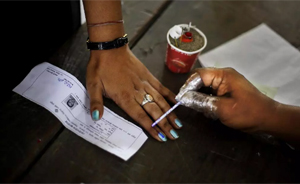
As per the assessment of Finance Ministry, bank counters are getting overcrowded due to same people turning up again and again to exchange old notes. "Ideally, the ink mark should have been put on the left hand as is done when a person casts his vote. But with by-elections due in some states, an ink mark for exchange or withdrawal of currency note on the left hand will lead to unnecessary difficulties. So it has been decided that the ink mark would be put on right hand," an official said.

The ink manufactured at the Mysore Paints and Varnish Ltd - the firm that has supplied indelible ink to the Election Commission since 1962 to mark voters, will be made available to banks and post offices from tonight.

Banks in major cities will start marking note exchangers with the ink, the official said.
Also, an expert committee comprising of officers from the Department of Economic Affairs and the Department of Financial Services are preparing standard operating procedure (SoPs) for ink marking as well as additional steps to be taken to manage the crowds.

The move comes amid long, unending queue at banks even after a week of Prime Minister Narendra Modi announcing withdrawal of old Rs 500/1000 notes in biggest crackdown on black money, corruption and counterfeit currency. The notes withdrawn accounted for 86 per cent of the cash circulating in the Asia's third-largest economy.

The source said the use of indelible ink would prevent "unscrupulous persons" from use conduits for exchanging notes. A persons, as per the revised guideline, is allowed to exchange old notes totalling up to 4,500 on a single day.

Earlier in the day, Economic Affairs Secretary Shaktikanta Das said it was noticed that the same people were coming back again and again to exchange notes, causing the long queues and creating hassles for genuine people to get their cash.

By-elections for four Lok Sabha seats - Cooch Behar and Tamluk in Purba Medinipur district in West Bengal, Shahdol in Madhya Pradesh and Lakhimpur in Assam will be held on November 19.

As many as 8 Assembly seats in Assam, Arunachal Pradesh, Madhya Pradesh, West Bengal, Tamil Nadu, Tripura and Puducherry will go to polls on the same day.

Comments

MARK
 - 
Tuesday, 15 Nov 2016

Dictatorship.... is in india... and that too its Worst ... Keeping the PUBLIC in trouble.

Instead of riding Ambani and adani .. cheddis are deceiving the people of india..

STILL bakhts did not understand this deception...

Add new comment

  • Coastaldigest.com reserves the right to delete or block any comments.
  • Coastaldigset.com is not responsible for its readers’ comments.
  • Comments that are abusive, incendiary or irrelevant are strictly prohibited.
  • Please use a genuine email ID and provide your name to avoid reject.
News Network
January 25,2020

Bengaluru, Jan 25: Karnataka Health Minister B Sriramulu on Friday, hit out at JD(S) leader HD Kumaraswamy, accusing the former Chief Minister of pursuing "vote bank" politics and advised him to move to Pakistan.

"It is better to move to Pakistan...if he shows so much love towards Pakistan, why should he live in India? He should not do dual politics like this. He wants to be fair to Pakistan and also to India," Sriramulu said.

Terming it as "double standards", the Minister said: "From so many years, you have been doing vote bank politics. You have to understand one thing...you are the son of former Prime Minister and also a former Chief Minister. By giving these type of statements, I think it will hurt the citizens of India. If you want to do vote bank politics I must suggest that it is better to leave the country."

His statement comes after Kumaraswamy took a jibe at BJP over its "obsession with Pakistan".

Comments

Add new comment

  • Coastaldigest.com reserves the right to delete or block any comments.
  • Coastaldigset.com is not responsible for its readers’ comments.
  • Comments that are abusive, incendiary or irrelevant are strictly prohibited.
  • Please use a genuine email ID and provide your name to avoid reject.
News Network
April 19,2020

Indian Overseas Congress (IOC) Chaiman Dr Sam Pitroda held video conference with senior IOC office bearers across Middle Eastern countries on 14th April 2020 to review the impact of COVID-19 pandemic among Indians residing in the region. Almost all speakers appreciated the efforts initiated and  implemented by  respective governments to contain spread of the deadly virus as well as measures taken towards welfare of the people affected by the lockdown. 

IOC Presidents, Mohammed Mansour - Bahrain, Abdullah Manjeri - Saudi Arabia, Dr J Ratan kunar - Oman and Girish kumar - Qatar, highlighted the quality treatment of patients and finacial aid provided by governments and other authorities. Bahrain IOC president Mansour , also  apprised about the 'Food for Needy' drive in Association with KHK Heroes foundation, initiated by HH Sheikh Khalid Bin Hamad Al Khalifa and quality treatments as well as financial aid to local and expat residents.

Anura Mathai, IOC  Global Event Coordinator, spoke about certain problems of Indians in the UAE. IOC Middle East Convener, Mansoor Palloor, emphasised and requested IOC Chairman to urge Indian government to arrange immediate repatriation of indians stranded in Gulf countries. AICC Secretary, Himanshu Vyas, IOC Secretary Dr Arathi Krishna, Dr Arshi Malik (Abha), Mohiuddin Sirajudeen (Jeddah), Advocate Joseph Palathara (Dammam) Prasad Kodru, Jayati Maitra Ziyad Ahmed (Qatar) and Khursheed Alam (Gen Secretary- Bahrain) also apprised the participants about various issues relevant to the pandemic and suggested further initiatives to be undertaken. 

Dr Sam Pitroda briefed about sustained and consolidated efforts by all IOC members  during this unprecedented situation facing the world and assured that he would convey IOC  concerns to the government and try his best to ensure all possible help is made available to all needy Indians.

Comments

Add new comment

  • Coastaldigest.com reserves the right to delete or block any comments.
  • Coastaldigset.com is not responsible for its readers’ comments.
  • Comments that are abusive, incendiary or irrelevant are strictly prohibited.
  • Please use a genuine email ID and provide your name to avoid reject.
News Network
May 17,2020

Bengaluru, May 17: Karnataka Deputy Chief Minister and Transport Minister Laxman Savadi on Sunday wrote to Union Minister Nitin Gadkari requesting to issue new lockdown guidelines including permission to operate public transport and said the lockdown has caused a financial loss of Rs 16,00 crore to all four Karnataka Transport Undertakings.

In view of these problems, the state Transport Minister requested Gadkari to permit the deployment of Non-AC buses on scheduled routes to ensure the adequacy of services.

The four State Transport Undertakings (STUs) in Karnataka which are providing bus-based public transport services within the state and to the neighbouring states are Karnataka State Road Transport Corporation (KSRTC), North West Karnataka Road Transport Corporation (NWKRTC), North Eastern Karnataka Road Transport Corporation (NEKRTC) and Bangalore Metropolitan Transport Corporation (BMTC).

"KSRTC, NWKRTC and NEKRTC operate buses for mofussil services i.e. Interdistrict, intradistrict and interstate, whereas BMTC operates only in urban and suburban areas in the city of Bengaluru. The four STUs put together hold a fleet of about 24,900 buses including 1,520 air-conditioned buses and operate about 71.00 lakh km. per day and carries about 98.00 lakh passengers every single day," Savadi outlined in the letter.

The Minister said due to the COVID-19 outbreak and the lockdown that ensued have brought regular bus operations and functioning to a grinding halt.

"This has caused a devastating impact on the operations of all the four STUs due to the combination of lack of revenue and continuing fixed costs such as salaries and pensions to staff, payables against existing loans etc. It has been estimated that the lockdown has caused a financial loss of INR 1,600/- crore to these four STUs," he added.

Savadi said even after post-COVID lockdown, operations and revenues won't reach its previous demand& supply patterns in the next six to eight months due to reduced economic activity and users' perceived risk of contacting COVID in public transport.

In addition to that, "occupancy should be allowed up to seating capacity (without standees). This is essential to meet minimal demand," he said in the letter.

"The crew should wear facemask and hand gloves. The crew with health issues should not be deployed. The face masks should be made mandatory for all the passengers. Only asymptomatic persons should be allowed to travel in public transport. The Government of India may consider staggering working hours for various sectors to reduce peak hour traffic demand," the minister listed out these recommendations in the letter.

Savadi said that with social distancing norm of reduced seating capacity in public transport, it will not be possible to provide transport facility to all the daily passengers. This will create demand for more buses, which cannot be met.

"Restrictions on public transport will lead to passenger commute by overcrowding in smaller vehicles like cars, maxi cabs, goods tempos etc. which will adversely affect preventive measures," he added.

Therefore, Savadi requested Union Minister to look into the above matter and issue fresh guidelines to all the states / UT's.

Comments

Add new comment

  • Coastaldigest.com reserves the right to delete or block any comments.
  • Coastaldigset.com is not responsible for its readers’ comments.
  • Comments that are abusive, incendiary or irrelevant are strictly prohibited.
  • Please use a genuine email ID and provide your name to avoid reject.