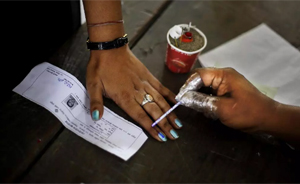
Demonetisation: Banks to use indelible ink while exchanging notes

November 15, 2016

New Delhi, Nov 15: A small mark of indelible ink, used mostly during elections to prevent multiple voting, will be put on the right hand finger of those exchanging banned 500 and 1,000 rupee notes for new ones from tomorrow to prevent crowding at banks by repeat exchangers.Untitled-1

As per the assessment of Finance Ministry, bank counters are getting overcrowded due to same people turning up again and again to exchange old notes. "Ideally, the ink mark should have been put on the left hand as is done when a person casts his vote. But with by-elections due in some states, an ink mark for exchange or withdrawal of currency note on the left hand will lead to unnecessary difficulties. So it has been decided that the ink mark would be put on right hand," an official said.

The ink manufactured at the Mysore Paints and Varnish Ltd - the firm that has supplied indelible ink to the Election Commission since 1962 to mark voters, will be made available to banks and post offices from tonight.

Banks in major cities will start marking note exchangers with the ink, the official said.
Also, an expert committee comprising of officers from the Department of Economic Affairs and the Department of Financial Services are preparing standard operating procedure (SoPs) for ink marking as well as additional steps to be taken to manage the crowds.

The move comes amid long, unending queue at banks even after a week of Prime Minister Narendra Modi announcing withdrawal of old Rs 500/1000 notes in biggest crackdown on black money, corruption and counterfeit currency. The notes withdrawn accounted for 86 per cent of the cash circulating in the Asia's third-largest economy.

The source said the use of indelible ink would prevent "unscrupulous persons" from use conduits for exchanging notes. A persons, as per the revised guideline, is allowed to exchange old notes totalling up to 4,500 on a single day.

Earlier in the day, Economic Affairs Secretary Shaktikanta Das said it was noticed that the same people were coming back again and again to exchange notes, causing the long queues and creating hassles for genuine people to get their cash.

By-elections for four Lok Sabha seats - Cooch Behar and Tamluk in Purba Medinipur district in West Bengal, Shahdol in Madhya Pradesh and Lakhimpur in Assam will be held on November 19.

As many as 8 Assembly seats in Assam, Arunachal Pradesh, Madhya Pradesh, West Bengal, Tamil Nadu, Tripura and Puducherry will go to polls on the same day.

Comments

MARK
 - 
Tuesday, 15 Nov 2016

Dictatorship.... is in india... and that too its Worst ... Keeping the PUBLIC in trouble.

Instead of riding Ambani and adani .. cheddis are deceiving the people of india..

STILL bakhts did not understand this deception...

Add new comment

  • Coastaldigest.com reserves the right to delete or block any comments.
  • Coastaldigset.com is not responsible for its readers’ comments.
  • Comments that are abusive, incendiary or irrelevant are strictly prohibited.
  • Please use a genuine email ID and provide your name to avoid reject.
News Network
April 4,2020

Mangaluru, Apr 4: About 20,000 quintal boiled rice has been distributed among the ration card holders through Public Distribution System, District-in-charge Minister Kota Srinivas Poojary said here on Saturday.

As people in the district prefer boiled rice over white rice, the government has given approval for distributing boiled rice. From next month, only boiled rice will be distributed in the district at fair price shops.

In the last two days, rice has been distributed among 61,302 cardholders in the district.

Comments

Add new comment

  • Coastaldigest.com reserves the right to delete or block any comments.
  • Coastaldigset.com is not responsible for its readers’ comments.
  • Comments that are abusive, incendiary or irrelevant are strictly prohibited.
  • Please use a genuine email ID and provide your name to avoid reject.
Agencies
July 17,2020

Bengaluru, Jul 17: Karnataka Chief Minister B S Yediyurappa on Friday said lockdown is not the solution for controlling COVID-19 and made it clear that there was no proposal before the government to extend it in Bengaluru.

Bengaluru urban and rural areas are currently under "complete lockdown" since 8 pm of July 14 and it will be effective till 5 am on July 22.

With the spike in cases, speculations were rife that the current lockdown is likely to be extended for 15 days, as that much time is required to break the chain.

"Lockdown is not the solution to control COVID. There is no proposal before the government to extend the lockdown," Yediyurappa was quoted as saying by his office in a release.

The Chief Minister today chaired a meeting with Ministers who have been made in-charge of eight zones in the city and officials regarding the COVID-19 situation in Bengaluru.

Earlier too, on July 13, the eve of the lockdown, Yediyurappa had said the government did not plan to extend it in Bengaluru urban and rural districts, and had appealed to the people to cooperate by not paying heed to rumours.

However, earlier today city Mayor M Goutham Kumar and commissioner of the civic body Bruhat Bengaluru Mahanagara Palike B H Anil Kumar had favoured its extension.

They had said that in their personal opinion, a 15 day lockdown would be good, as that much time is required to break the chain.

The Opposition Congress too had asked for a minimum of 15 days lockdown after taking expert opinion.

"Respected Chief Minister, you have imposed lockdown in Bengaluru, but it is difficult to expect results from this lockdown, which has been imposed just for for the sake of it.

Take expert opinion and enforce strict lockdown in Bengaluru at least for 15 days.

If not, even if God comes,it will be difficult to protect Bengaluru," KPCC Working President Eshwar Khandre tweeted.

Speaking to reporters after attending the meeting chaired by the CM, Revenue Minister R Ashoka said lockdown will not be extended and all activities can resume as usual from July 22.

"Lockdown will not be extended. I'm saying this after discussing with the Chief Minister. There is no such thinking before the government.

CM has got report from the experts, it was discussed in the meeting.

By lockdown we can only postpone things, we have taken that breathing time.

If we continue lockdown it will keep on continuing," he said.

The Minister said the process of sealing places, wherever required, would continue.

He said the plan to conduct more tests was discussed at the meeting and all the required zone wise arrangements would be made

"We also discussed about beds and shortage of ventilators and steps will be taken to arrange for them," he said.

As of July 16 evening, cumulatively 51,422 COVID-19 positive cases have been confirmed in the state, which includes 1,032 deaths and 19,729 discharges.

Bengaluru urban district tops the list of positive cases, with a total of 25,288 infections.

Out of 4,169 fresh cases reported on Thursday, a whopping 2,344 were from Bengaluru urban alone

At the meeting, the Chief Minister said all necessary steps should be taken to clear all the difficulties faced by infected patients in getting admitted to hospitals.

The CMO statement quoted Yediyurappa as directing Ministers to hold meetings with private hospitals to ensure that COVID and non COVID patients get treatment.

Warning of strict action against private hospitals if they don't allocate beds for COVID patients,he said volunteers and nodal officers would be appointed to gather information about admission of such patients and availability of beds

The Chief Minister said rapid antigen tests should be conducted on those dying at hospitals or homes and necessary action taken to hand over the bodies or to conduct last rites as per the procedures, depending on the cause of death.

Recruitment was on to appoint doctors to resolve shortage, he said,adding that volunteers have been identified in each ward for micromanagement and ambulances allocated.

Marriage halls and lodges have been selected in all wards for those not having separate quarantine facilities, Yediyurappa said and stressed on increasing testing.

Deploying extra police force at places where there are chances of people gathering in large numbers, ensuring beds availability and ambulances within two hours of a patient testing positive- with decentralized monitoring, giving priority to those symptomatic above 65-years during allocation of beds were among directions given by the Chief Minister.

Comments

Add new comment

  • Coastaldigest.com reserves the right to delete or block any comments.
  • Coastaldigset.com is not responsible for its readers’ comments.
  • Comments that are abusive, incendiary or irrelevant are strictly prohibited.
  • Please use a genuine email ID and provide your name to avoid reject.
News Network
July 28,2020

Hounde, Jul 28: Coronavirus and its restrictions are pushing already hungry communities over the edge, killing an estimated 10,000 more young children a month as meager farms are cut off from markets and villages are isolated from food and medical aid, the United Nations warned Monday.

In the call to action shared with The Associated Press ahead of publication, four UN agencies warned that growing malnutrition would have long-term consequences, transforming individual tragedies into a generational catastrophe.

Hunger is already stalking Haboue Solange Boue, an infant from Burkina Faso who lost half her former body weight of 5.5 pounds (2.5 kilograms) in just a month. Coronavirus restrictions closed the markets, and her family sold fewer vegetables. Her mother was too malnourished to nurse.

“My child,” Danssanin Lanizou whispered, choking back tears as she unwrapped a blanket to reveal her baby's protruding ribs.

More than 550,000 additional children each month are being struck by what is called wasting, according to the UN — malnutrition that manifests in spindly limbs and distended bellies. Over a year, that's up 6.7 million from last year's total of 47 million. Wasting and stunting can permanently damage children physically and mentally.

“The food security effects of the COVID crisis are going to reflect many years from now,” said Dr. Francesco Branca, the WHO head of nutrition. “There is going to be a societal effect.”

From Latin America to South Asia to sub-Saharan Africa, more poor families than ever are staring down a future without enough food.

In April, World Food Program head David Beasley warned that the coronavirus economy would cause global famines “of biblical proportions” this year. There are different stages of what is known as food insecurity; famine is officially declared when, along with other measures, 30% of the population suffers from wasting.

The World Food Program estimated in February that one Venezuelan in three was already going hungry, as inflation rendered salaries nearly worthless and forced millions to flee abroad. Then the virus arrived.

“Every day we receive a malnourished child,” said Dr. Francisco Nieto, who works in a hospital in the border state of Tachira.

In May, Nieto recalled, after two months of quarantine, 18-month-old twins arrived with bodies bloated from malnutrition. The children's mother was jobless and living with her own mother. She told the doctor she fed them only a simple drink made with boiled bananas.

“Not even a cracker? Some chicken?” he asked.

“Nothing,” the children's grandmother responded. By the time the doctor saw them, it was too late: One boy died eight days later.

The leaders of four international agencies — the World Health Organization, UNICEF, the World Food Program and the Food and Agriculture Organization — have called for at least dollar 2.4 billion immediately to address global hunger.

But even more than lack of money, restrictions on movement have prevented families from seeking treatment, said Victor Aguayo, the head of UNICEF's nutrition program.

“By having schools closed, by having primary health care services disrupted, by having nutritional programs dysfunctional, we are also creating harm,” Aguayo said. He cited as an example the near-global suspension of Vitamin A supplements, which are a crucial way to bolster developing immune systems.

In Afghanistan, movement restrictions prevent families from bringing their malnourished children to hospitals for food and aid just when they need it most. The Indira Gandhi hospital in the capital, Kabul, has seen only three or four malnourished children, said specialist Nematullah Amiri. Last year, there were 10 times as many.

Because the children don't come in, there's no way to know for certain the scale of the problem, but a recent study by Johns Hopkins University indicated an additional 13,000 Afghans younger than 5 could die.

Afghanistan is now in a red zone of hunger, with severe childhood malnutrition spiking from 690,000 in January to 780,000 — a 13% increase, according to UNICEF.

In Yemen, restrictions on movement have blocked aid distribution, along with the stalling of salaries and price hikes. The Arab world's poorest country is suffering further from a fall in remittances and a drop in funding from humanitarian agencies.

Yemen is now on the brink of famine, according to the Famine Early Warning Systems Network, which uses surveys, satellite data and weather mapping to pinpoint places most in need.

Some of the worst hunger still occurs in sub-Saharan Africa. In Sudan, 9.6 million people live from one meal to the next — a 65% increase from the same time last year.

Lockdowns across Sudanese provinces, as around the world, have dried up work and incomes for millions. With inflation hitting 136%, prices for basic goods have more than tripled.

“It has never been easy but now we are starving, eating grass, weeds, just plants from the earth,” said Ibrahim Youssef, director of the Kalma camp for internally displaced people in war-ravaged south Darfur.

Adam Haroun, an official in the Krinding camp in west Darfur, recorded nine deaths linked with malnutrition, otherwise a rare occurrence, over the past two months — five newborns and four older adults, he said.

Before the pandemic and lockdown, the Abdullah family ate three meals a day, sometimes with bread, or they'd add butter to porridge. Now they are down to just one meal of “millet porridge” — water mixed with grain. Zakaria Yehia Abdullah, a farmer now at Krinding, said the hunger is showing “in my children's faces.”

“I don't have the basics I need to survive,” said the 67-year-old, who who hasn't worked the fields since April. “That means the 10 people counting on me can't survive either.”


Comments

Add new comment

  • Coastaldigest.com reserves the right to delete or block any comments.
  • Coastaldigset.com is not responsible for its readers’ comments.
  • Comments that are abusive, incendiary or irrelevant are strictly prohibited.
  • Please use a genuine email ID and provide your name to avoid reject.