


Demonetisation: Banks to use indelible ink while exchanging notes

November 15, 2016

New Delhi, Nov 15: A small mark of indelible ink, used mostly during elections to prevent multiple voting, will be put on the right hand finger of those exchanging banned 500 and 1,000 rupee notes for new ones from tomorrow to prevent crowding at banks by repeat exchangers.Untitled-1
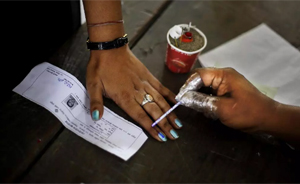
As per the assessment of Finance Ministry, bank counters are getting overcrowded due to same people turning up again and again to exchange old notes. "Ideally, the ink mark should have been put on the left hand as is done when a person casts his vote. But with by-elections due in some states, an ink mark for exchange or withdrawal of currency note on the left hand will lead to unnecessary difficulties. So it has been decided that the ink mark would be put on right hand," an official said.

The ink manufactured at the Mysore Paints and Varnish Ltd - the firm that has supplied indelible ink to the Election Commission since 1962 to mark voters, will be made available to banks and post offices from tonight.

Banks in major cities will start marking note exchangers with the ink, the official said.
Also, an expert committee comprising of officers from the Department of Economic Affairs and the Department of Financial Services are preparing standard operating procedure (SoPs) for ink marking as well as additional steps to be taken to manage the crowds.

The move comes amid long, unending queue at banks even after a week of Prime Minister Narendra Modi announcing withdrawal of old Rs 500/1000 notes in biggest crackdown on black money, corruption and counterfeit currency. The notes withdrawn accounted for 86 per cent of the cash circulating in the Asia's third-largest economy.

The source said the use of indelible ink would prevent "unscrupulous persons" from use conduits for exchanging notes. A persons, as per the revised guideline, is allowed to exchange old notes totalling up to 4,500 on a single day.

Earlier in the day, Economic Affairs Secretary Shaktikanta Das said it was noticed that the same people were coming back again and again to exchange notes, causing the long queues and creating hassles for genuine people to get their cash.

By-elections for four Lok Sabha seats - Cooch Behar and Tamluk in Purba Medinipur district in West Bengal, Shahdol in Madhya Pradesh and Lakhimpur in Assam will be held on November 19.

As many as 8 Assembly seats in Assam, Arunachal Pradesh, Madhya Pradesh, West Bengal, Tamil Nadu, Tripura and Puducherry will go to polls on the same day.

Comments

MARK
 - 
Tuesday, 15 Nov 2016

Dictatorship.... is in india... and that too its Worst ... Keeping the PUBLIC in trouble.

Instead of riding Ambani and adani .. cheddis are deceiving the people of india..

STILL bakhts did not understand this deception...

Add new comment

  • Coastaldigest.com reserves the right to delete or block any comments.
  • Coastaldigset.com is not responsible for its readers’ comments.
  • Comments that are abusive, incendiary or irrelevant are strictly prohibited.
  • Please use a genuine email ID and provide your name to avoid reject.
News Network
February 9,2020

Assan, Feb 9: Coming down heavily on Amit Shah, JDS supremo HD Deve Gowda said that the Union Home Minister is dreaming of a Hindu nation. Addressing the crowd at an anti-CAA/NRC rally in Hassan, he said that the Home Minister has forgotten that India is a secular, multi-lingual country.

“Shah cannot make India into a Hindu nation. People should come forward and oppose the Acts in the interest of peace and welfare of the nation,” the former PM said, urging secular leaders to unite and fight against the undemocratic policies put forth by the Centre.

“Only secular forces can protect minorities by taking to the streets,” he said. Talking about the controversy around former Union minister Anant Kumar Hegde’s statements, Gowda said BJP leaders are airing anti-national comments, which is disturbing peace. “Muslims, Christians and Hindus should unite to fight against the BJP’s unilateral decisions.”

Comments

Add new comment

  • Coastaldigest.com reserves the right to delete or block any comments.
  • Coastaldigset.com is not responsible for its readers’ comments.
  • Comments that are abusive, incendiary or irrelevant are strictly prohibited.
  • Please use a genuine email ID and provide your name to avoid reject.
News Network
June 11,2020

Bengaluru, Jun 11: Most COVID-19 deaths in Karnataka occur when infected elderly people, those with Severe Acute Respiratory Illness (SARI) or any other symptoms delay reaching designated hospitals, a top official said.

Munish Moudgil, chief of COVID-19 War Room in the state, said most of those infected with the virus are brought to COVID-19 designated hospitals at a very late stage and recovery then becomes extremely tough.

He said about 65 per cent of those killed suffered from SARI and are aged above 60.

The death rate due to SARI is 43 per cent for those in the 40-60 age group, he said, releasing data on coronavirus deaths, to reporters.

In the same age group, the mortality due to Influenza Like Illness (ILI) was 17.4 per cent, whereas it is 11.1 per cent among people aged above 60 .

He said 25 per cent of symptomatic patients aged above 60 die due to the virus, while it was 10.7 per cent in the 40-60 age group.

The fatalities among those aged 60 is high even if they are asymptomatic, Mr Moudgil, who is secretary in the Department of Personnel and Administrative Reforms, said.

He said the average number of days spent at these hospitals by those who recovered is about 15 days, compared to 3.5 days for those who died of the virus.

Listen to the latest songs, only on JioSaavn.com

"Hence persons who are elderly and who have comorbidities or who have SARI must reach designated Covid hospitals at the earliest," Mr Moudgil said.

As of date, Karnataka has reported 69 COVID-19 deaths As many as 6,041 people have tested positive for COVID-19, including 2,862 discharges and 3,108 active cases.

Comments

Add new comment

  • Coastaldigest.com reserves the right to delete or block any comments.
  • Coastaldigset.com is not responsible for its readers’ comments.
  • Comments that are abusive, incendiary or irrelevant are strictly prohibited.
  • Please use a genuine email ID and provide your name to avoid reject.
News Network
February 27,2020

Benagluru, Feb 27: The sudden hike in bus fares by the state-run transport corporation has triggered a public outrage and protests by the opposition Congress and the Janata Dal-Secular (JD-S) in Karnataka.

Terming the hike as anti-people and inflationary, the Congress urged the ruling BJP to withdraw it forthwith and spare the commuters from the additional burden.

"KSRTC and its affiliates should not further burden the people when the cost of living has gone up and its bus service is used by the majority in the absence of trains in many regions of the state," said Ravi Gowda of the Congress.

In a surprise announcement on Tuesday night, the Karnataka State Road Transport Corporation (KSRTC) and its two affiliates -- North Eastern Karnataka Road Transport Corporation (NEKSRTC )and North Western Karnataka Road Transport Corporation (NWKSRTC) -- increased bus fares by 12% with effect from Wednesday, drawing the ire of commuters and opposition parties alike.

Condemning the fare hike, JD(S) leader and former Chief Minister H D Kumaraswamy urged the KSRTC to roll back the revised fares and give relief to the common man reeling under price rise due to CGST, SGST and food inflation.

"The BJP government has deliberately increased the bus fare ahead of the state budget for 2020-21 fiscal on March 2, catching people unawares. Though student passes have been spared from the hike, regular passengers are forced to pay Rs 5-32 more instead of getting better efficiency, management and productivity," Kumaraswamy said in a statement in Bengaluru.

It's an additional burden on us, said Bengaluru resident K. Venkatesh, while adding,

"The 12 percent hike in bus fares by the KSRTC and its north-east and north-west affiliates from Wednesday will hit passengers hard and make commuting costly.”

"The fare hike will negate the state government's efforts to encourage public transport service and force passengers to travel on the train, which is cheaper, faster and safer," asserted Venugopal Gupta, a cloth merchant in the city.

Justifying the hike, KSRTC Managing Director Shivayogi Kalasad told media that the hike was inevitable due to the steady increase in diesel price, dearness allowance in staff salary and overall cost of operations.

"Since the last fare revision came in May 2014, the operational cost has gone up substantially due to Rs 11.27 per litre hike in diesel price, increase in DA to employees and repairing, maintenance and fleet management costs," Kalasad said.

The financial burden due to fuel price hike is Rs 261 crore, DA Rs 341 crore and operational cost Rs 601 crore per annum for KSRTC alone, he said.

"For the benefit of rural passengers, fares have been reduced to Rs 5 from Rs 7 for the first 3 km. There is no increase in fares for the first 12 km and up to first 6 km in express service," Kalasad added.

Comments

Add new comment

  • Coastaldigest.com reserves the right to delete or block any comments.
  • Coastaldigset.com is not responsible for its readers’ comments.
  • Comments that are abusive, incendiary or irrelevant are strictly prohibited.
  • Please use a genuine email ID and provide your name to avoid reject.