Demonetisation: Banks to use indelible ink while exchanging notes

November 15, 2016

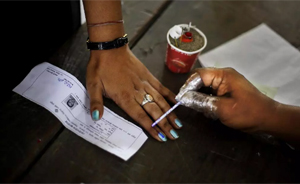
New Delhi, Nov 15: A small mark of indelible ink, used mostly during elections to prevent multiple voting, will be put on the right hand finger of those exchanging banned 500 and 1,000 rupee notes for new ones from tomorrow to prevent crowding at banks by repeat exchangers.Untitled-1

As per the assessment of Finance Ministry, bank counters are getting overcrowded due to same people turning up again and again to exchange old notes. "Ideally, the ink mark should have been put on the left hand as is done when a person casts his vote. But with by-elections due in some states, an ink mark for exchange or withdrawal of currency note on the left hand will lead to unnecessary difficulties. So it has been decided that the ink mark would be put on right hand," an official said.

The ink manufactured at the Mysore Paints and Varnish Ltd - the firm that has supplied indelible ink to the Election Commission since 1962 to mark voters, will be made available to banks and post offices from tonight.

Banks in major cities will start marking note exchangers with the ink, the official said.
Also, an expert committee comprising of officers from the Department of Economic Affairs and the Department of Financial Services are preparing standard operating procedure (SoPs) for ink marking as well as additional steps to be taken to manage the crowds.

The move comes amid long, unending queue at banks even after a week of Prime Minister Narendra Modi announcing withdrawal of old Rs 500/1000 notes in biggest crackdown on black money, corruption and counterfeit currency. The notes withdrawn accounted for 86 per cent of the cash circulating in the Asia's third-largest economy.

The source said the use of indelible ink would prevent "unscrupulous persons" from use conduits for exchanging notes. A persons, as per the revised guideline, is allowed to exchange old notes totalling up to 4,500 on a single day.

Earlier in the day, Economic Affairs Secretary Shaktikanta Das said it was noticed that the same people were coming back again and again to exchange notes, causing the long queues and creating hassles for genuine people to get their cash.

By-elections for four Lok Sabha seats - Cooch Behar and Tamluk in Purba Medinipur district in West Bengal, Shahdol in Madhya Pradesh and Lakhimpur in Assam will be held on November 19.

As many as 8 Assembly seats in Assam, Arunachal Pradesh, Madhya Pradesh, West Bengal, Tamil Nadu, Tripura and Puducherry will go to polls on the same day.

Comments

MARK
 - 
Tuesday, 15 Nov 2016

Dictatorship.... is in india... and that too its Worst ... Keeping the PUBLIC in trouble.

Instead of riding Ambani and adani .. cheddis are deceiving the people of india..

STILL bakhts did not understand this deception...

Add new comment

  • Coastaldigest.com reserves the right to delete or block any comments.
  • Coastaldigset.com is not responsible for its readers’ comments.
  • Comments that are abusive, incendiary or irrelevant are strictly prohibited.
  • Please use a genuine email ID and provide your name to avoid reject.
Ram Puniyani
June 29,2020

In Minneapolis, US an African American, George Floyd lost his life as the white policeman, Derek Chauvin, caught hold of him and put his knee on his neck. This is a technique developed by Israel police. For nine long minutes the knee of the while policeman was on the neck of George, who kept shouting, I can’t breathe.

Following this gruesome murder America erupted with protests, ‘Black lives matter’. The protestors were not just African Americans but also a large section of whites. Within US one police Chief apologized for the act of this. In a touching gesture of apology the police force came on its knees. This had reverberations in different parts of the World.

The act was the outcome of the remnants of the racial hatred against blacks by the whites. It is the hatred and the perceptions which are the roots of such acts of violence. What was also touching that the state of democracy in US is so deep that even the police apologized, the nation, whites and blacks, stood up as a sensitive collective against this violence.

US is not the only country where the brutal acts of violence torment the marginalized sections of society. In India there is a list of dalits, minorities and adivasis who are regularly subjected to such acts. But the reaction is very different. We have witnessed the case of Tabrez Ansari, who was tied to the pole by the mob and beaten ruthlessly. When he was taken to police station, police took enough time to take him to hospital and Tabrez died.

Mohsin Sheikh, a Pune techie was murdered by Hindu Rashtra Sena mob, the day Modi came to power in 2014. Afrazul was killed by Shambhulal Regar, videotaped the act released on social media. Regar believed that Muslims are indulging in love Jihad, so deserve such a fate. Mohammad Akhlaq is one among many names who were mob lynched on the issue of beef cow. The list can fill pages after pages.

Recently a young dalit boy was shot dead for the crime of entering a temple. In Una four dalits were stripped above waste and beaten mercilessly. Commenting on this act the Union Minister Ramvilas Paswan commented that it is a minor incident. Again the list of atrocities against dalits is long enough. The question is what Paswan is saying is the typical response to such gruesome murders and tortures. In US loss of one black life, created the democratic and humane response. In India there is a general silence in response to these atrocities. Some times after a good lapse of time, the Prime Minister will utter, ‘Mother Bharati has lost a son’. Most of the time victim is blamed. Some social groups raise their voice in some fora but by and large the deafening silence from the country is the norm.

India is regarded as the largest democracy. Democracy is the rule of law, and the ground on which the injustices are opposed. In America though the present President is insensitive person, but its institutions and processes of democratic articulations are strong. The institutions have deepened their roots and though prejudices may be guiding the actions of some of the officers like the killer of George, there are also police officers who can tell their President to shut up if he has nothing meaningful to say on the issue. The prejudices against Blacks may be prevalent and deep in character, still there are large average sections of society, who on the principles of ‘Black lives matter’. There are large sections of vocal population who can protest the violation of basic norms of democracy and humanism.

In India by contrast there are multiple reasons as to why the lives of Tabrez Ansari, Mohammad Akhlaq, Una dalit victims and their likes don’t matter. Though we claim that we are a democracy, insensitivity to injustices is on the rise. The strong propaganda against the people from margins has become so vicious during last few decades that any violence against them has become sort of a new normal. The large populace, though disturbed by such brutalities, is also fed the strong dose of biases against the victims. The communal forces have a great command over effective section of media and large section of social media, which generates Hate against these disadvantaged groups, thereby the response is muted, if at all.

As such also the process of deepening of our democracy has been weak. Democracy is a dynamic process; it’s not a fixed entity. Decades ago workers and dalits could protest for their rights. Now even if peasants make strong protests, dominant media presents it as blocking of traffic! How the roots of democracy are eroded and are visible in the form where the criticism of the ruling dispensation is labelled as anti National..

Our institutions have been eroded over a period of time, and these institutions coming to the rescue of the marginalized sections have been now become unthinkable. The outreach of communal, divisive ideology, the ideology which looks down on minorities, dalits and Adivasis has risen by leaps and bounds.

The democracy in India is gradually being turned in to a hollow shell, the rule of law being converted in to rule of an ideology, which does not have faith in Indian Constitution, which looks down upon pluralism and diversity of this country, which is more concerned for the privileges of the upper caste, rich and affluent. The crux of the matter is the weak nature of democracy, which was on way to become strong, but from decades of 1980s, as emotive issues took over, the strength of democracy started dwindling, and that’s when the murders of the types of George Floyd, become passé. One does complement the deeper roots of American democracy and its ability to protect the democratic institutions, which is not the case in India, where protests of the type, which were witnessed after George Floyd’s murder may be unthinkable, at least in the present times. 

Comments

Add new comment

  • Coastaldigest.com reserves the right to delete or block any comments.
  • Coastaldigset.com is not responsible for its readers’ comments.
  • Comments that are abusive, incendiary or irrelevant are strictly prohibited.
  • Please use a genuine email ID and provide your name to avoid reject.
News Network
April 19,2020

Belagavi, Apr 19: Veteran writer and Translator Chandrakanth Kusnoor passed away in his house on Sunday due to age-related disease.

He was 90.

He was survived by wife, four sons and one daughter.

According to family sources, the last rites were held in the wee hours of Sunday.

Mr Kushnoor, a multi-faceted personality, maybe the one of the few who had won the Karnataka Nataka Academy, Karnataka Lalitha Kala Academy and Karnataka Sahitya Academy awards for his works as writer, translator, novelist, poet, playwright, painter, art critic and institution builder.

He had translated many books from Kannada (late U R Ananthmurthy and Srikrishna Alanahalli) into Hindi, and other books into Marathi and Urdu.

He was among the pioneering abstract writers in Kannada. His plays like Dindi, Vidushaka, Ratto Ratto Rayara Magale and Ani Bantu Ondu Ani, were widely performed.

His biographical novel Gohar Jan chronicles the growth of professional theatre music tradition.

He had converted his home in Channamma Nagar into a mini art gallery and used to paint till recently. He hailed from Kalaburagi where he worked as a college professor for some years. He had settled in Belagavi after his retirement as the Deputy Director of Kannada and culture.

He had won the Karnataka Rajyotsava Award.

Comments

Add new comment

  • Coastaldigest.com reserves the right to delete or block any comments.
  • Coastaldigset.com is not responsible for its readers’ comments.
  • Comments that are abusive, incendiary or irrelevant are strictly prohibited.
  • Please use a genuine email ID and provide your name to avoid reject.
News Network
May 18,2020

Dubai, May 18: An Indian working in a mining company in the UAE has become the latest expatriate to have lost his job for hate-filled social media posts targeting Islam and Muslims.

Brajkishore Gupta was fired without notice for calling Indian Muslims 'coronavirus spreaders' and hailing the Delhi violence as 'divine justice' in his Facebook posts.

Gupta, who is from Chapra, Bihar, was employed by Stevin Rock, a mining company headquartered in Ras Al Khaimah city.

"This isolated incident involving a junior employee was investigated and dealt with immediately resulting in the termination without notice of this person's employment with Stevin Rock," said the company's business development and exploration manager Jean-Francois Milian.

"Our company policy supports the direction of the UAE government in promoting tolerance and equality and strongly renouncing racism and discrimination and we have sent communications to all of our employees irrespective of their religious or ethnic background reminding them that any such behaviour is unacceptable and will lead to immediate dismissal," Milian was quoted as saying in the report.

Three Indians based in the UAE were either fired or suspended from their jobs for "Islamophobic" posts on social media early this month.

On April 20, India's ambassador to the UAE Pavan Kapoor had warned Indian expatriates against such behaviour.

"India and UAE share the value of non-discrimination on any grounds. Discrimination is against our moral fabric and the Rule of law. Indian nationals in the UAE should always remember this," he said in a tweet.

Last month, Sharjah-based businessman Sohan Roy had to apologise for "unintentionally hurting religious sentiments" through his poem, which alluded to a Muslim religious group.

In March, chef Trilok Singh was fired from a restaurant in Dubai for an online threat against a student in Delhi over her views on the Citizenship Amendment Act.

Comments

Add new comment

  • Coastaldigest.com reserves the right to delete or block any comments.
  • Coastaldigset.com is not responsible for its readers’ comments.
  • Comments that are abusive, incendiary or irrelevant are strictly prohibited.
  • Please use a genuine email ID and provide your name to avoid reject.