


Demonetisation: Banks to use indelible ink while exchanging notes

November 15, 2016

New Delhi, Nov 15: A small mark of indelible ink, used mostly during elections to prevent multiple voting, will be put on the right hand finger of those exchanging banned 500 and 1,000 rupee notes for new ones from tomorrow to prevent crowding at banks by repeat exchangers.Untitled-1
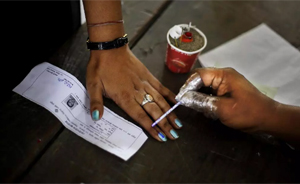
As per the assessment of Finance Ministry, bank counters are getting overcrowded due to same people turning up again and again to exchange old notes. "Ideally, the ink mark should have been put on the left hand as is done when a person casts his vote. But with by-elections due in some states, an ink mark for exchange or withdrawal of currency note on the left hand will lead to unnecessary difficulties. So it has been decided that the ink mark would be put on right hand," an official said.

The ink manufactured at the Mysore Paints and Varnish Ltd - the firm that has supplied indelible ink to the Election Commission since 1962 to mark voters, will be made available to banks and post offices from tonight.

Banks in major cities will start marking note exchangers with the ink, the official said.
Also, an expert committee comprising of officers from the Department of Economic Affairs and the Department of Financial Services are preparing standard operating procedure (SoPs) for ink marking as well as additional steps to be taken to manage the crowds.

The move comes amid long, unending queue at banks even after a week of Prime Minister Narendra Modi announcing withdrawal of old Rs 500/1000 notes in biggest crackdown on black money, corruption and counterfeit currency. The notes withdrawn accounted for 86 per cent of the cash circulating in the Asia's third-largest economy.

The source said the use of indelible ink would prevent "unscrupulous persons" from use conduits for exchanging notes. A persons, as per the revised guideline, is allowed to exchange old notes totalling up to 4,500 on a single day.

Earlier in the day, Economic Affairs Secretary Shaktikanta Das said it was noticed that the same people were coming back again and again to exchange notes, causing the long queues and creating hassles for genuine people to get their cash.

By-elections for four Lok Sabha seats - Cooch Behar and Tamluk in Purba Medinipur district in West Bengal, Shahdol in Madhya Pradesh and Lakhimpur in Assam will be held on November 19.

As many as 8 Assembly seats in Assam, Arunachal Pradesh, Madhya Pradesh, West Bengal, Tamil Nadu, Tripura and Puducherry will go to polls on the same day.

Comments

MARK
 - 
Tuesday, 15 Nov 2016

Dictatorship.... is in india... and that too its Worst ... Keeping the PUBLIC in trouble.

Instead of riding Ambani and adani .. cheddis are deceiving the people of india..

STILL bakhts did not understand this deception...

Add new comment

  • Coastaldigest.com reserves the right to delete or block any comments.
  • Coastaldigset.com is not responsible for its readers’ comments.
  • Comments that are abusive, incendiary or irrelevant are strictly prohibited.
  • Please use a genuine email ID and provide your name to avoid reject.
News Network
February 3,2020

Kasaragod, Feb 3: The third novel coronavirus case has been reported in India, with another Keralite student who returned from Wuhan University on Monday testing positive for the infection.

The medical student is in an isolation ward at Kanhangad government hospital in Kasaragod, Health Minister K K Shailaja informed the state assembly.

The condition of the student is "stable", she said.

Out of the 104 samples tested till Sunday, three have tested positive.

This is the third positive case reported from Kerala.

Two earlier positive cases, also of students who came back from Wuhan, the epicentre of the virus, were reported from Thrissur and Alapuzha districts.

The minister made the statement in the assembly under Rule 300 in the wake of three positive cases reported from the state.

A total of 1,999 people, who have a travel history from China and other affected countries, are under observation in Kerala, of whom 75 are in isolation wards of various hospitals.

The remaining 1,924 are under home quarantine as per a medical bulletin issued on Sunday night.

The minister has made it clear that those under observation at home should keep away from public functions and should not participate in any events or go out of their homes during the 28 day incubation period.

Comments

Add new comment

  • Coastaldigest.com reserves the right to delete or block any comments.
  • Coastaldigset.com is not responsible for its readers’ comments.
  • Comments that are abusive, incendiary or irrelevant are strictly prohibited.
  • Please use a genuine email ID and provide your name to avoid reject.
Media Release
February 14,2020

Veteran journalist P. Sainath has said that the nation is in a crisis. And this crisis is not limited to just the rural area. It has become a national crisis at various areas such as agriculture, education, economy, job creation etc.

He was delivering the endowment lecture on the topic ‘Indian democracy at the post-liberalization and post-truth era’ at Media Manthan 2020 organized by the PG department of journalism and mass communication at St Aloysius College (Autonomous). 

Mr Sainath said that the many policies adopted in the 90s led to India becoming unusually unequal. Referring to the speech Ambedkar had made at the Constituent Assembly while handing over the draft of the Constitution, Mr Sainath said, “Ambedkar had warned about the weakness of Indian democracy that liberty without equality allows the supremacy of a few over the multitude. Liberty, equality and fraternity must be kept together as we cannot have one without the other.” 

Mr Sainath stated that the agrarian crisis was no longer about the loss of productivity, employment or about farmer suicide; it was a societal, civilizational crisis. Commenting on the lopsided policies such as cow-slaughter ban, he explained how cow slaughter ban had adversely affected many industries due to their interdependency. While Muslims who slaughtered cows were rendered helpless, the cattle traders who were mostly OBCs lost their earnings as the cattle prices crashed. An important industry like Kolhapur sandals industry in Maharashtra went bankrupt as a result of the cow slaughter ban in Maharashtra. He said the policymakers had no idea how the rural industries were interconnected. Demonetisation too devastated the rural economy as 98 percent of rural transactions happen through cash. 

Mr Sainath also spoke about the crisis of inequality which affects the Dalits and the Adivasis far more than anyone else as 90 percent of the rural households take home less than Rs 10,000/- per month. “Women are yet another group whose labour is never counted in the gross domestic product. Women and girls globally do unpaid work which amounts to about 12.5 billion working hours per year. Monetarily speaking, this is worth 10.8 trillion dollars,” Mr Sainath added. 

Speaking about the crisis of jobs Mr Sainath said that major companies were laying off employees just to create more profits for the investors and the adoption of artificial intelligence in the industry would further destroy millions of jobs.

Rector of St Aloysius College Institutions Fr Dionysius Vaz SJ, Principal Dr (Fr) Praveen Martis SJ, HOD of Journalism and Mass Communication department Dr (Fr) Melwyn Pinto SJ were present.

‘Veerappan and Vijay Mallya’s business models are interesting!’

Addressing the gathering during his endowment lecture on Friday, Mr Sainath made an interesting comment on the so called ‘revenue model’. “Whenever I visit IIMs and IITs for lectures on my PARI project, the students there ask me what my revenue model for my project is. I tell them that I do not have a revenue model. In fact, journalism does not begin with a revenue model. Gandhiji, Ambedkar, Bhagat Singh were all great journalists. But they did not have a revenue model,” Mr Sainath said.

On a lighter note, he said that the best revenue model that he liked was that of forest brigand Veerappan and liquor baron Vijay Mallya. “Veerappan ruled the forest for forty years and from the top ministers to the villagers he could dictate terms and liver royally. Similarly, Mallya’s revenue model was to steal the banks and run away abroad and live like a king,” Mr Sainath added.

Journalism is not and can never be a business. It is a calling, he opined. While newspaper can be a business, television can be a business, journalism per se cannot be reduced to a business. “Unfortunately today, journalists are recruited on a contract basis and they have no bargaining power; and there are no unions to fight for their cause. Hence, they are at the mercy of the corporate media houses for their survival and are made to write stories that cannot be called journalism,” Mr Sainath said.

Answering a question as to the pressures he faced as a journalist, he said that external pressures from the government or others could be very well handled. It is the internal pressures from once own media house that journalists find it difficult to manage.


Comments

Add new comment

  • Coastaldigest.com reserves the right to delete or block any comments.
  • Coastaldigset.com is not responsible for its readers’ comments.
  • Comments that are abusive, incendiary or irrelevant are strictly prohibited.
  • Please use a genuine email ID and provide your name to avoid reject.
News Network
January 9,2020

Bengaluru, Jan 9: Primary and Secondary Education Minister S Suresh Kumar on Thursday said that the Education Department would launch a helpline by March 2020 to address the complaints.

Speaking to reporters here, he said, the helpline is not only for children but also for teachers.

"Entire department including teachers and parents can make use of the opportunity”, the minister said.

“The helpline can be called for any complaint related to the Education Department. Our objective is to resolve problems within a stipulated time,” the Minister said.

Comments

Add new comment

  • Coastaldigest.com reserves the right to delete or block any comments.
  • Coastaldigset.com is not responsible for its readers’ comments.
  • Comments that are abusive, incendiary or irrelevant are strictly prohibited.
  • Please use a genuine email ID and provide your name to avoid reject.