


Demonetisation: ED enquiry op at 50 banks across country

December 7, 2016

New Delhi, Dec 7: Stepping up action to check financial crimes post demonetisation, the ED today launched an 'enquiry of records' operation at over 50 bank branches across the country to detect money laundering and hawala dealing instances through these channels.
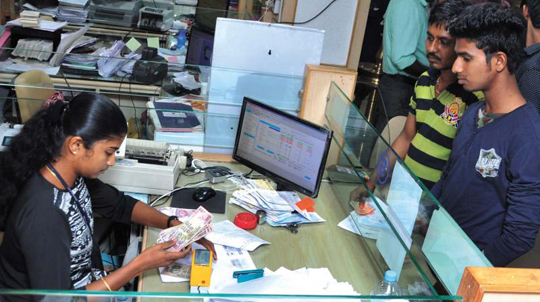
Demonetisation

Officials said multiple teams of the Enforcement Directorate (ED) swooped early morning at over 50 branches of at least ten banks, both in the private and public sector, along with banking auditors to "scrutinise" transaction records and account statements, armed with vital inputs gathered from financial snoop agencies.

They said ED teams have launched the operations at branches located in major cities like Delhi, Mumbai, Bengaluru, Hyderabad, Kolkata, Chennai and others based on records of transaction of these branches where the maximum amount of old notes have been deposited or huge cash has been deposited in bank accounts in one go or in a staggered fashion giving rise to suspicion of suspect deposits.

Officials said the sleuths and auditors are "looking at the banking transaction records post November 8" and instructions have been issued to these teams to ensure that regular operations and customer dealings are not affected due to this.

The ED, tasked with enforcing two important laws to check financial crimes--Prevention of Money Laundering Act (PMLA) and Foreign Exchange Management Act (FEMA)--has sourced Suspicious Transaction Reports (STRs) and Cash Transaction Reports (CTRs) of the banks under scanner from various financial intelligence agencies and has launched the operation to check possible financial irregularities, instances of money laundering and hawala dealings.

The agency had recently arrested two Axis Bank employees working at a branch in Delhi while probing a similar instance under PMLA.

ED, last week, had also conducted searches at 40 locations across the country in order to check black money held with currency exchanges, hawala dealers and others.

Comments

Skazi
 - 
Wednesday, 7 Dec 2016

Why only the transactions post Nov 8 are checked .... Make a comprehensive checking of all transactions from April 1 ....
Mr 56\ CHESTWALA... Pls show your courage"

Add new comment

  • Coastaldigest.com reserves the right to delete or block any comments.
  • Coastaldigset.com is not responsible for its readers’ comments.
  • Comments that are abusive, incendiary or irrelevant are strictly prohibited.
  • Please use a genuine email ID and provide your name to avoid reject.
News Network
June 29,2020

Kolkata, Jun 29: Sweet-loving Bengalis have something to cheer about in COVID-19 time as the West Bengal government decided to come out with a "sandesh" which will contain honey from Sundarbans and increase immunity, an official said on Sunday.

Cotton cheese made from cow milk will be mixed with pure honey from the Sunderbans to prepare the "Arogya Sandesh" which will also have extracts of tulsi leaves, an official of the Animal Resources Development Department said.

No artificial flavours would be added to the sweetmeat which will be available in the department's outlets in the city and neighbouring districts, he said.

The sandesh will boost the immune system as a whole but it is not a COVID-19 antidote, the official said.

Sunderbans Affairs Minister Manturam Pakhira said the honey for making Arogya Sandesh will be collected from beehives in places such as Pirkhali, Jharkhali and other parts of the Sunderbans and it will be stored in a scientific manner.

The sandesh is expected to hit the shelves in another two months and the pricing will be within the reach of the common man, the animal resources development department official said.

Earlier this month, a reputed sweetmeat chain of Kolkata came out with an "Immunity Sandesh" claiming that it contains various herbs and spices such as haldi (turmeric), tulsi, saffron, and cardamom and Himalayan honey, which will boost immunity to fight novel coronavirus.

Comments

Add new comment

  • Coastaldigest.com reserves the right to delete or block any comments.
  • Coastaldigset.com is not responsible for its readers’ comments.
  • Comments that are abusive, incendiary or irrelevant are strictly prohibited.
  • Please use a genuine email ID and provide your name to avoid reject.
Agencies
January 12,2020

Mumbai, Jan 12: Thousands of citizens on Sunday congregated in Mumbai's suburban Jogeshwari to oppose the new citizenship law, the proposed NRC and NPR.

They also condemned last Sunday's violence on the JNU campus in Delhi, where masked men ran riot and attacked students. Leftist organisations had claimed RSS-affiliated ABVP's role in the attack, a charge denied by the students' body.

Former Tata Institute of Social Science (TISS) general secretary Fahad Ahmed told PTI that they assembled under the aegis of 'Hum Bharat Ke Log' in Millat Nagar area.

"Prime minister Narendra Modi should call 56 students from across the country to debate on the CAA, NRC and NPR," Ahmed said in an apparent jibe at Modi's "56 inch chest" remark, which the latter had made ahead of the 2014 Lok Sabha polls.

"Why the PM is not talking to us? Why is he not communicating? Even the Britishers used to talk to Indians whom they ruled, but our PM is not talking to poor people," he alleged.

Bollywood actor Sushasht Singh also spoke on the occasion.

"We are people of this country and such acts (CAA) are tarnishing the image of our country," he said.

At the gathering, people waved banners with slogans like "I Am From Gujarat, My Documents Burned in 2002", "No CAA, Boycott NRC, Stop Dividing India, Don't Divide us", "Save Constitution", written on them.

A large number of police personnel were present at the venue.

The Citizenship Amendment Act (CAA), which was notified on January 10, grants Indian citizenship to non-Muslim minorities migrated to India from Afghanistan, Pakistan and Bangladesh till December 31, 2014, following persecution over their faith.

Massive protests were witnessed against the CAA, mainly by the student community, since its passage by Parliament in December last year.

Opposition parties have been dubbing the CAA an "anti-Muslim" legislation, a charge being debunked by the government.

The Congress and other parties like the TMC have also opposed the proposed National Register of Citizens (NRC) and the National Population Register (NPR).

Union home minister Amit Shah has said that the government won't rest until persecuted refugees are granted Indian citizenship.

Comments

Add new comment

  • Coastaldigest.com reserves the right to delete or block any comments.
  • Coastaldigset.com is not responsible for its readers’ comments.
  • Comments that are abusive, incendiary or irrelevant are strictly prohibited.
  • Please use a genuine email ID and provide your name to avoid reject.
Agencies
June 15,2020

New Delhi, Jun 15: Average temperature of India experienced a rise of 0.7 degree Celsius, along with decline in rainfall, significant increase in frequency of very severe cyclonic storms and droughts in over a decade due to human activities, the Ministry of Earth Sciences in its research report said.

The contentions were made in a report issued by the ministry on the impact of climate change. It will be published by Union Minister Harsh Vardhan on June 19.

According to the report, "Since the middle of the twentieth century, India witnessed rise in temperature; decrease in monsoon; rise in extreme temperature and rainfall, droughts, and sea levels; and increase intensity of severe cyclones.

The report, prepared by researchers of the Centre for Climate Change Research, a cell under The Ministry's Indian Institute of Tropical Meteorology, Pune, further stated that there is compelling scientific evidence that human activities have influenced these changes in regional climate.

India's average temperature has risen by around 0.7 degrees Celsius during 1901-2018, it said, adding that the rise is largely on account of GHG-induced warming and partially offset by forcing due to anthropogenic aerosols.

It states that the average temperature over India is projected to rise by 4.4 degrees Celsius, while the intensity of heat waves is likely to increase by 3-4 times by the end of the century.

In the 30-year period between 1986 and 2015, temperatures of the warmest day and the coldest night of the year have risen by about 0.63 degrees Celsius and 0.4 degree Celsius.

According to the report, by the end of the century, the temperatures of the warmest day and the coldest night are projected to rise by approximately 4.7 degrees Celsius and 5.5 degrees Celsius, respectively.

Alarmingly, sea surface temperature of the tropical Indian Ocean has also risen by one degrees Celsius on average during 1951-2015.

"The frequency of very severe cyclonic storms during the post-monsoon season has increased significantly (+1 event per decade) during the last two decades (2000-2018)," it added.

This came in the backdrop of Cyclone 'Amphan' and 'Nisarga' which made landfalls on May 20 and June 3 and killed several people, flattened villages, and destroyed farms.

"This is the first-ever climate change assessment report for India. This report will be very useful for policy makers, researchers, social scientists, economists, and students," said M. Rajeevan, secretary, the Ministry of Earth Sciences.

Besides this, the report also highlighted various other unnerving data on climate change in the country. Both the frequency and extent of droughts have increased significantly during 1951-2016.

The overall decrease of seasonal "summer monsoon rainfall" during the last 6-7 decades has led to an increased propensity for droughts over India.

"In particular, areas over central India, southwest coast, southern peninsula and north-eastern India have experienced more than 2 droughts per decade, on average, during this period. The area affected by drought has also increased by 1.3 per cent per decade over the same period."

The Hindu Kush Himalayas (HKH) also experienced a temperature rise of about 1.3 degree Celsius during 1951-2014.

Several areas of the Himalayas have experienced a declining trend in snowfall and also retreat of glaciers in recent decades. By the end of the twenty-first century, its annual mean surface temperature is projected to increase by about 5.2 degree Celsius.

The summer monsoon precipitation from June to September over India has also declined by around 6 per cent from 1951 to 2015, with notable decreases over the Indo-Gangetic Plains and the Western Ghats, the report further states.

Comments

Add new comment

  • Coastaldigest.com reserves the right to delete or block any comments.
  • Coastaldigset.com is not responsible for its readers’ comments.
  • Comments that are abusive, incendiary or irrelevant are strictly prohibited.
  • Please use a genuine email ID and provide your name to avoid reject.