Demonetisation: ED enquiry op at 50 banks across country

December 7, 2016

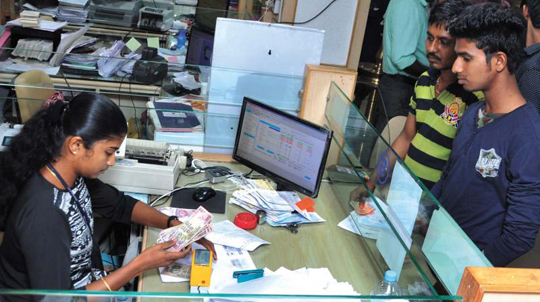
New Delhi, Dec 7: Stepping up action to check financial crimes post demonetisation, the ED today launched an 'enquiry of records' operation at over 50 bank branches across the country to detect money laundering and hawala dealing instances through these channels.

Demonetisation

Officials said multiple teams of the Enforcement Directorate (ED) swooped early morning at over 50 branches of at least ten banks, both in the private and public sector, along with banking auditors to "scrutinise" transaction records and account statements, armed with vital inputs gathered from financial snoop agencies.

They said ED teams have launched the operations at branches located in major cities like Delhi, Mumbai, Bengaluru, Hyderabad, Kolkata, Chennai and others based on records of transaction of these branches where the maximum amount of old notes have been deposited or huge cash has been deposited in bank accounts in one go or in a staggered fashion giving rise to suspicion of suspect deposits.

Officials said the sleuths and auditors are "looking at the banking transaction records post November 8" and instructions have been issued to these teams to ensure that regular operations and customer dealings are not affected due to this.

The ED, tasked with enforcing two important laws to check financial crimes--Prevention of Money Laundering Act (PMLA) and Foreign Exchange Management Act (FEMA)--has sourced Suspicious Transaction Reports (STRs) and Cash Transaction Reports (CTRs) of the banks under scanner from various financial intelligence agencies and has launched the operation to check possible financial irregularities, instances of money laundering and hawala dealings.

The agency had recently arrested two Axis Bank employees working at a branch in Delhi while probing a similar instance under PMLA.

ED, last week, had also conducted searches at 40 locations across the country in order to check black money held with currency exchanges, hawala dealers and others.

Comments

Skazi
 - 
Wednesday, 7 Dec 2016

Why only the transactions post Nov 8 are checked .... Make a comprehensive checking of all transactions from April 1 ....
Mr 56\ CHESTWALA... Pls show your courage"

Add new comment

  • Coastaldigest.com reserves the right to delete or block any comments.
  • Coastaldigset.com is not responsible for its readers’ comments.
  • Comments that are abusive, incendiary or irrelevant are strictly prohibited.
  • Please use a genuine email ID and provide your name to avoid reject.
News Network
April 28,2020

Kozhikode, Apr 28: The remains of seven people who died in the Gulf countries were airlifted from Dubai by a cargo flight which arrived here Tuesday, ending the uncertainty over bringing back the bodies of those who died following non-Covid-19 reasons.

Airport sources said the flight reached the airport by around noon.

The bodies include natives of Kerala, one each of people from Goa and Sivaganga in Tamil Nadu.

"Karipur in among the few airports where cargo flights are operating in South India.

This is the reason why the bodies of those belonging to Goa and Sivaganga and other parts of Kerala have all been brought here for onward transport to respective destinations by road," an airport official said.

"As per information received from the airport, the bodies are of John Johannan of Kollam, David Shamy of Punnakkal, Kannur, Sathyan of Cheranelloor, Thrissur, O C Mathai and Sijo Joy, both of Pathanamthitta, Sreenivasan of Sivaganga and Henrick D Soza of South Goa," said Thomas, Assistant Sub Inspector, Special Branch CID, Malappuram.

Special passes have been issued to ambulances to transport the bodies to their destinations after the formalities at the airport are over, a senior police officer said.

There had been some confusion on bringing back the bodies from the Gulf region for about a week for want of clearance from the embassy authorities.

Chief Minister Pinarayi Vijayan had written to Prime Minister Narendra Modi last week seeking his intervention in ensuring that bodies of Keralites, who die in Gulf countries due to no non COVID-19 reasons, should be broughtto the state without any delay forenabling family members to perform their last rites.

Vijayan also wanted Modi to direct Indian Embassies to issue necessary clearances without seeking individual approvals from the Ministry of Home Affairs and avoid any delay.

The mortal remains are now being broughtin cargo planes as passenger flights are not being operated due to the COVID-19 lockdown.

Comments

Add new comment

  • Coastaldigest.com reserves the right to delete or block any comments.
  • Coastaldigset.com is not responsible for its readers’ comments.
  • Comments that are abusive, incendiary or irrelevant are strictly prohibited.
  • Please use a genuine email ID and provide your name to avoid reject.
News Network
March 12,2020

New Delhi, Mar 12: TMC MP Saugata Roy said Home Minister Amit Shah should resign for "failing" to control the riots in Delhi and demanded a judicial inquiry by a sitting Supreme Court judge.

Participating in a discussion on the violence in Delhi in Lok Sabha, Roy said the Delhi riots happened 72 years after Mahatma Gandhi was killed by a Hindu fanatic.

"Gandhiji has been murdered again in Delhi by, you know who," Roy said while addressing the Chair.

Taking on BJP MP Meenakshi Lekhi for defending BJP leaders for their controversial remarks, which he claimed instigated the violence, Roy said he has seldom heard such a communal speech ever.

Dubbing the BJP MP as "Devil's Advocate", Roy said, "She spent five minutes defending the most hated man. May I quote (William) Shakespeare and call her the Devil's Advocate?...She is the best Devil's Advocate possible. She has also been an advocate for the Delhi Police which has shown total inaction and ineptness in this whole riot in Delhi."

Thereafter Roy trained his gun at Shah, who was present in the house while the TMC MP was speaking.

He said that when the riots started on February 24, Home Minister Shah was sitting in the front row at Motera Stadium (in Gujarat) welcoming US President Donald Trump.

"When Mr. Shah should have been in Delhi Police control room, he was welcoming Mr. Trump at Motera. There was no order to the police. Then on 25th, things went out of control. Armed mobs fought with each other on the streets of Delhi," Roy said.

Demanding resignation of Shah, Roy raised questions on NSA Ajit Doval's visit to the riots-affected areas on February 26 and asked what was the Home Minister doing.

"Is it NSA's business to control ordinary law and order situation? Why was the Home Minister absent in action? There is no explanation for the same," he said.

The TMC leader said he feels bad standing face-to-face with Shah.

"He is still young, he has a good future. He should acknowledge responsibility for his failure to control or stop Delhi riots and bring peace in three days. In the name of God, go and do not stay in the Home Minister's position," Roy said, adding he is the man who could not prevent riots in Delhi, at a place 10 kilometres away from the Home Ministry.

Roy demanded a judicial inquiry into the riots by a sitting Supreme Court judge and complete rehabilitation for all the riot victims.

Comments

Add new comment

  • Coastaldigest.com reserves the right to delete or block any comments.
  • Coastaldigset.com is not responsible for its readers’ comments.
  • Comments that are abusive, incendiary or irrelevant are strictly prohibited.
  • Please use a genuine email ID and provide your name to avoid reject.
Agencies
May 27,2020

New Delhi, May 27: India’s fourth recession since Independence, first since liberalisation, and perhaps the worst to date is here, according to rating agency, Crisil.

CRISIL sees the Indian economy shrinking 5 per cent in fiscal 2021 (on-year), because of the Covid-19 pandemic. The first quarter will suffer a staggering 25 per cent contraction.

About 10 per cent of gross domestic product (GDP) in real terms could be permanently lost. "So going back to the growth rates seen before the pandemic is unlikely in the next three fiscals", Crisil said.

Crisil has revised its earlier forecast downwards. "Earlier, on April 28, we had slashed our prediction to 1.8 per cent growth from 3.5 per cent growth. Things have only gone downhill since", it said.

While we expect non-agricultural GDP to contract 6 per cent, agriculture could cushion the blow by growing at 2.5 per cent.

In the past 69 years, India has seen a recession only thrice as per available data in fiscals 1958, 1966 and 1980. The reason was the same each time a monsoon shock that hit agriculture, then a sizeable part of the economy.

"The recession staring at us today is different," it added. For one, agriculture could soften the blow this time by growing near its trend rate, assuming a normal monsoon. Two, the pandemic-induced lockdowns have affected most non-agriculture sectors. And three, the global disruption has upended whatever opportunities India had on the exports front.

Economic conditions have slid precipitously since the April-end forecast of 1.8 per cent GDP growth for fiscal 2021 (baseline), Crisil said.

On the lockdown extension, it said that the government has extended the lockdown four times to deal with the rising number of cases, curtailing economic activity severely (lockdown 4.0 is ending on May 31).

The first quarter of this fiscal will be the worst affected. June is unlikely to see major relaxations as the Covid-19 affliction curve is yet to flatten in India.

"Not only will the first quarter be a washout for the non-agricultural economy, services such as education, and travel and tourism among others, could continue to see a big hit in the quarters to come. Jobs and incomes will see extended losses as these sectors are large employers," Crisil said.

CRISIL also foresees economic activity in states with high Covid-19 cases to suffer prolonged disruption as restrictions could continue longer.

A rough estimate based on a sample of eight states, which contribute over half of India's GDP, shows that their 'red zones' (as per lockdown 3.0) contributed 42 per cent to the state GDP on average regardless of the share of such red zones.

On average, the orange zones contribute 46 per cent, while the green zones where activity is allowed to be close to normal contribute only 12 per cent to state GDP.

The economic costs are higher than earlier expectations, according to Crisil. The economic costs now beginning to show up in the hard numbers are far worse than initial expectations.

Industrial production for March fell by over 16%. The purchasing managers indices for the manufacturing and services sectors were at 27.4 and 5.4, respectively, in April, implying extraordinary contraction. That compares with 51.8 and 49.3, respectively, in March.

Exports contracted 60.3 per cent in April, and new telecom subscribers declined 35 per cent, while railway freight movement plunged 35 per cent on-year.

"Indeed, given one of the most stringent lockdowns in the world, April could well be the worst performing month for India this fiscal," it said.

Added to that is the economic package without enough muscle. The government recently announced a Rs 20.9 lakh crore economic relief package to support the economy. The package has some short-term measures to cushion the economy, but sets its sights majorly on reforms, most of which will have payoffs only over the medium term.

"We estimate the fiscal cost of this package at 1.2 per cent of GDP, which is lower than what we had assumed in our earlier estimate (when we foresaw a growth in GDP)," it said.

"We believe a catch-up to the pre-crisis trend level of GDP growth will not be possible in the next three fiscals despite policy support. Under the base case, we estimate a 10 per cent permanent loss to real GDP (from the decadal-trend level), assuming average growth of about 7 per cent between fiscals 2022 and 2024," Crisil said.

Interestingly, after the Global Financial Crisis (GFC), a sharp growth spurt helped catch up with the trend within two years. GDP grew 8.2 per cent on average in the two fiscals following the GFC. Massive fiscal spending, monetary easing and swift global recovery played a role in a V-shaped recovery.

To catch-up would require average GDP growth to surge to 11 per cent over the next three fiscals, something that has never happened before.

The research said that successive lockdowns have a non-linear and multiplicative effect on the economy a two-month lockdown will be more than twice as debilitating as a one-month imposition, as buffers keep eroding.

Partial relaxations continue to be a hindrance to supply chains, transportation and logistics. Hence, unless the entire supply chain is unlocked, the impact of improved economic activity will be subdued.

Therefore, despite the stringency of lockdown easing a tad in the third and the fourth phases, their negative impact on GDP is expected to massively outweigh the benefits from mild fiscal support and low crude oil prices, especially in the April-June quarter. "Consequently, we expect the current quarter's GDP to shrink 25 per cent on-year," it said.

Counting lockdown 4.0, Indians have had 68 days of confinement. S&P Global estimates that one month of lockdown shaves 3 per cent off annual GDP on average across Asia-Pacific.

Since India's lockdown has been the most stringent in Asia, the impact on economic growth will be correspondingly larger.

Google's Community Mobility Reports show a sharp fall in movement of people to places of recreation, retail shops, public transport and workplace travel. While data for May shows some improvement in India, mobility trends are much below the average or baseline, and lower compared with countries such as the US, South Korea, Brazil and Indonesia.


Comments

Add new comment

  • Coastaldigest.com reserves the right to delete or block any comments.
  • Coastaldigset.com is not responsible for its readers’ comments.
  • Comments that are abusive, incendiary or irrelevant are strictly prohibited.
  • Please use a genuine email ID and provide your name to avoid reject.