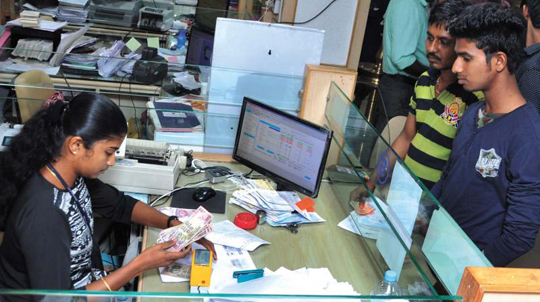
Demonetisation: ED enquiry op at 50 banks across country

December 7, 2016

New Delhi, Dec 7: Stepping up action to check financial crimes post demonetisation, the ED today launched an 'enquiry of records' operation at over 50 bank branches across the country to detect money laundering and hawala dealing instances through these channels.

Demonetisation

Officials said multiple teams of the Enforcement Directorate (ED) swooped early morning at over 50 branches of at least ten banks, both in the private and public sector, along with banking auditors to "scrutinise" transaction records and account statements, armed with vital inputs gathered from financial snoop agencies.

They said ED teams have launched the operations at branches located in major cities like Delhi, Mumbai, Bengaluru, Hyderabad, Kolkata, Chennai and others based on records of transaction of these branches where the maximum amount of old notes have been deposited or huge cash has been deposited in bank accounts in one go or in a staggered fashion giving rise to suspicion of suspect deposits.

Officials said the sleuths and auditors are "looking at the banking transaction records post November 8" and instructions have been issued to these teams to ensure that regular operations and customer dealings are not affected due to this.

The ED, tasked with enforcing two important laws to check financial crimes--Prevention of Money Laundering Act (PMLA) and Foreign Exchange Management Act (FEMA)--has sourced Suspicious Transaction Reports (STRs) and Cash Transaction Reports (CTRs) of the banks under scanner from various financial intelligence agencies and has launched the operation to check possible financial irregularities, instances of money laundering and hawala dealings.

The agency had recently arrested two Axis Bank employees working at a branch in Delhi while probing a similar instance under PMLA.

ED, last week, had also conducted searches at 40 locations across the country in order to check black money held with currency exchanges, hawala dealers and others.

Comments

Skazi
 - 
Wednesday, 7 Dec 2016

Why only the transactions post Nov 8 are checked .... Make a comprehensive checking of all transactions from April 1 ....
Mr 56\ CHESTWALA... Pls show your courage"

Add new comment

  • Coastaldigest.com reserves the right to delete or block any comments.
  • Coastaldigset.com is not responsible for its readers’ comments.
  • Comments that are abusive, incendiary or irrelevant are strictly prohibited.
  • Please use a genuine email ID and provide your name to avoid reject.
News Network
April 28,2020

Kozhikode, Apr 28: The remains of seven people who died in the Gulf countries were airlifted from Dubai by a cargo flight which arrived here Tuesday, ending the uncertainty over bringing back the bodies of those who died following non-Covid-19 reasons.

Airport sources said the flight reached the airport by around noon.

The bodies include natives of Kerala, one each of people from Goa and Sivaganga in Tamil Nadu.

"Karipur in among the few airports where cargo flights are operating in South India.

This is the reason why the bodies of those belonging to Goa and Sivaganga and other parts of Kerala have all been brought here for onward transport to respective destinations by road," an airport official said.

"As per information received from the airport, the bodies are of John Johannan of Kollam, David Shamy of Punnakkal, Kannur, Sathyan of Cheranelloor, Thrissur, O C Mathai and Sijo Joy, both of Pathanamthitta, Sreenivasan of Sivaganga and Henrick D Soza of South Goa," said Thomas, Assistant Sub Inspector, Special Branch CID, Malappuram.

Special passes have been issued to ambulances to transport the bodies to their destinations after the formalities at the airport are over, a senior police officer said.

There had been some confusion on bringing back the bodies from the Gulf region for about a week for want of clearance from the embassy authorities.

Chief Minister Pinarayi Vijayan had written to Prime Minister Narendra Modi last week seeking his intervention in ensuring that bodies of Keralites, who die in Gulf countries due to no non COVID-19 reasons, should be broughtto the state without any delay forenabling family members to perform their last rites.

Vijayan also wanted Modi to direct Indian Embassies to issue necessary clearances without seeking individual approvals from the Ministry of Home Affairs and avoid any delay.

The mortal remains are now being broughtin cargo planes as passenger flights are not being operated due to the COVID-19 lockdown.

Comments

Add new comment

  • Coastaldigest.com reserves the right to delete or block any comments.
  • Coastaldigset.com is not responsible for its readers’ comments.
  • Comments that are abusive, incendiary or irrelevant are strictly prohibited.
  • Please use a genuine email ID and provide your name to avoid reject.
News Network
May 7,2020

Visakhapatnam, May 7: Andhra Pradesh Chief Minister Y S Jagan Mohan Reddy on Thursday announced an ex- gratia payment of Rs one crore each to the kin of those killed in the styrene gas leak incident at LG Polymers Limited near here.

The NDRF had put the death toll from the leak at 11.

The chief minister announced a committee to probe into the mishap and also said the government would talk to the LG Polymers management seeking job for the kin of the deceased in any of its businesses.

Speaking to reporters after conducting a review meeting, Reddy also announced Rs 10 lakh each to those undergoing treatment on ventilator support and Rs 25,000 to those who took treatment as out-patients after developing health complications due to inhalation of the styrene vapour.

Earlier, he held a review meeting at the Andhra Medical College with District Collector Vinay Chand and others.

The gas leak victims undergoing treatment in various hospitals would be paid Rs one lakh each. The 15,000-odd population in the five villages that were affected by the gas leak would be paid Rs 10,000 each, the chief minister added.

Reddy further announced constitution of a high-level committee, headed by the Special Chief Secretary (Environment and Forests), to probe into the mishap and make recommendations to prevent such tragedies in the future.

Earlier, he visited the King George Hospital and consoled the victims of the gas leak.

Accompanied by his Deputy holding the health portfolio A K K Srinivas and Chief Secretary Nilam Sawhney, Reddy flew down to the port city and went straight to the KGH.

He met the gas leak victims undergoing treatment and enquired about their well-being.

At the review meeting, the Collector informed the Chief Minister that the gas spread was limited to a 1.5 to 2 km area from the epicentre of the leak and that the locals were evacuated to safety.

Of the two styrene tanks in the plant, the leak occurred from one that was holding about 1,800 kilo litres of the chemical.

Comments

Add new comment

  • Coastaldigest.com reserves the right to delete or block any comments.
  • Coastaldigset.com is not responsible for its readers’ comments.
  • Comments that are abusive, incendiary or irrelevant are strictly prohibited.
  • Please use a genuine email ID and provide your name to avoid reject.
News Network
June 25,2020

India has jumped past 4.5 lakh coronavirus cases and 14,476 people have succumbed to the viral infection so far. In this backdrop, speaking to IANS in an exclusive interview, AIIMS Director Randeep Guleria said India is also vulnerable to second wave of coronavirus and people should continue to follow social distancing, wearing mask and other precautions, after cases begin to decline.

He added that in order to contain the outbreak of Covid-19, a limited lockdown in hotspots, where volume of cases is very high, may be considered along with a micro-plan to prevent leakage of cases from these areas to other non-containment areas. Excerpts of the interview are below:

Q: Reports say China and South Korea are witnessing a second wave of coronavirus infection, what is this second wave, is India also vulnerable to this?

A: When cases come down significantly, people tend to drop their guard against the viral infection, and this leads to the second wave (which means a sudden increase in the number of cases). After cases begin to decline, people should continue to follow the precautions -- continue to maintain social distancing and wear masks regularly. See what happened in Singapore, it was struck by a second wave of coronavirus. Look, what happened in the 1918 pandemic, people dropped their guard and the second wave of viral infection struck back. If people do not follow social distancing then the spike in cases is apparent. We need to take these precautions at least for one year. India is also vulnerable to this second wave.

Q: If Covid-19 cases continue to rise rapidly, do you think we need another lockdown in areas where volume of cases are very high?

A: A large volume of cases is concentrated in specific areas like hotspots, and in order to maintain things in order, we may need a limited lockdown in these areas. This should be followed by a micro-plan which entails extensive testing of people and also extensive contact tracing of people who have got in touch with positive people. Need to ensure there is no leakage of cases from these areas. People from these areas should not mix with others in non-containment areas. This will aid in containing the outbreak of the virus. People who have developed symptoms should get themselves tested, especially in the containment areas.

Q: With more than 4.5 lakh cases and close to 14,500 deaths, do you think India has reached its peak and a decline in cases is prominent?

A: The cases will continue to increase for some time. The doubling time of cases has also increased. But, the cases will also begin to flatten. Though, it is difficult to give an exact time period in this viral infection, it seems, the growth in cases will flatten in the end of July or beginning of August. A decline will come to this viral infection, but it does not mean that people should drop their guard. As a measure, we need to decrease community participation and citizens should continue to follow social distancing. People should get themselves tested. All these efforts will help in preventing people from contracting this virus. These precautions will also prevent us from the second wave, and we must continue to take precautions. The virus has not gone away, it is still lurking.

Q: India has crossed the 4.5 lakh coronavirus cases so far, although our recovery rate is good, but still 10,000 to 15,000 cases are reported daily. Why do cases continue to spiral, what is the reason?

A: We have to remember a few things -- the bulk of cases are in 10 cities, nearly 70 per cent, and if we take into account cases per million population, the number is not very high, as compared with countries including countries in Europe. Many European countries put together still do not add up to the Indian population. Do not compare India to countries like Italy, Spain etc. We need to focus on hotspots, which contribute to between 70 -80 per cent of cases, and we have to identify cases in these areas at an early stage. The population density is very high in these cities. People in lower socio-economic status are highly vulnerable to the viral infection, as many live together in small spaces and there is a lot of mixing of people happening there. Look at the market places, people are not following social distancing and not wearing masks. In fact, many are in close vicinity of each other.


Comments

Add new comment

  • Coastaldigest.com reserves the right to delete or block any comments.
  • Coastaldigset.com is not responsible for its readers’ comments.
  • Comments that are abusive, incendiary or irrelevant are strictly prohibited.
  • Please use a genuine email ID and provide your name to avoid reject.