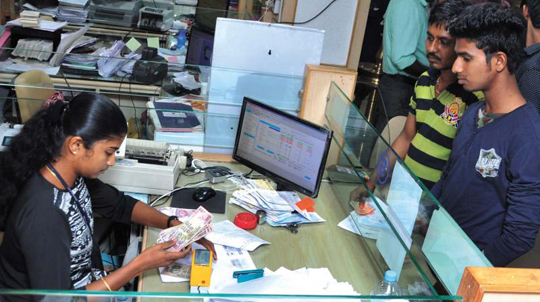
Demonetisation: ED enquiry op at 50 banks across country

December 7, 2016

New Delhi, Dec 7: Stepping up action to check financial crimes post demonetisation, the ED today launched an 'enquiry of records' operation at over 50 bank branches across the country to detect money laundering and hawala dealing instances through these channels.

Demonetisation

Officials said multiple teams of the Enforcement Directorate (ED) swooped early morning at over 50 branches of at least ten banks, both in the private and public sector, along with banking auditors to "scrutinise" transaction records and account statements, armed with vital inputs gathered from financial snoop agencies.

They said ED teams have launched the operations at branches located in major cities like Delhi, Mumbai, Bengaluru, Hyderabad, Kolkata, Chennai and others based on records of transaction of these branches where the maximum amount of old notes have been deposited or huge cash has been deposited in bank accounts in one go or in a staggered fashion giving rise to suspicion of suspect deposits.

Officials said the sleuths and auditors are "looking at the banking transaction records post November 8" and instructions have been issued to these teams to ensure that regular operations and customer dealings are not affected due to this.

The ED, tasked with enforcing two important laws to check financial crimes--Prevention of Money Laundering Act (PMLA) and Foreign Exchange Management Act (FEMA)--has sourced Suspicious Transaction Reports (STRs) and Cash Transaction Reports (CTRs) of the banks under scanner from various financial intelligence agencies and has launched the operation to check possible financial irregularities, instances of money laundering and hawala dealings.

The agency had recently arrested two Axis Bank employees working at a branch in Delhi while probing a similar instance under PMLA.

ED, last week, had also conducted searches at 40 locations across the country in order to check black money held with currency exchanges, hawala dealers and others.

Comments

Skazi
 - 
Wednesday, 7 Dec 2016

Why only the transactions post Nov 8 are checked .... Make a comprehensive checking of all transactions from April 1 ....
Mr 56\ CHESTWALA... Pls show your courage"

Add new comment

  • Coastaldigest.com reserves the right to delete or block any comments.
  • Coastaldigset.com is not responsible for its readers’ comments.
  • Comments that are abusive, incendiary or irrelevant are strictly prohibited.
  • Please use a genuine email ID and provide your name to avoid reject.
News Network
January 18,2020

Jan 18: Days after the arrest of Deputy SP Davinder Singh along with two Hizbul Mujahideen terrorists, Shiv Sena on Saturday questioned the role of police in the Kashmir Valley.

"Cross border infiltration is ongoing in Kashmir. But the police machinery is being used to help the terrorists in Kashmir to safely cross the border (to Pakistan) and a President's medal awarded Deputy SP was arrested for doing so. In Kashmir (it seems), the government is using the police for some other purposes, what will the country's Home Ministry say if somebody has a doubt in connection with the Pulwama attacks," Sena mouthpiece, Saamna, read.

This was in reference to the incident in which Jammu and Kashmir police intercepted a vehicle on Sunday and arrested DySP Davinder Singh along with two top Hizbul Mujahideen terrorists, who were travelling together.

The Sena mouthpiece asserted that the impact and acceptance of the Centre removing Article 370 should be visible "through the people" during the upcoming Republic Day celebrations.

"Jammu and Kashmir is now a Union Territory. It is being ruled by the Centre through President's Rule. The government had removed Article 370 in a historic decision...The joy and excitement in the people over the removal of 370 should be visible in the Republic Day celebrations this time. The tricolour should be seen flying over all houses in Kashmir, it is the least that can be expected," it added.

The Sena mouthpiece further said that with the arrest of terrorists in the recent days, it hoped that "Republic Day will be celebrated safely in Delhi, Jammu and Kashmir".

Comments

Add new comment

  • Coastaldigest.com reserves the right to delete or block any comments.
  • Coastaldigset.com is not responsible for its readers’ comments.
  • Comments that are abusive, incendiary or irrelevant are strictly prohibited.
  • Please use a genuine email ID and provide your name to avoid reject.
News Network
April 28,2020

New Delhi, Apr 28: Outstanding loans amounting to Rs 68,607 crore of top 50 wilful bank loan defaulters in the country including firms of Mehul Choksi and Vijay Mallya have been technically written off till September 30, 2019, the Reserve Bank of India said in a RTI reply.

Absconding dimantaire Choksi's company Gitanjali Gems tops the list of these defaulters with a whopping amount of Rs 5,492 crore, according to the list.

This is followed by REI Agro with Rs 4,314 crore and Winsome Diamonds with Rs 4,076 crore.

Rotomac Global Private Limited has funded advances of Rs 2,850 crore which have been technically written off and Kudos Chemie Ltd with Rs 2,326 crore, Ruchi Soya Industries Limited, now owned by Ramdev's Patanjali, with Rs 2,212 crore and Zoom Developers Pvt Ltd with Rs 2,012 crore being the other companies.

Mallya's Kingfisher Airlines figures in the list at number 9, with outstanding of Rs 1943 crore which have been technically written off by the banks.

Forever Precious Jewellery and Diamonds Private Limited has loans of Rs 1,962 crore written off while Deccan Chronicle Holdings Limited have Rs 1915 crore written off loans.

Choksi's other firms Gili India and Nakshatra Brands also have loans of Rs 1,447 and Rs 1109 crore respectively written off.

REI Agro of Jhunjhunwala brothers is already under the scanner of ED. The CBI and ED are also probing alleged fraud by the owners of Winsome Diamonds.

Vikram Kothari's Rotomac is the fourth in the list. He and his son Rahul Kothari were arrested by the CBI for bank loan default.

In the last Parliament session, Rahul Gandhi had asked the government to provide a list of top 50 bank loans defaulters in the country, leading to sharp exchanges and uproar in the Lok Sabha.

"The information on top 50 wilful defaulters and their sum of funded amount outstanding and amount technically/prudentially written off as on September 30, 2019 reported in CRILC by banks, is provided," the RBI said in its written response dated April 24.

In his application, RTI activist Saket Gokhale had sought the list of defaulters as on February 16, but the RBI said the requested information is not available.

The RBI said that according to section 8 (1)(a) of RTI Act 2005 read with para 77 of Supreme Court judgement of December 16, 2015 in Jayantilal N Mistry case, information on overseas borrowers is exempted from public disclosure.

"Data is as reported by banks and RBI will not be held responsibly or accountable for any misreporting and/or incorrect reporting by the reporting entities," the RBI said in the written reply to the RTI query.

Comments

Add new comment

  • Coastaldigest.com reserves the right to delete or block any comments.
  • Coastaldigset.com is not responsible for its readers’ comments.
  • Comments that are abusive, incendiary or irrelevant are strictly prohibited.
  • Please use a genuine email ID and provide your name to avoid reject.
Agencies
May 23,2020

New Delhi, May 23: The nationwide lockdown will no longer help India in its fight against COVID-19, and in its place community-driven containment, isolation and quarantine strategies have to be brought into play, leading virologist Shahid Jameel said.

The recipient of Shanti Swarup Bhatnagar Prize for Science and Technology also stressed that testing should be carried out vigorously to identify coronavirus hotspots and isolate those areas.

"Our current testing rate at 1,744 tests per million population is one of the lowest in the world. We should deploy both antibody tests and confirmatory PCR tests. This will tell us about pockets of ongoing infection and past (recovered) infection. This will provide data to open up gradually and let economic activity resume," Jameel told PTI in an interview.

He stressed that testing has to be dynamic to continuously monitor red, orange and green zones and change these based on that data.

About community transmission of COVID-19 in India, Jameel said the country reached that stage long ago.

"We reached community transmission a long time ago. It's just that the health authorities are not admitting it. Even ICMR's own study of SARI (severe acute respiratory illness) showed that about 40 per cent of those who tested positive for SARS-CoV-2 did not have any history of overseas travel or contact to a known case. If this is not community transmission, then what is?" he posed.

Lockdown bought India time in its fight against coronavirus, but continuing it is unlikely to yield any further dividend, Jameel said.

"Instead, community-driven local lockdowns, isolations and quarantines have to come into play. Building trust is most important so that people follow rules. A public health problem cannot be dealt with as a law-and-order problem."

The nationwide lockdown, initially imposed from March 25 to April 14, has been extended thrice and will continue at least till May 31. The virus has claimed 3,720 lives and infected over 1.25 lakh people in the country so far.

Jameel has expertise in the fields of molecular biology, infectious diseases, and biotechnology. He is the CEO of Wellcome Trust/Department of Biotechnology's India Alliance and is best known for extensive research in Hepatitis E virus and HIV.

He said COVID-19 will eventually be controlled through herd immunity, which is acquired in two ways – when a sufficient fraction of the population gets infected and recovers, and with vaccination.

"It is estimated that for SARS-CoV-2 at least 60 per cent of the population would have to be infected and recovered, or vaccinated. This will happen over the course of the next few years," Jameel said.

Herd immunity is reached when the majority of a population becomes immune to an infectious disease, either because they have become infected and recovered, or through vaccination. When that happens, the disease is less likely to spread to people who aren't immune, because there just aren't enough infectious carriers.

"India has 1.38 billion people, a population density of about 400/sq km and a healthcare system ranked at 143 in the world. If we allow 60 per cent people to get infected quickly in the hopes of herd immunity, that would mean 830 million infections," Jameel said.

"If 15 per cent need hospitalization that means about 125 million isolation beds (we have 0.3 million). If five per cent need oxygen and ventilatory support, this amounts to about 42 million oxygen support and ICU beds; we have 0.1 million oxygen support beds and 34,000 ICU beds. This would overwhelm the healthcare system causing mayhem," he said.

Jameel said if the population level mortality is 0.5 per cent that would mean 40 lakh deaths. "Are we prepared to pay this price for herd immunity in the short term? Clearly not," he said.

He said it is unlikely that a vaccine would be available by the end of the year.

"Even then, we don't know yet how long it would give protection – weeks, months, one year, a few years? I don't think we will return to pre-coronavirus days for at least the next 3-5 years. This is also a chance to evaluate if we want to return to those unsustainable, environment-damaging ways. COVID-19 is a timely warning to reform our way of living," he said.

Jameel said it is hard to predict but plausible that COVID-19 would return in second or third wave.

"Later waves come when we don't understand the disease and become lax. A comparison to Spanish Flu is not entirely valid because in 1918 no one knew what caused it. No one had seen a virus till the mid-1930s as the electron microscope needed to view those was invented in 1931," he said.

"Today we know a lot more about the pathogen, its genetic makeup, how it transmits and how to prevent it. We need to be sensible and follow expert advice," he said.

If there is any scientific evidence linking deforestation, rapid urbanisation, climate change with pandemics like COVID-19, he said zoonotic viruses -- those that jump from animals to humans -- happen so when wild animal–human contacts increase.

"Deforestation destroys animal habitats bringing them closer to humans. When you cut forests, bats come to roost on trees closer to human habitations. Their viruses in secretions/stool get transmitted to domestic animals and on to humans. This happened clearly with Nipah virus outbreak in Malaysia in 1997-98 from fruit bats to pigs to humans," he said.

"COVID-19 possibly arose in wet animal markets due to dietary habits that bring all kinds of live and dead wild animals in close contact with humans," Jameel added.


Comments

Add new comment

  • Coastaldigest.com reserves the right to delete or block any comments.
  • Coastaldigset.com is not responsible for its readers’ comments.
  • Comments that are abusive, incendiary or irrelevant are strictly prohibited.
  • Please use a genuine email ID and provide your name to avoid reject.