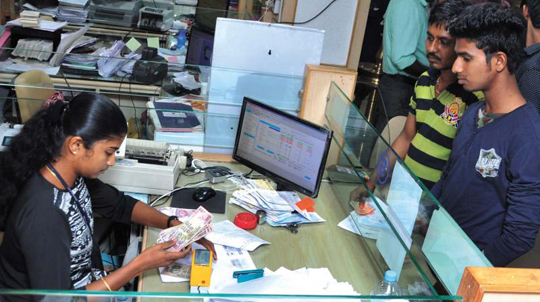
Demonetisation: ED enquiry op at 50 banks across country

December 7, 2016

New Delhi, Dec 7: Stepping up action to check financial crimes post demonetisation, the ED today launched an 'enquiry of records' operation at over 50 bank branches across the country to detect money laundering and hawala dealing instances through these channels.

Demonetisation

Officials said multiple teams of the Enforcement Directorate (ED) swooped early morning at over 50 branches of at least ten banks, both in the private and public sector, along with banking auditors to "scrutinise" transaction records and account statements, armed with vital inputs gathered from financial snoop agencies.

They said ED teams have launched the operations at branches located in major cities like Delhi, Mumbai, Bengaluru, Hyderabad, Kolkata, Chennai and others based on records of transaction of these branches where the maximum amount of old notes have been deposited or huge cash has been deposited in bank accounts in one go or in a staggered fashion giving rise to suspicion of suspect deposits.

Officials said the sleuths and auditors are "looking at the banking transaction records post November 8" and instructions have been issued to these teams to ensure that regular operations and customer dealings are not affected due to this.

The ED, tasked with enforcing two important laws to check financial crimes--Prevention of Money Laundering Act (PMLA) and Foreign Exchange Management Act (FEMA)--has sourced Suspicious Transaction Reports (STRs) and Cash Transaction Reports (CTRs) of the banks under scanner from various financial intelligence agencies and has launched the operation to check possible financial irregularities, instances of money laundering and hawala dealings.

The agency had recently arrested two Axis Bank employees working at a branch in Delhi while probing a similar instance under PMLA.

ED, last week, had also conducted searches at 40 locations across the country in order to check black money held with currency exchanges, hawala dealers and others.

Comments

Skazi
 - 
Wednesday, 7 Dec 2016

Why only the transactions post Nov 8 are checked .... Make a comprehensive checking of all transactions from April 1 ....
Mr 56\ CHESTWALA... Pls show your courage"

Add new comment

  • Coastaldigest.com reserves the right to delete or block any comments.
  • Coastaldigset.com is not responsible for its readers’ comments.
  • Comments that are abusive, incendiary or irrelevant are strictly prohibited.
  • Please use a genuine email ID and provide your name to avoid reject.
Agencies
June 21,2020

New Delhi, June 21: The world is feeling the need for yoga more than ever due to the coronavirus pandemic and the ancient Indian practice is helping a large number of Covid-19 patients across the globe in defeating the disease, Prime Minister Narendra Modi said on Sunday.

The coronavirus specifically attacks the respiratory system and 'pranayama' or breathing exercise helps in strengthening the respiratory system the most, Modi said in his message on the sixth International Day of Yoga.

Modi said yoga has emerged as a force for unity and it does not discriminate as it goes beyond race, colour, gender, faith and nations.

"Yoga enhances our quest for a healthier planet. It has emerged as a force for unity and deepens the bonds of humanity. It does not discriminate. It goes beyond race, colour, gender, faith and nations. Anybody can embrace Yog," the prime minister said.

In his nearly 15-minute address early Sunday morning, Modi said that due to the coronavirus pandemic, the world is feeling the need for yoga more than ever.

"If our immunity is strong, it is of great help in defeating this disease. For boosting immunity, there are several methods in yoga, various 'asanas' are there. These asanas are such that they increase the strength of the body and also strengthen our metabolism," he said.

Talking about the benefits of 'pranayama' -- a form of breathing exercise, Modi said it is very effective and has countless variations like 'Sheetali, Kapalbhati and Bhrastika'.

"All these forms of yoga, help a lot in strengthening both our respiratory and immune system," he said, urging people to include 'pranayama' in their daily routine.

"A large number of Covid-19 patients all over the world are taking the benefits of all these techniques of yoga. The strength of yoga is helping them defeat this disease," Modi said.

Asserting that anybody can embrace yoga, the prime minister said that all that is needed is some part of one's time and an empty space.

"Yoga is giving us not only the physical strength, but also mental balance and emotional stability to confidently negotiate the challenges before us," Modi said.

"If we can fine-tune our chords of health and hope, the day is not far away when world will witness the success of a healthy and happy humanity. Yoga can definitely help us make this happen," he said.

With the shadow of the COVID-19 pandemic looming large, International Day of Yoga is being marked on digital media platforms sans mass gatherings. This year's theme is 'Yoga at Home and Yoga with Family'.

Yoga Day is going digital for the first time since June 21, 2015, when it began to be celebrated annually across the world, coinciding with the Summer Solstice each year.

On December 11, 2014, the United Nations General Assembly declared June 21 as 'International Day of Yoga', months after Prime Minister Modi had proposed the idea.

The Ministry of Ayurveda, Yoga & Naturopathy, Unani, Siddha and Homoeopathy (AYUSH) had planned to hold a grand event in Leh, but cancelled it due to the pandemic.

In his message on Sunday, Modi said the International Yoga Day is a day of unity and gives the message of universal brotherhood.

"It is a day of oneness and humanness. What brings us together, unites us, that is yoga. What bridges distances is yoga. In times of this coronavirus pandemic, people's participation in the 'My Life - My Yoga' across the world shows that people's interest in yoga is increasing," he said.

He said that doing work properly and fulfilling one's duties is also a form of yoga.

"Eating the right food, playing the right sports, having right habits of sleeping and waking, and doing your work and your duties is yoga," Modi said.

"With this 'karmayoga', we get the solution to all the problems. 'Karmayoga' is also helping others selflessly. This spirit of 'karmayoga' is embedded in the spirit of India. Whenever the need arose, the whole world witnessed India's selflessness," he said.

The power as an individual, society and country increases manifold when people act according to yoga and with the spirit of 'karmayoga', Modi said.

"Today we have to take a pledge in this spirit -- we will do everything possible for our health, for the health of our loved ones. As a conscious citizen, we will move forward unitedly as a family and society," he said.

The PM's message was followed by a live demonstration of Common Yoga Protocol (CYP). The CYP drill was designed keeping in mind people of different age groups and of varied walks of life, the ministry had said in its statement.

Yoga programmes are organised across the globe by Indian missions every year, but this year will be different. Several missions are organising digital events to mark the occasion.


Comments

Add new comment

  • Coastaldigest.com reserves the right to delete or block any comments.
  • Coastaldigset.com is not responsible for its readers’ comments.
  • Comments that are abusive, incendiary or irrelevant are strictly prohibited.
  • Please use a genuine email ID and provide your name to avoid reject.
News Network
June 24,2020

New Delhi, Jun 24: A litre of diesel on Wednesday was more expensive than a litre of petrol after the price of the former was hiked by 48 paise on the 18th successive day of fuel price revisions. While petrol price remained unchanged for the first time since June 7, diesel prices maintained upward trajectory to touch new highs.

It is for the first time in Delhi that diesel has become more expensive than petrol. A litre of the fuel now costs ₹79.88 as against ₹79.76 for a litre of petrol, as per a report in news agency ANI.

While surging fuel prices may generate much-needed revenue for governments, it would also have a detrimental impact on household budgets. The spike in diesel prices also has a wider impact on the transport and agricultural sectors which are largely dependent on the fuel.

The widest gap between the prices of the two fuels was on June 18 of 2012 when a litre of petrol was at ₹71.16 in Delhi while diesel was at ₹40.91. On June 28, the gap between the two fuels was 31.17 per litre in Mumbai. Around that time, there was a spurt in sales of diesel passenger vehicles while demand for such vehicles has come down significantly in current times. This has also led many manufacturers to ditch diesel engines completely.

The current trend of fuel price hikes are unlikely to do demand for petrol vehicles much good either.

Daily price revisions of the two fuel had been temporarily halted for 83 days till it was resumed on June 7.

India's demand for fuel doubled in May and has been steadily rising in June with the easing of restrictions. Indian refineries have already scaled up crude processing with Indian Oil Corp, the country's top refiner, looking to operate its plants at about 90% capacity in June.

The rising fuel prices, however, have resulted in political uproar with Congress leading the charge against the central government and accusing it of penalising consumers by imposing high taxes. A demand for including fuel prices under Goods and Services Tax (GST) has also been renewed by many but it is highly unlikely that it would happen. With oil companies looking to cut back on their previous loses and governments - central as well as states - aiming to generate revenue after tumultous weeks of lockdown, fuel price hikes are likely to stay till at least the end of June.

Comments

Add new comment

  • Coastaldigest.com reserves the right to delete or block any comments.
  • Coastaldigset.com is not responsible for its readers’ comments.
  • Comments that are abusive, incendiary or irrelevant are strictly prohibited.
  • Please use a genuine email ID and provide your name to avoid reject.
News Network
June 26,2020

New Delhi, Jun 26: Petrol prices in the national capital have reached Rs 80.13 per litre on June 26, up by 21 paise from yesterday’s Rs 79.92 per litre; while diesel prices in Delhi also rose to Rs 80.19 per litre – up by 17 paise compared to yesterday’s Rs 80.02 per litre.

This is the 20th consecutive day that fuel prices have been hiked by oil marketing companies (OMCs). The hikes began from June 8 after a 83-day halt on revised pricing during the lockdown period.

The state government’s increased value-added tax (VAT) on diesel since May is causing the fuel’s prices to soar in Delhi. VAT was increased to 30 percent for both petrol and diesel from 27 percent and 16.75 percent, respectively.

Coupled with the Centre’s hiked excise duty of Rs 3 per litre since March 14 and then Rs 10 per litre on petrol and Rs 13 per litre on diesel since May 5 has affected prices.

The hike on diesel prices is unusual, as the government traditionally keeps the price for the fuel low due to its impact on agriculture and other high consumption economic activities.

Comments

Add new comment

  • Coastaldigest.com reserves the right to delete or block any comments.
  • Coastaldigset.com is not responsible for its readers’ comments.
  • Comments that are abusive, incendiary or irrelevant are strictly prohibited.
  • Please use a genuine email ID and provide your name to avoid reject.