


Demonetisation: ED enquiry op at 50 banks across country

December 7, 2016

New Delhi, Dec 7: Stepping up action to check financial crimes post demonetisation, the ED today launched an 'enquiry of records' operation at over 50 bank branches across the country to detect money laundering and hawala dealing instances through these channels.
Demonetisation

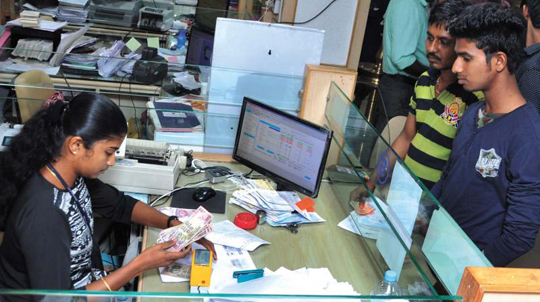
Officials said multiple teams of the Enforcement Directorate (ED) swooped early morning at over 50 branches of at least ten banks, both in the private and public sector, along with banking auditors to "scrutinise" transaction records and account statements, armed with vital inputs gathered from financial snoop agencies.

They said ED teams have launched the operations at branches located in major cities like Delhi, Mumbai, Bengaluru, Hyderabad, Kolkata, Chennai and others based on records of transaction of these branches where the maximum amount of old notes have been deposited or huge cash has been deposited in bank accounts in one go or in a staggered fashion giving rise to suspicion of suspect deposits.

Officials said the sleuths and auditors are "looking at the banking transaction records post November 8" and instructions have been issued to these teams to ensure that regular operations and customer dealings are not affected due to this.

The ED, tasked with enforcing two important laws to check financial crimes--Prevention of Money Laundering Act (PMLA) and Foreign Exchange Management Act (FEMA)--has sourced Suspicious Transaction Reports (STRs) and Cash Transaction Reports (CTRs) of the banks under scanner from various financial intelligence agencies and has launched the operation to check possible financial irregularities, instances of money laundering and hawala dealings.

The agency had recently arrested two Axis Bank employees working at a branch in Delhi while probing a similar instance under PMLA.

ED, last week, had also conducted searches at 40 locations across the country in order to check black money held with currency exchanges, hawala dealers and others.

Comments

Skazi
 - 
Wednesday, 7 Dec 2016

Why only the transactions post Nov 8 are checked .... Make a comprehensive checking of all transactions from April 1 ....
Mr 56\ CHESTWALA... Pls show your courage"

Add new comment

  • Coastaldigest.com reserves the right to delete or block any comments.
  • Coastaldigset.com is not responsible for its readers’ comments.
  • Comments that are abusive, incendiary or irrelevant are strictly prohibited.
  • Please use a genuine email ID and provide your name to avoid reject.
News Network
January 12,2020

New Delhi, Jan 12: As many as 109 children were sexually abused every day in India in 2018, according to the data by the National Crime Records Bureau, which showed a 22 per cent jump in such cases from the previous year.

According to the recently released NCRB data, 32,608 cases were reported in 2017 while 39,827 cases were reported in 2018 under the Protection of Children from Sexual Offences Act (POCSO).

POCSO Act, 2012 is a comprehensive law to provide for the protection of children from offences of sexual assault, sexual harassment and pornography. It requires special treatment of cases relating to child sexual abuse such as setting-up of special courts, special prosecutors, and support persons for child victims.

As many as 21,605 child rapes were recorded in 2018 which included 21,401 rapes of girls and 204 of boys, the data showed.

The highest number of child rapes were recorded in Maharashtra at 2,832 followed by Uttar Pradesh at 2023 and Tamil Nadu at 1457, the data showed.

Overall crimes against children has increased steeply over six times in the decade over 2008-2018, from 22,500 cases recorded in 2008 to 1,41,764 cases in 2018, according to the NCRB data from 2008 and 2018.

In 2017, 1,29,032 cases of crime against children were recorded.

Priti Mahara, Director of Policy Research and Advocacy at CRY – Child Rights and You (CRY) said, that while on the one hand, the increasing numbers of crimes against children are extremely alarming, it also suggests an increasing trend in reporting which is a positive sign as it reflects people's faith in the system.

"It also provides a direction in which government interventions must be made and evidence needs to be created. While some major efforts have been taken to ensure child protection, a lot more is needed to see expected results on the ground," Mahara said.

In percentage terms, major crime against children during 2018 were kidnapping and abduction which accounted for 44.2 per cent followed by cases under POCSO, which accounted for 34.7 per cent, the data showed.

A total of 67,134 children (19,784 male,47,191 female and 159 transgender) were reported missing in 2018. During the year 2018, a total of 71,176 children (22,239 male, 48,787 female and 150 transgender) were traced, the NCRB data said.

As many as 781 cases of use of child for pornography or storing child pornography material was also recorded in 2018, more than double that of  2017 when 331 such cases were recorded, the data showed.

The state-wise segregation of crimes against children reveals Uttar Pradesh, Madhya Pradesh, Maharashtra, Delhi and Bihar accounted for 51 per cent of all crimes in the country, the data said.

While Uttar Pradesh tops the list with 19,936 recorded crimes against children (14 per cent of total crimes), Madhya Pradesh and Maharashtra are the close second and third with 18,992 and 18,892 crimes registered respectively.

The report also showed that cases of sexual harassment in shelter homes against women and children reportedly increased by 30 per cent, from 544 cases recorded in 2017 to 707 cases in 2018.

Mahara suggested that financial investments must be adequately increased with a focus on prevention of crimes against children and the identification of vulnerable children and families.

"Strengthening community-level child protection system is also a key to prevention. While there is growing evidence of the precarious lives that children in India are leading, it is essential that this evidence is used to effectively inform policy and programme initiatives," she said.

As many as 501 incidences were also recorded under The Prohibition of Child Marriage Act, a 26 per cent jump from 2017 when 395 cases were reported under the Act.

Comments

Add new comment

  • Coastaldigest.com reserves the right to delete or block any comments.
  • Coastaldigset.com is not responsible for its readers’ comments.
  • Comments that are abusive, incendiary or irrelevant are strictly prohibited.
  • Please use a genuine email ID and provide your name to avoid reject.
Agencies
April 13,2020

With the beginning of Ramzan just about 10 days away, Maulana Khalid Rashid Firangi Mahali, the chairperson of the Islamic Centre of India and the Imam of Aishbagh Eidgah has issued an advisory to people on how to observe Ramzan during the lockdown.

In his appeal, the Sunni cleric, who is a member of the All India Muslim Personal Law Board (AIMPLB), has urged people that the holy month of Ramzan is likely to begin from April 25. The lockdown may also be extended beyond April 14.

"In this case, it is advised that people observe roza (fast) and do iftar (meal to break the fast) in the evenings at their homes. There should be no congregational prayers in the mosque but only at homes. Only those who stay or are staying at a mosque should pray there and that too while maintaining adequate social distance," said Maulana Khalid Rashid Firangi Mahali in a video message.

The cleric, in the 12-point advisory, has asked people to fast as is mandatory in Islam and to pray for the end of the pandemic, during the month of worship.

The advisory says that those who used to arrange for iftar of poor and needy persons at the mosque, should continue to do so this year as well but the food should be distributed to the needy.

"Those who conducted Iftar parties in Ramzan should give the money kept for it in charity. Not more than five people should be present at any time at a mosque," the cleric added.

Earlier for April 8 and April 9, both Shia and Sunni clerics had appealed to the people to stay indoors and pray on the occasion of Shab-e-Baraat, respectively. To ensure full compliance of the lockdown, the gates of several graveyards in the city were locked up by the caretakers since traditionally Muslims visit graves of their ancestors on Shab-e-Baraat--the night of Allah's forgiveness, to pray for their ancestors.

Comments

Add new comment

  • Coastaldigest.com reserves the right to delete or block any comments.
  • Coastaldigset.com is not responsible for its readers’ comments.
  • Comments that are abusive, incendiary or irrelevant are strictly prohibited.
  • Please use a genuine email ID and provide your name to avoid reject.
Agencies
June 7,2020

New Delhi, Jun 7: The Islamic Centre of India on Saturday issued an advisory for those visiting mosques in view of the Centre’s decision to allow reopening of religious places from June 8.

Islamic Centre of India chairman Maulana Khalid Rasheed Farangi Mahali advised people above 65 years and under 10 years of age not to visit mosques and instead offer prayers at home.

He also advised against crowding in mosques, stressing that not more than five people should be present at a time and social distancing be maintained, with the ‘namazis’ using masks and keeping a distance of six feet among themselves while offering prayers.

He added that the situation would be reviewed after 15 days and if required, another advisory would be issued.

Comments

Add new comment

  • Coastaldigest.com reserves the right to delete or block any comments.
  • Coastaldigset.com is not responsible for its readers’ comments.
  • Comments that are abusive, incendiary or irrelevant are strictly prohibited.
  • Please use a genuine email ID and provide your name to avoid reject.