


Demonetisation: ED enquiry op at 50 banks across country

December 7, 2016

New Delhi, Dec 7: Stepping up action to check financial crimes post demonetisation, the ED today launched an 'enquiry of records' operation at over 50 bank branches across the country to detect money laundering and hawala dealing instances through these channels.
Demonetisation

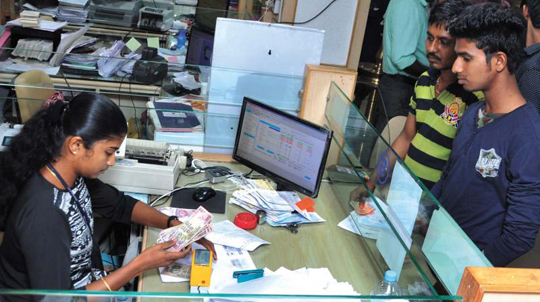
Officials said multiple teams of the Enforcement Directorate (ED) swooped early morning at over 50 branches of at least ten banks, both in the private and public sector, along with banking auditors to "scrutinise" transaction records and account statements, armed with vital inputs gathered from financial snoop agencies.

They said ED teams have launched the operations at branches located in major cities like Delhi, Mumbai, Bengaluru, Hyderabad, Kolkata, Chennai and others based on records of transaction of these branches where the maximum amount of old notes have been deposited or huge cash has been deposited in bank accounts in one go or in a staggered fashion giving rise to suspicion of suspect deposits.

Officials said the sleuths and auditors are "looking at the banking transaction records post November 8" and instructions have been issued to these teams to ensure that regular operations and customer dealings are not affected due to this.

The ED, tasked with enforcing two important laws to check financial crimes--Prevention of Money Laundering Act (PMLA) and Foreign Exchange Management Act (FEMA)--has sourced Suspicious Transaction Reports (STRs) and Cash Transaction Reports (CTRs) of the banks under scanner from various financial intelligence agencies and has launched the operation to check possible financial irregularities, instances of money laundering and hawala dealings.

The agency had recently arrested two Axis Bank employees working at a branch in Delhi while probing a similar instance under PMLA.

ED, last week, had also conducted searches at 40 locations across the country in order to check black money held with currency exchanges, hawala dealers and others.

Comments

Skazi
 - 
Wednesday, 7 Dec 2016

Why only the transactions post Nov 8 are checked .... Make a comprehensive checking of all transactions from April 1 ....
Mr 56\ CHESTWALA... Pls show your courage"

Add new comment

  • Coastaldigest.com reserves the right to delete or block any comments.
  • Coastaldigset.com is not responsible for its readers’ comments.
  • Comments that are abusive, incendiary or irrelevant are strictly prohibited.
  • Please use a genuine email ID and provide your name to avoid reject.
News Network
June 30,2020

New Delhi, Jun 30: The Home Ministry on Monday issued guidelines for 'Unlock 2.0' phase across country between July 1 and July 31. The report stated that COVID-19 lockdown shall continue to remain in force in containment zones till July 31. In containment zones, only essential activities to be allowed. The government's guidelines come on a day when Maharashtra and Tamil Nadu extended lockdowns in their respective states to July 31.

Unlock 2.0 Guidelines:

•   Schools, colleges, educational institutes wil remain closed till July 31. Online/distance learning shall continue to be permitted and shall be encouraged

•   Lockdown shall continue to remain in force in containment zones till July 31st.  In containment zones, only essential activities to be allowed.

•   Night Curfew shall continue to remain in force, between 10:00 pm and 5:00 am, except for essential activities and other relaxations.

•   Social/ political/ sports/ entertainment/ academic/ cultural/ religious functions and other large congregations remain prohibited.

•   International air travel, except as allowed by MHA, will also remain barred.

•   Shops depending upon their area, can have more than 5 persons at a time. However, they have to maintain adequate physical distance.

•   Training institutions of the central and state governments will be allowed to function with effect from July 15 and SOP in this regard will be issued by the Department of Personnel and Training.

Meanwhile, Union Home Secretary Ajay Bhalla wrote to Chief Secretaries of all states and UTs, urging them to ensure compliance of Unlock 2 guidelines and direct all concerned authorities for their strict implementation.

Comments

Add new comment

  • Coastaldigest.com reserves the right to delete or block any comments.
  • Coastaldigset.com is not responsible for its readers’ comments.
  • Comments that are abusive, incendiary or irrelevant are strictly prohibited.
  • Please use a genuine email ID and provide your name to avoid reject.
News Network
April 15,2020

New Delhi, Apr 15: With 1,076 new COVID-19 cases reported in the last 24 hours, India's tally of coronavirus cases has risen to 11,439, said the Union Ministry of Health and Family Welfare on Wednesday.

Out of the total tally, 9,756 cases are active while 1,306 patients have been cured/discharged and migrated.

With 38 new deaths reported in the last 24 hours, the death toll rises to 377.

According to the ministry, Maharashtra is the worst-affected state with 2,687 cases of which 259 patients have recovered/discharged while 178 patients have lost their lives due to the virus.

Delhi comes in at the second position with 1,561 cases of which 30 patients have recovered while 30 patients have succumbed to the virus.

Tamil Nadu is the third state with over 1,000 cases at 1,204 cases of which 81 have recovered and 12 have died due to the deadly virus.

Rajasthan is nearing the 1,000 mark with 969 cases of which 147 people have recovered while 3 patients are dead. Madhya Pradesh reported 730 cases including 51 patients recovered and 50 patients dead.

On Tuesday, in an address to the nation, Prime Minister Narendra Modi announced that the 21-day national lockdown has been extended till May 3.

Comments

Add new comment

  • Coastaldigest.com reserves the right to delete or block any comments.
  • Coastaldigset.com is not responsible for its readers’ comments.
  • Comments that are abusive, incendiary or irrelevant are strictly prohibited.
  • Please use a genuine email ID and provide your name to avoid reject.
News Network
July 18,2020

New Delhi, Jul 18: The Covid-19 lockdown-led reduction in air pollution levels across five Indian cities, including Delhi and Mumbai, may have prevented about 630 premature deaths, and saved USD 690 million in health costs in the country, according to a new study.

Scientists, including those from the University of Surrey in the UK, assessed the levels of harmful fine particulate matter (PM2.5) from vehicles and other sources in five Indian cities -- Delhi, Mumbai, Kolkata, Chennai and Hyderabad -- since the beginning of the lockdown period.

The study, published in the journal Sustainable Cities and Society, compared these lockdown PM2.5 figures from 25 March up until 11 May, with those from similar periods of the preceding five years, and found that the measure reduced pollution levels in all these places.

According to the scientists, during this period, the levels of these harmful air pollutants reduced by 10 per cent in Mumbai, and by up to 54 per cent in Delhi.

"The percentage reduction for the other cities ranged from 24 to 32 per cent, which was slightly smaller than the measured values for Delhi and Mumbai," the scientists noted in the study.

"While the reduction in PM2.5 pollution may not be surprising, the size of the reduction should make us all take notice of the impact we have been having on the planet," said Prashant Kumar, a co-author of the study from the University of Surrey.

The scientists said these reductions in PM2.5 were comparable to those reported in other cities across the world, such as in Austria's capital Vienna (60 per cent), and Shanghai (42 per cent) in China.

They also calculated the monetary value of the reduced mortality due to air pollution and found that the lowered levels of PM2.5 may have saved 630 people from premature death, and USD 690 million in health costs in India.

Coronavirus India update: State-wise total number of confirmed cases, deaths on July 17

According to the researchers, the present lockdown situation offers observational opportunities regarding potential control systems and regulations for improved urban air quality.

They said an integrated approach might help in understanding the overall impacts of Covid-19 lockdown-style interventions and support the implementation of relevant policy frameworks.

"This is an opportunity for us all to discuss and debate what the 'new normal' should look like - particularly when it comes to the quality of the air we breathe," Kumar said.

Comments

Add new comment

  • Coastaldigest.com reserves the right to delete or block any comments.
  • Coastaldigset.com is not responsible for its readers’ comments.
  • Comments that are abusive, incendiary or irrelevant are strictly prohibited.
  • Please use a genuine email ID and provide your name to avoid reject.