


Demonetisation: ED enquiry op at 50 banks across country

December 7, 2016

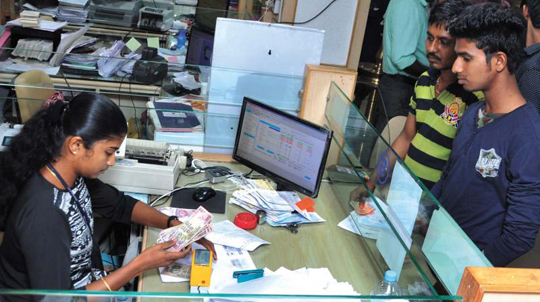
New Delhi, Dec 7: Stepping up action to check financial crimes post demonetisation, the ED today launched an 'enquiry of records' operation at over 50 bank branches across the country to detect money laundering and hawala dealing instances through these channels.
Demonetisation

Officials said multiple teams of the Enforcement Directorate (ED) swooped early morning at over 50 branches of at least ten banks, both in the private and public sector, along with banking auditors to "scrutinise" transaction records and account statements, armed with vital inputs gathered from financial snoop agencies.

They said ED teams have launched the operations at branches located in major cities like Delhi, Mumbai, Bengaluru, Hyderabad, Kolkata, Chennai and others based on records of transaction of these branches where the maximum amount of old notes have been deposited or huge cash has been deposited in bank accounts in one go or in a staggered fashion giving rise to suspicion of suspect deposits.

Officials said the sleuths and auditors are "looking at the banking transaction records post November 8" and instructions have been issued to these teams to ensure that regular operations and customer dealings are not affected due to this.

The ED, tasked with enforcing two important laws to check financial crimes--Prevention of Money Laundering Act (PMLA) and Foreign Exchange Management Act (FEMA)--has sourced Suspicious Transaction Reports (STRs) and Cash Transaction Reports (CTRs) of the banks under scanner from various financial intelligence agencies and has launched the operation to check possible financial irregularities, instances of money laundering and hawala dealings.

The agency had recently arrested two Axis Bank employees working at a branch in Delhi while probing a similar instance under PMLA.

ED, last week, had also conducted searches at 40 locations across the country in order to check black money held with currency exchanges, hawala dealers and others.

Comments

Skazi
 - 
Wednesday, 7 Dec 2016

Why only the transactions post Nov 8 are checked .... Make a comprehensive checking of all transactions from April 1 ....
Mr 56\ CHESTWALA... Pls show your courage"

Add new comment

  • Coastaldigest.com reserves the right to delete or block any comments.
  • Coastaldigset.com is not responsible for its readers’ comments.
  • Comments that are abusive, incendiary or irrelevant are strictly prohibited.
  • Please use a genuine email ID and provide your name to avoid reject.
Agencies
March 16,2020

New Delhi, Mar 16: Chief Justice of India Sharad Arvind Bobde on Monday said that rules for preventing overcrowding in the courts to avoid the spread of coronavirus cannot be relaxed for journalists alone on the basis of profession.

"Can't make an exception on the basis of profession," CJI Bobde said while asking journalists to share information and notes and suggesting that a system can be put in place to facilitate daily media briefing by Secretary-General.

Video conferencing facility being contemplated may be brought into place but not sooner than one week from now and reporters may take turns to attend hearings, CJI Bobde said.

He said that the court does not wish to prevent any reportage.

Attorney General KK Venugopal and Solicitor General Tushar Mehta informed the Chief Justice of India about the crowded corridors on account of restricted entry inside courtrooms.

CJI Bobde said that he himself wishes to assess and take stock of the situation and may do so tomorrow at 10.30 am.

This comes after the top court introduced several precautionary measures to prevent the spread of coronavirus and allowed only restricted entry of lawyers, litigants, and journalists in the courtroom.

Thermal-screening of the lawyers, litigants, and media persons were also conducted in the Supreme Court on Monday amid coronavirus fears.

Comments

Add new comment

  • Coastaldigest.com reserves the right to delete or block any comments.
  • Coastaldigset.com is not responsible for its readers’ comments.
  • Comments that are abusive, incendiary or irrelevant are strictly prohibited.
  • Please use a genuine email ID and provide your name to avoid reject.
News Network
March 2,2020

New Delhi, Mar 2: As communal violence spiked in north-east Delhi earlier this week, Hindu, Muslim and Sikh residents of a colony came together and stood guard against frenzied mobs which ran riot in nearby areas vandalising homes, shops and torching cars.

They have not let their guard down even as the situation is limping back to normalcy following four days of violence that has claimed at least 42 lives and left over 200 injured.

The B-Block colony in Yamuna Vihar has a Hindu-dominated Bahjanpura on one side and Muslim populated Ghonda on the other.

People from all faiths in the locality sit outside their homes at night and deal with any suspected outsider, Arib, a dentist in his 30s, said.

"It is the sloganeering by mobs that causes panic in the dead of night. Such slogans are from both sides and we hear groups of people moving forward towards our area.

"This is where we let the Muslim locals deal with Muslim groups and Hindu residents deal with Hindu groups coming from outside," he said.

Businessmen, doctors and people working at government offices stuck together as violence reached its crest on Monday and Tuesday, and have been guarding the locality round the clock.

Earlier, the locals had claimed inadequate police deployment in the area, but were satisfied as patrolling by security personnel increased in the last two days.

Charanjeet Singh, a Sikh who owns a transport firm, said residents have ensured that not too many people gather to guard the colony at night. It has been decided not use sticks or rods, an idea which seems to have worked in maintaining peace, he said.

"I was 10 years old when we came to this locality from Uttar Pradesh's Meerut in 1982. There were riots in 1984 and tension in 2002, but even then our area remained peaceful. We have always been united and that is the way we have helped each other," Singh, who is now in his 50s, told PTI.

Faisal, a businessman in his 30s, said after two days of major violence, there was palpable tension in the area. "Nobody could sleep in the neighbourhood even on Wednesday and Thursday when the situation was brought under control," he said.

Faisal said around 4 am on Wednesday, three to four miscreants had torched a car, but were chased away by vigilant residents. They raised an alarm and others gathered, saving other vehicles parked nearby from being damaged, he added.

On the idea of not keeping sticks while guarding B-Block, Singh said, "Violence begets violence, crowd begets crowd. We thought if somebody would see sticks or rods in our hands from a distance and large crowds standing guard, it is likely they would want to come prepared. This could fuel violence."

"Now, if there is some young man returning late in the night, we identify if he belongs to our area. If not, we normally inform him about the situation and guide him to his destination, if required," he added.

Seventy-year-old V K Sharma said people in his colony never had any trouble with each other, as he blamed "outside elements" for the violence in north-east Delhi.

"Some people have some problem with symbols. If they find a particular religion's symbol on a shop, home or a car, they vandalise it.

"This is on both sides, Hindus as well as Muslims. But not all people in all religion are like that. There are good people who outnumber these handful people involved in violence," he said.

The violence happened for two days but it would take months for fear to subside, Sharma said, as he took out his two granddaughters, aged nine and two, out for ice cream.

"I cannot reduce the tension outside my home, but at least I can make these kids feel good by reducing their craving for ice cream,” he added.

Colony resident Shiv Kumar, a property consultant, and Wasim, a government official, said they too were members of this voluntary guards' team of the colony which stays up at night to fend off miscreants.

Comments

Add new comment

  • Coastaldigest.com reserves the right to delete or block any comments.
  • Coastaldigset.com is not responsible for its readers’ comments.
  • Comments that are abusive, incendiary or irrelevant are strictly prohibited.
  • Please use a genuine email ID and provide your name to avoid reject.
Agencies
June 12,2020

New Delhi, Jun 13: Ten days after recording two lakh COVID-19 cases, India surpassed the three lakh-mark on Saturday with the worst daily spike of 11,458 infections, while the death toll too climbed to 8,884 with 386 new fatalities, the Union Health Ministry said.

India took 64 days to cross the 1 lakh-mark from 100 cases, then in another fortnight it reached the grim milestone of two lakh cases. It has now become the fourth worst-hit nation by the pandemic with a caseload of 3,08,993, according to coronavirus statistics website Worldometer.

However, the Health Ministry said on Friday the doubling time of coronavirus cases has improved to 17.4 days from 15.4 days. And its data updated at 8 am on Saturday showed active cases at 1,45,779 and those who have recovered at 1,54,329; one patient has migrated.

"Thus, around 49.9 per cent patients have recovered so far," a ministry official said.

The total number of confirmed cases include foreigners.

Of the 386 new deaths, Delhi accounted for the highest 129 fatalities followed by Maharashtra 127. The virus is moving rapidly in Delhi, which for the first time reported over 2,000 cases on Friday, and Maharashtra, where the number of cases has crossed one lakh.

Gujarat reported 30 deaths, Uttar Pradesh 20, Tamil Nadu 18, West Bengal, Telangana and Madhya Pradesh 9 each, Karnataka and Rajasthan 7 each, Haryana and Uttarakhand 6 each, Punjab 4, Assam 2, Kerala, Jammu and Kashmir and Odisha 1 each.

Of the total 8,884 deaths, Maharashtra tops the tally with 3,717 fatalities followed by Gujarat with 1,415, Delhi with 1,214, West Bengal with 451, Madhya Pradesh with 440, Tamil Nadu with 367, Uttar Pradesh with 365, Rajasthan with 272 and Telangana with 174 deaths.

The death toll reached 80 in Andhra Pradesh, 79 in Karnataka, 70 in Haryana and 63 in Punjab. Jammu and Kashmir has reported 53 COVID-19 fatalities, Bihar 36 and Uttarakhand 21, Kerala 19, Odisha 10 and Jharkhand and Assam 8 each.

Chhattisgarh and Himachal Pradesh have registered 6 deaths each, Chandigarh 5, Puducherry 2, while Meghalaya, Tripura and Ladakh 1 each, according to the health ministry.

Maharashtra has reported the maximum number of cases at 1,01,141 followed by Tamil Nadu (40,698), Delhi (36,824), Gujarat (22,527), Uttar Pradesh (12,616), Rajasthan (12,068) and Madhya Pradesh (10,443).

The number of COVID-19 cases has gone up to 10,244 in West Bengal, 6,516 in Karnataka, 6,334 in Haryana and 6,103 in Bihar. It has risen to 5,680 in Andhra Pradesh, 4,730 in Jammu and Kashmir, 4,484 in Telangana and 3,498 in Odisha and Assam each.

Punjab has reported 2,986 cases while Kerala has 2,322 cases.

A total of 1,724 people have been infected by the virus in Uttarakhand, 1,617 in Jharkhand, 1,424 in Chhattisgarh, 961 in Tripura, 486 in Himachal Pradesh, 463 in Goa, 385 from Manipur and 334 in Chandigarh.

Ladakh has registered 239 COVID-19 cases, Puducherry 157, Nagaland 156, Mizoram 104, Arunachal Pradesh 67, Sikkim 63, Meghalaya 44 while Andaman and Nicobar Islands has registered 38 cases.

Dadar and Nagar Haveli and Daman and Diu together have reported 30 cases.

The ministry said 7,984 cases are being reassigned to states and "our figures are being reconciled with the ICMR". State-wise distribution is subject to further verification and reconciliation, it added.

Comments

Add new comment

  • Coastaldigest.com reserves the right to delete or block any comments.
  • Coastaldigset.com is not responsible for its readers’ comments.
  • Comments that are abusive, incendiary or irrelevant are strictly prohibited.
  • Please use a genuine email ID and provide your name to avoid reject.