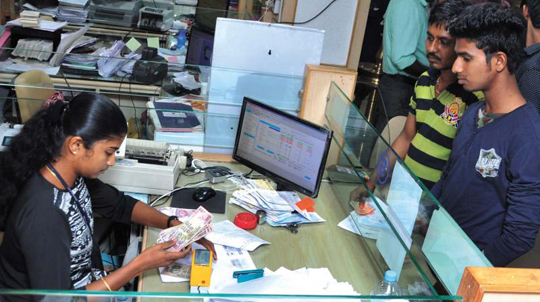
Demonetisation: ED enquiry op at 50 banks across country

December 7, 2016

New Delhi, Dec 7: Stepping up action to check financial crimes post demonetisation, the ED today launched an 'enquiry of records' operation at over 50 bank branches across the country to detect money laundering and hawala dealing instances through these channels.

Demonetisation

Officials said multiple teams of the Enforcement Directorate (ED) swooped early morning at over 50 branches of at least ten banks, both in the private and public sector, along with banking auditors to "scrutinise" transaction records and account statements, armed with vital inputs gathered from financial snoop agencies.

They said ED teams have launched the operations at branches located in major cities like Delhi, Mumbai, Bengaluru, Hyderabad, Kolkata, Chennai and others based on records of transaction of these branches where the maximum amount of old notes have been deposited or huge cash has been deposited in bank accounts in one go or in a staggered fashion giving rise to suspicion of suspect deposits.

Officials said the sleuths and auditors are "looking at the banking transaction records post November 8" and instructions have been issued to these teams to ensure that regular operations and customer dealings are not affected due to this.

The ED, tasked with enforcing two important laws to check financial crimes--Prevention of Money Laundering Act (PMLA) and Foreign Exchange Management Act (FEMA)--has sourced Suspicious Transaction Reports (STRs) and Cash Transaction Reports (CTRs) of the banks under scanner from various financial intelligence agencies and has launched the operation to check possible financial irregularities, instances of money laundering and hawala dealings.

The agency had recently arrested two Axis Bank employees working at a branch in Delhi while probing a similar instance under PMLA.

ED, last week, had also conducted searches at 40 locations across the country in order to check black money held with currency exchanges, hawala dealers and others.

Comments

Skazi
 - 
Wednesday, 7 Dec 2016

Why only the transactions post Nov 8 are checked .... Make a comprehensive checking of all transactions from April 1 ....
Mr 56\ CHESTWALA... Pls show your courage"

Add new comment

  • Coastaldigest.com reserves the right to delete or block any comments.
  • Coastaldigset.com is not responsible for its readers’ comments.
  • Comments that are abusive, incendiary or irrelevant are strictly prohibited.
  • Please use a genuine email ID and provide your name to avoid reject.
Agencies
March 6,2020

Thiruvananthapuram, Mar 6: A 12-member team from Telangana on Friday visited Kerala to study how the state contained the spread of novel coronavirus.

Interacting with the team, Kerala Health Minister KK Shailaja said, "The team will be given a presentation at National Health Mission and they will visit Alappuzha district to know how the health facilities are set up by Kerala Health Department on the grassroots level."

"The team comprising doctors and senior health officials will visit the control room set up by the Health Department and also will attend daily review meetings. They will also visit an isolation ward in the hospital and interact with doctors and nurses, " the minister said.

She added, "Kerala model is being followed by other states too. All states are working together and the country as a whole is fighting the coronavirus. They are sharing our experience. All of India is standing together. Contact tracing and isolation is the most important part."

Dr Mahaboob Khan, part of the Telangana team told media persons, that the discussion with the health minister was fruitful.

"Kerala was the first state in India where a positive coronavirus case was reported. All three positive cases reported have been discharged after testing negative. So we wanted to study how Kerala was able to contain it and the health system in place here, " he said.

Comments

Add new comment

  • Coastaldigest.com reserves the right to delete or block any comments.
  • Coastaldigset.com is not responsible for its readers’ comments.
  • Comments that are abusive, incendiary or irrelevant are strictly prohibited.
  • Please use a genuine email ID and provide your name to avoid reject.
News Network
June 27,2020

Jun 27: Alittle-known Indian IT firm offered its hacking services to help clients spy on more than 10,000 email accounts over a period of seven years.

New Delhi-based BellTroX InfoTech Services targeted government officials in Europe, gambling tycoons in the Bahamas, and well-known investors in the United States including private equity giant KKR and short seller Muddy Waters, according to three former employees, outside researchers, and a trail of online evidence.

Aspects of BellTroX's hacking spree aimed at American targets are currently under investigation by U.S. law enforcement, five people familiar with the matter told Reuters. The U.S. Department of Justice declined to comment.

Reuters does not know the identity of BellTroX's clients. In a telephone interview, the company's owner, Sumit Gupta, declined to disclose who had hired him and denied any wrongdoing.

Muddy Waters founder Carson Block said he was "disappointed, but not surprised, to learn that we were likely targeted for hacking by a client of BellTroX." KKR declined to comment.

Researchers at internet watchdog group Citizen Lab, who spent more than two years mapping out the infrastructure used by the hackers, released a report that BellTroX employees were behind the espionage campaign.

"This is one of the largest spy-for-hire operations ever exposed," said Citizen Lab researcher John Scott-Railton.

Although they receive a fraction of the attention devoted to state-sponsored espionage groups or headline-grabbing heists, "cyber mercenary" services are widely used, he said. "Our investigation found that no sector is immune."

A cache of data reviewed by Reuters provides insight into the operation, detailing tens of thousands of malicious messages designed to trick victims into giving up their passwords that were sent by BellTroX between 2013 and 2020. The data was supplied on condition of anonymity by online service providers used by the hackers after Reuters alerted the firms to unusual patterns of activity on their platforms.

The data is effectively a digital hit list showing who was targeted and when. Reuters validated the data by checking it against emails received by the targets.

On the list: judges in South Africa, politicians in Mexico, lawyers in France and environmental groups in the United States. These dozens of people, among the thousands targeted by BellTroX, did not respond to messages or declined comment.

Reuters was not able to establish how many of the hacking attempts were successful.

BellTroX's Gupta was charged in a 2015 hacking case in which two U.S. private investigators admitted to paying him to hack the accounts of marketing executives. Gupta was declared a fugitive in 2017, although the U.S. Justice Department declined to comment on the current status of the case or whether an extradition request had been issued.

Speaking by phone from his home in New Delhi, Gupta denied hacking and said he had never been contacted by law enforcement. He said he had only ever helped private investigators download messages from email inboxes after they provided him with login details.

"I didn't help them access anything, I just helped them with downloading the mails and they provided me all the details," he told Reuters. "I am not aware how they got these details but I was just helping them with the technical support."

Reuters could not determine why the private investigators might need Gupta to download emails. Gupta did not return follow-up messages. Spokesmen for Delhi police and India's foreign ministry did not respond to requests for comment.

HOROSCOPES AND PORNOGRAPHY

Operating from a small room above a shuttered tea stall in a west-Delhi retail complex, BellTroX bombarded its targets with tens of thousands of malicious emails, according to the data reviewed by Reuters. Some messages would imitate colleagues or relatives; others posed as Facebook login requests or graphic notifications to unsubscribe from pornography websites.

Fahmi Quadir's New York-based short selling firm Safkhet Capital was among 17 investment companies targeted by BellTroX between 2017 and 2019. She said she noticed a surge in suspicious emails in early 2018, shortly after she launched her fund.

Initially "it didn't seem necessarily malicious," Quadir said. "It was just horoscopes; then it escalated to pornography."

Eventually the hackers upped their game, sending her credible-sounding messages that looked like they came from her coworkers, other short sellers or members of her family. "They were even trying to emulate my sister," Quadir said, adding that she believes the attacks were unsuccessful.

U.S. advocacy groups were also repeatedly targeted. Among them were digital rights organizations Free Press and Fight for the Future, both of whom have lobbied for net neutrality. The groups said a small number of employee accounts were compromised, but the wider organizations' networks were untouched. The spying on those groups was detailed in a report by the Electronic Frontier Foundation in 2017, but has not been publicly tied to BellTroX until now.

Timothy Karr, a director at Free Press, said his organization "sees an uptick in breach attempts whenever we're engaged in heated and high-profile public policy debates." Evan Greer, deputy director of Fight for the Future, said: "When corporations and politicians can hire digital mercenaries to target civil society advocates, it undermines our democratic process."

While Reuters was not able to establish who hired BellTroX to carry out the hacking, two former employees said the company and others like it were usually contracted by private investigators on behalf of business rivals or political opponents.

Bart Santos of San Diego-based Bulldog Investigations was one of a dozen private detectives in the United States and Europe who told Reuters they had received unsolicited advertisements for hacking services out of India - including one from a person who described himself as a former BellTroX employee. The pitch offered to carry out "data penetration" and "email penetration."

Santos said he ignored those overtures, but could understand why some people didn't. "The Indian guys have a reputation for customer service," he said.


Comments

Add new comment

  • Coastaldigest.com reserves the right to delete or block any comments.
  • Coastaldigset.com is not responsible for its readers’ comments.
  • Comments that are abusive, incendiary or irrelevant are strictly prohibited.
  • Please use a genuine email ID and provide your name to avoid reject.
Agencies
June 22,2020

Mumbai, Jun 22: After downgrading India's outlook to negative from stable, Fitch Ratings on Monday revised the outlook on nine Indian banks to negative.

The outlook on the Long-Term Issuer Default Ratings (IDR) was revised to negative from stable due to the banks' high dependence on the Centre to re-capitalise them.

Accordingly, the IDR outlook of the Export-Import Bank of India, the State Bank of India, the Bank of Baroda, the Bank of Baroda (New Zealand), the Bank of India, the Canara Bank, the Punjab National Bank, ICICI Bank and Axis Bank Ltd have been downgraded to negative.

"At the same time, Fitch has affirmed IDBI Bank Limited's (IDBI) IDR while maintaining the outlook at negative," Fitch said in a statement.

The rating actions follow Fitch's revision of the outlook on the 'BBB-' rating on India to negative from stable on June 18, due to the impact of the escalating coronavirus pandemic on India's economy.

"The IDRs for all the above Indian banks are support-driven and anchored to their respective SRFs," the statement said.

"They are based on Fitch's assessment of high to moderate probability of extraordinary state support for these banks, which takes into account our assessment of the sovereign's ability and propensity to provide extraordinary support."

According to the statement, the negative outlook on India's sovereign rating reflects an increasing strain on the state's ability to provide extraordinary support, due to the sovereign's limited fiscal space and the significant deterioration in fiscal metrics due to challenges from the COVID-19 pandemic.

"The rating action does not affect the banks' Viability Rating (VR). EXIM does not have a VR as its role as a policy bank makes an assessment of its standalone credit profile less meaningful."

Comments

Add new comment

  • Coastaldigest.com reserves the right to delete or block any comments.
  • Coastaldigset.com is not responsible for its readers’ comments.
  • Comments that are abusive, incendiary or irrelevant are strictly prohibited.
  • Please use a genuine email ID and provide your name to avoid reject.