Demonetisation: ED enquiry op at 50 banks across country

December 7, 2016

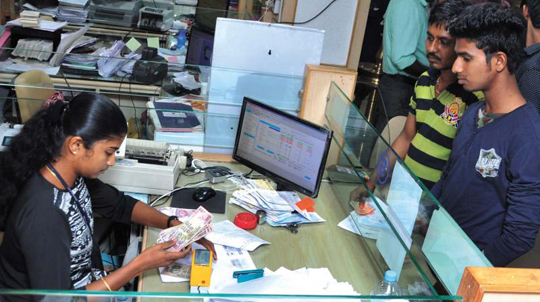
New Delhi, Dec 7: Stepping up action to check financial crimes post demonetisation, the ED today launched an 'enquiry of records' operation at over 50 bank branches across the country to detect money laundering and hawala dealing instances through these channels.

Demonetisation

Officials said multiple teams of the Enforcement Directorate (ED) swooped early morning at over 50 branches of at least ten banks, both in the private and public sector, along with banking auditors to "scrutinise" transaction records and account statements, armed with vital inputs gathered from financial snoop agencies.

They said ED teams have launched the operations at branches located in major cities like Delhi, Mumbai, Bengaluru, Hyderabad, Kolkata, Chennai and others based on records of transaction of these branches where the maximum amount of old notes have been deposited or huge cash has been deposited in bank accounts in one go or in a staggered fashion giving rise to suspicion of suspect deposits.

Officials said the sleuths and auditors are "looking at the banking transaction records post November 8" and instructions have been issued to these teams to ensure that regular operations and customer dealings are not affected due to this.

The ED, tasked with enforcing two important laws to check financial crimes--Prevention of Money Laundering Act (PMLA) and Foreign Exchange Management Act (FEMA)--has sourced Suspicious Transaction Reports (STRs) and Cash Transaction Reports (CTRs) of the banks under scanner from various financial intelligence agencies and has launched the operation to check possible financial irregularities, instances of money laundering and hawala dealings.

The agency had recently arrested two Axis Bank employees working at a branch in Delhi while probing a similar instance under PMLA.

ED, last week, had also conducted searches at 40 locations across the country in order to check black money held with currency exchanges, hawala dealers and others.

Comments

Skazi
 - 
Wednesday, 7 Dec 2016

Why only the transactions post Nov 8 are checked .... Make a comprehensive checking of all transactions from April 1 ....
Mr 56\ CHESTWALA... Pls show your courage"

Add new comment

  • Coastaldigest.com reserves the right to delete or block any comments.
  • Coastaldigset.com is not responsible for its readers’ comments.
  • Comments that are abusive, incendiary or irrelevant are strictly prohibited.
  • Please use a genuine email ID and provide your name to avoid reject.
News Network
April 21,2020

New Delhi, Apr 21: The historic rout in oil markets that sent US crude prices plummeting to as much as minus USD 40 a barrel is unlikely to translate into any big reduction in petrol and diesel prices in India as domestic pricing is based on different benchmark, and refineries are already filled up to brim and cannot buy US crude just yet.

With storage capacity already overflowing amid coronavirus-induced demand collapse, traders rushed to to get rid of unwanted stocks triggering the collapse of US West Texas Intermediate (WTI) crude for May delivery.

Indian Oil Corp (IOC) Chairman Sanjiv Singh said the collapse was triggered by traders unable to take deliveries of crude they had previously booked because of a demand collapse. And so they paid the seller to keep oil in their storage.

"If you look at June futures, it is trading in positive territory... around USD 20 per barrel," he said.

Low oil prices may seem good in short-term but in the long run it will hurt the oil economy as producers will have no surplus to invest in exploration and production which will lead to a drop in production, he said.

He did not comment on retail fuel prices that have been static since March 16.

Oil companies have not changed rates despite a fall in international prices as they first adjusted them against the increase that was warranted from a Rs 3 per litre hike in excise duty and close to Re 1 per litre additional cost of switching over to cleaner BS-VI grade fuel from April 1.

Petrol in Delhi is priced at Rs 69.59 a litre and diesel comes for Rs 62.29 per litre.

"The negative price has no direct impact on India or Indian oil prices, as this has taken place due to crude oil produced and traded within the US. India's prices are driven partly by another benchmark, the Brent, which is still trading at USD 25/barrel. Therefore, the retail price of fuels in India are unlikely to fall," said Amit Bhandari, Fellow, Energy and Environment Studies, Gateway House.

Also, Indian refineries are already overflowing as fuel demand has evaporated due to the unprecedented nationwide lockdown imposed to curb spread of COVID-19. So, they can't rush to buy US crude.

The refineries have already cut operating rate to half because the fuel they produce has not been sold yet.

India imports 4 million barrels/day (1.4 billion barrels/year) of oil. The country has been benefitting from the falling prices of oil for the last five years, when oil dropped from a peak of USD 110/barrel to USD 50-60/barrel last year, enabling India to invest in public service programmes.

"However, the additional USD 30 fall of this week is good for India - but there is also a downside. If oil prices are too low, the economies of oil-rich gulf countries will be hurt, threatening the job prospects of the 8 million Indians working in the Gulf countries. India is the largest recipient of foreign remittances due to these workers – very low oil prices will hurt this cash stream," Bhandari said.

He said the negative price of oil shows how much oil oversupply exists in international markets today. "Global oil consumption has fallen due to the COVID-19 pandemic that traders are willing to pay customers to get rid of the barrels they can't store. The world does not have enough storage capacity, and dumping the oil is an environmental crime."

The first half of April saw Brent crude oil prices plummet 63.6 per cent to USD 26.9 per barrel. Prices of Western Texas Intermediate (WTI), the American oil, had also fallen similarly by 63.1 per cent.

But on April 20, WTI prices turned rapidly negative because traders on the Nymex exchange rushed to offload their May futures positions a day before expiry of contracts (on April 21).

Such WTI futures are traded on the Nymex exchange with contracts settled in physical crude oil. Problem is, those who had gone long are unable to find storage facilities for the oil and had to liquidate their contracts before expiry. This caused the plunge in WTI prices.

Contrast to this, June WTI Nymex futures prices is hovering around USD 21, while Brent for June delivery is at USD 25.

Miren Lodha, Director, CRISIL Research said the demand for crude oil was declining already because of economic slowdown when the COVID-19 pandemic-driven lockdowns crushed it further.

Consequently, oil demand is expected to contract by 8-10 million barrels per day (mbpd) in 2020 assuming demand recovery begins from the third quarter of the year, he said, adding if recovery doesn't happen by then, further demand destruction could occur.

On the supply side, producers reining in output following a strategic deal between OPEC members, Russia and the US.

Under this agreement, OPEC+ would reduce oil production by 9.7 mbpd for May and June, but gradually ease the curb to 7.7 mbpd between July and December 2020, and to 5.8 mbpd till April 2022 to stabilise prices.

"This is expected to reduce some surplus in the market by the end of 2020," Lodha said.

Crude oil demand is expected to decline by over 20 mbpd in April alone. Typically, monthly global demand is about 100 mbpd. Given this scenario, supply curbs would have limited influence.

Consequently, Brent oil prices is expected to be in the USD 25-30 range for the second quarter while increasing marginally in the last 2 quarters of 2020.

"The gigantic inventory build-ups and lack of storage facilities would also put pressure on prices," he said, adding overall Brent could average USD 30-35 in 2020, with a strong downward bias.


Comments

Add new comment

  • Coastaldigest.com reserves the right to delete or block any comments.
  • Coastaldigset.com is not responsible for its readers’ comments.
  • Comments that are abusive, incendiary or irrelevant are strictly prohibited.
  • Please use a genuine email ID and provide your name to avoid reject.
News Network
February 28,2020

Feb 28: Life was limping back to normalcy in some parts of the riot-hit northeast Delhi, with police and paramilitary personnel maintaining strict vigil in view of Friday prayers at mosques.

Police officers said they were also making extra efforts to quell rumours, and holding regular flag marches and interactions in the neighbourhoods of affected areas as confidence-building measures.

In some areas of northeast Delhi, signs of normal life were witnessed with opening of shops. In violence-hit areas also, shops in streets and bylanes were open.

Nearly 7,000 paramilitary forces have been deployed in the affected areas of the northeast district since Monday. Besides, hundreds of Delhi police personnel are on the ground to maintain peace and prevent any untoward incident.

At least 38 were killed and over 200 injured in the communal clashes that broke out in northeast Delhi on Monday after violence between citizenship law supporters and protesters spiralled out of control The areas affected include Jaffrabad, Maujpur, Chand Bagh, Khureji Khas and Bhajanpura..

The Union Home Ministry had said on Thursday night that no major incident was reported from the northeast district in the past 36 hours, It had said that prohibitory orders imposed under Section 144 would be relaxed for 10 hours in view of improvement in the situation.

Comments

Add new comment

  • Coastaldigest.com reserves the right to delete or block any comments.
  • Coastaldigset.com is not responsible for its readers’ comments.
  • Comments that are abusive, incendiary or irrelevant are strictly prohibited.
  • Please use a genuine email ID and provide your name to avoid reject.
News Network
March 4,2020

New Delhi, Mar 4: The Supreme Court on Wednesday revoked the ban of cryptocurrency imposed by the Reserve Bank of India (RBI) in 2018.

Pronouncing the verdict, the three-judge bench of the apex court said the ban was 'disproportionate'.

The bench included Justice Rohinton Fali Nariman, Justice S Ravindra Bhat and Justice V Ramasubramanian.

The Internet and Mobile Association of India (IAMAI), whose members include cryptocurrency exchanges, and others had approached the top court objecting to a 2018 RBI circular directing regulated entities to not deal with cryptocurrencies.

Advocate Ashim Sood, appearing for IAMI, submitted that Reserve Bank of India lacked jurisdiction to forbid dealings in cryptocurrencies. The blanket ban was based on an erroneous understanding that it was impossible to regulate cryptocurrencies, Sood submitted.

The petitioners had argued that the RBI's circular taking cryptocurrencies out of the banking channels would deplete the ability of law enforcement agencies to regulate illegal activities in the industry.

IAMAI had claimed the move of RBI had effectively banned legitimate business activity via the virtual currencies (VCs).

The RBI on April 6, 2018, had issued the circular that barred RBI-regulated entities from "providing any service in relation to virtual currencies, including those of transfer or receipt of money in accounts relating to the purchase or sale of virtual currencies".

Comments

Add new comment

  • Coastaldigest.com reserves the right to delete or block any comments.
  • Coastaldigset.com is not responsible for its readers’ comments.
  • Comments that are abusive, incendiary or irrelevant are strictly prohibited.
  • Please use a genuine email ID and provide your name to avoid reject.