


Demonetisation is organised loot, legalised plunder: Manmohan Singh

November 24, 2016

New Delhi, Nov 24: Stepping up the opposition tirade against demonetisation, former Prime Minister Manmohan Singh today castigated the government and the Prime Minister over the move, saying its implementation was a "monumental management failure" and a case of "organised loot and legalised plunder."manmhn
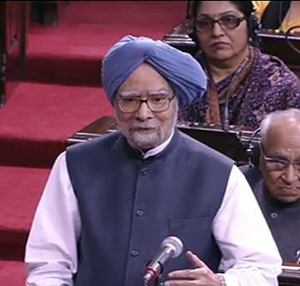
Singh, who spoke in the presence of Prime Minister Narendra Modi in Rajya Sabha, said the decision will result in decline of GDP by 2 per cent, it being an "under-estimate".

He hoped the Prime Minister will find a practical and pragmatic decision to mitigate the sufferings of the common man and the poor who have been in distress after the decision.

He said agriculture, unorganised sectors and small industry has also been hit hard by it and people were losing faith in the currency and banking system.

"These measures convinced me that the way the scheme has been implemented, it's a monumental management failure. And in fact, it is a case of organised loot and legalised plunder.

"It is not my intention to pick holes what this side or other side does. But I sincerely hope that the PM even in this late hour will help find us practical and pragmatic ways to provide relief to the suffering of the people of this country," he said in Rajya Sabha as the debate on the issue resumed after Modi came into the House.

Earlier, Leader of Opposition Ghulam Nabi Azad requested Chairman Hamid Ansari and Leader of the House Arun Jaitley that the Question Hour should not be taken up as the Prime Minister was present in the House and the debate be taken up.

Azad's request was readily accepted by the government with Jaitley saying that the debate should start immediately and Modi will certainly participate in it.

Participating in the resumed debate, Singh said it is important to take note of the grievances of the ordinary people who have suffered as a result of this imposition on the country "overnight" by the Prime Minister.

"My own feeling is that the national income, that is the GDP of the country, can decline by about 2 percentage points as a result of what has been done. This is an under-estimate and not an over-estimate.

"Therefore, I feel the Prime Minister must come with some constructive proposal on how we can implement the scheme and at the same time prevent the distrust that has been caused to the common people," Singh said.

The former Prime Minister did not agree with the Prime Minister's plea to wait for 50 days for the results of demonetisation to come about, saying no one knows about the final outcome of the decision.

"Well 50 days is a short period, but for those who are poor and deprived sections of the community even 50 days of torture can bring about disastrous effect. And that's why about 60 to 65 people have lost their lives. Maybe more.

"What is more is, what has been done can weaken and erode our people's confidence in the currency system and in the banking system," he said.

Asking Modi to spell out the names of countries where people have deposited their money in banks but are not allowed to withdraw their money, he said, "this alone I think is enough to condemn what has been done in the name of greater growth."

He said the scheme of demonetisation, the way it is being implemented, will hurt agricultural growth in our country, small industry and all those people who work in the informal sectors of the economy.

Singh, an eminent economist, criticised the government for issuing fresh instructions and modifying the rules every day on the conditions under which people can withdraw their money.

"That reflects very poorly on the Prime Minister's Office, the Finance Minister's office and on the Reserve Bank of India. I am very sorry that the Reserve Bank has been exposed to this kind of criticism which I think is fully justified," the former Prime Minister said.

He said though he agreed with the objectives of the scheme to demonetise currency notes of Rs 500 and Rs 1000 as spelt out by the Prime Minister, he wished to highlight the problems that the common people and poor have been subjected to by the move.

"But I do want to point out at least that in the process of demonetisation monumental mismanagement has been undertaken about which today there is no two opinions in the country as a whole," he said.

Referring to those saying that the move which was doing harm and creating distrust in the short run was good in the long run, Singh quoted John Maynard Keynes to say that "in the long run, all of us are dead".

"I urge upon the Prime Minister to find practical, pragmatic ways and measures to relieve the distress of the people, who happen to be a great majority of our people. After all 90 per cent of our people were in the informal sector, 55 per cent of our workers in agriculture are feeling distress," he said.

He also noted that the cooperative banking system which served large number of people in rural areas was non-functional and has been prevented from handling cash.

The senior Congress leader said though it is not his intention to pick holes in what this side or other side does, but hoped that the Prime Minister "even in this late hour will help find us practical and pragmatic ways to provide relief to the suffering of the people of this country".

Comments

Wonder Kotian
 - 
Thursday, 24 Nov 2016

Our Great Iron Man said correct, But he is trying \Dog's tail putting inside pipe\" but after removing same situation, Hindustan totally destroying already most of the business, Trading, Industry's totally loss point."

Add new comment

  • Coastaldigest.com reserves the right to delete or block any comments.
  • Coastaldigset.com is not responsible for its readers’ comments.
  • Comments that are abusive, incendiary or irrelevant are strictly prohibited.
  • Please use a genuine email ID and provide your name to avoid reject.
News Network
February 11,2020

Belagavi, Feb 11: Tension prevailed for sometime here after a few villagers spotted four country-made pistols disposed in the garbage site by the road between Markandey Nagar – Waghavade village on Sunday. Police rushed to the spot and seized the arms which are believed to be of Portugal era.

Sources said some villagers noticed a pistol lying along with heaps of refuse. They informed Bhavakanna Patil, the owner of the agricultural field adjacent to the garbage site. Patil and the villagers checked the garbage and found three more pistols totalling four.

Police said the pistols are about 50 to 60 years old. Going by their condition, all rusted, it is believed that they were left unused for a long time. The Belagavi rural police who have filed a suo motu case related to the incident are getting into the skin of case to trace the owners and those who disposed them in the garbage pit. 

According to preliminary investigation, it is learnt that such pistols were in vogue during Portugal rule in Goa. There are chances that those who inherited the arms may have disposed it for the fear of possessing weapon illegally. The chances of some notorious people who reside in the vicinity near Waghavade and surrounding areas, where burglaries and dacoity are frequently reported, disposing the arms due to the fear of police also cannot be ignored. Police Commissioner Lokesh Kumar was not available for comments.

Comments

Add new comment

  • Coastaldigest.com reserves the right to delete or block any comments.
  • Coastaldigset.com is not responsible for its readers’ comments.
  • Comments that are abusive, incendiary or irrelevant are strictly prohibited.
  • Please use a genuine email ID and provide your name to avoid reject.
News Network
April 21,2020

Global oil markets remained under intense pressure on Tuesday, with Brent crude dropping below $20 per barrel for the first time in 18 years while other major benchmarks across the world tumbled. 

Brent, the international crude marker, slipped to $18.10, indicating that markets see no immediate let-up to the collapse in oil demand that sent some US oil benchmarks plunging under $0 for the first time on Monday, leaving producers paying for buyers to take their oil away while available storage is scarce.

Coronavirus has sent the oil sector into a state of crisis, with lockdowns implemented by authorities to smother the outbreak slashing demand for crude by as much as a third.

Contracts for the US benchmark West Texas Intermediate for delivery next month tumbled as low as minus $40 a barrel on Monday. Analysts at Citi warned that “if global storage worsens more quickly, Brent could chase WTI down to the bottom”.

The collapse in the May WTI contract was partly a technical product of the fact that it expires on Tuesday, meaning trading volumes were low and making the contract for June delivery more noteworthy, analysts said. That contract held above $20 a barrel on Monday but slid as much as 42 per cent on Tuesday to trade at lows of $11.79, suggesting the blowout in the May contract was more than a blip and that the entire global oil market faced challenges.

Goldman Sachs analysts said the June contact was likely to face downward pressure in the coming weeks, pointing to the “still unresolved market surplus”.

“As storage becomes saturated, price volatility will remain exceptionally high in coming weeks,” they said. “But with ultimately a finite amount of storage left to fill, production will soon need to fall sizeably to bring the market into balance, finally setting the stage for higher prices once demand gradually recovers.”

Warren Patterson, head of commodities strategy at ING, said it was likely that “storage this time next month will be even more of an issue, given the surplus environment”.

“And so in the absence of a meaningful demand recovery, negative prices could return for June,” he added.

European equities traded lower, partly dragged down by weaker energy stocks. The continent-wide Stoxx 600 was down 1.9 per cent, with its oil and gas sub-index dropping 3.3 per cent. In London the FTSE shed 1.7 per cent, while Frankfurt’s Dax slid 2.3 per cent. 

Equities were also broadly lower in Asia, with futures tipping US stocks to fall 1 per cent when trading in New York begins later.

On Wall Street overnight, the S&P 500 closed down 1.8 per cent, partly because of weakness in energy shares, but also due to increased pessimism over the time it will take for countries to emerge from lockdowns.

In fixed income, the yield on the 10-year US Treasury fell 0.03 percentage points to 0.585 per cent as investors retreated to the safety of the debt.

Comments

Add new comment

  • Coastaldigest.com reserves the right to delete or block any comments.
  • Coastaldigset.com is not responsible for its readers’ comments.
  • Comments that are abusive, incendiary or irrelevant are strictly prohibited.
  • Please use a genuine email ID and provide your name to avoid reject.
News Network
April 19,2020

Kasaragod, Apr 19: Kasaragod, Kerala's COVID-19 hotspot, is the only district in the southern state lacking adequate health infrastructure.

In spite of treating the highest number of COVID-19 patients in the state with meagre infrastructural facilities and even without the support of a medical college in the north Kerala district, no deaths have been reported due to coronavirus.

The state health department views the performance of M Kunhiraman and his team, consisting of Janardhana Naik and Krishna Naik, at the General hospital in Kasaragod as a success story.

"Not only did they control the situation quickly with minimum infrastructure, they also started turning out a large number of negative cases within a few weeks and creditably ensured zero mortality.

This can be showcased as a best global model," Chairman of the Information Education and Communication (IEC) Committee and Project Director Kerala State Aids Control Society, R Ramesh said.

Recalling the ordeal, Janardhana Naik said his first major challenge was the physical examination of a patient with suspected COVID-19.

"Even with the PPE kit, nobody knew how effective they were and it took a whole 30 minutes to wear them properly.

But as time passed, we got accustomed to it," he said.

The traditional method of dealing with a patient involved knowing his or her history, observation and physical examination.

For hundreds of years, the hands-on body approach has been the soul of the doctor-patient relationship -- taking the pulse, tapping on and listening to the chest, feeling lumps.

With the onset of COVID-19 all that has changed.

"In fact, the whole exercise was fraught with grave risks because everything connected with COVID-19 was new.

Doctors have to keep a distance even though the physical examination wearing a Personal Protective Equipment (PPE) is difficult.

Sounds from the body are inaudible, vision is blurred through the smog-covered goggles and a stethoscope seldom has any use," Janardhana Naik said.

It was from March 15 that the hospital started receiving COVID-19 patients, primarily from Dubai.

By the time the first person came, the hospital was ready for him.

Soon, patient numbers began to swell and in a couple of weeks they reached about 91.

From then on, it was teamwork.

Committees were formed for each and every task, including the help desk, IT, treatment, medical board, training, food, waste disposal and data maintenance.

Initially, patients had many misgivings about the hospital.

"Some were disillusioned and even aggressive. Some were not happy with the facilities the hospital had to offer.

But gradually through good treatment and counselling by a psychiatrist, who visited the hospital on alternate days, the confidence and mood of the patients changed and they became friendly with the staff," Naik elaborated.

Counselling was also given to the concerned family members of the patients.

Besides treatment, the medical staff had to spend a considerable amount of time clearing the doubts of patients.

When they got discharged some patients insisted on seeing the faces of the medical staff, who till then were anonymous entities covered from head to toe.

Some even wanted to take selfies with them.

However, the medical team politely turned down their requests and preferred to remain hidden in their work attires.

The mood of the patients also rubbed off on the doctors and hospital staff.

All the physicians and hospital staff are now more confident of dealing with contagious diseases after treating COVID-19 patients.

"Our previous experience of treating H1N1, Chikungunya and Dengue cases helped us a lot.

Words of encouragement from the Health Minister K K Shailaja, Health Principal Secretary Dr Rajan N Khobragade and Health Services Director Dr Sarita R L gave us the impetus to build up confidence.

Moreover, the field health workers did a wonderful job in containing the viral spread," Naik added.

As the number of coronavirus cases rose, the state government on April 5 deputed a 26-member medical team from Thiruvananthapuram to set up a COVID-19 hospital in the district.

They turned a block of the under construction Government Medical College as a hospital-like facility, setting up a 200 bed facility to treat coronavirus patients.

Comments

Add new comment

  • Coastaldigest.com reserves the right to delete or block any comments.
  • Coastaldigset.com is not responsible for its readers’ comments.
  • Comments that are abusive, incendiary or irrelevant are strictly prohibited.
  • Please use a genuine email ID and provide your name to avoid reject.