


Demonetisation is organised loot, legalised plunder: Manmohan Singh

November 24, 2016

New Delhi, Nov 24: Stepping up the opposition tirade against demonetisation, former Prime Minister Manmohan Singh today castigated the government and the Prime Minister over the move, saying its implementation was a "monumental management failure" and a case of "organised loot and legalised plunder."manmhn
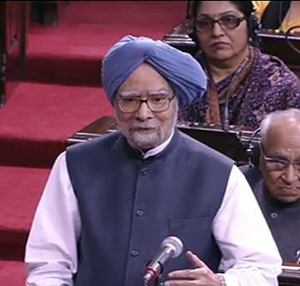
Singh, who spoke in the presence of Prime Minister Narendra Modi in Rajya Sabha, said the decision will result in decline of GDP by 2 per cent, it being an "under-estimate".

He hoped the Prime Minister will find a practical and pragmatic decision to mitigate the sufferings of the common man and the poor who have been in distress after the decision.

He said agriculture, unorganised sectors and small industry has also been hit hard by it and people were losing faith in the currency and banking system.

"These measures convinced me that the way the scheme has been implemented, it's a monumental management failure. And in fact, it is a case of organised loot and legalised plunder.

"It is not my intention to pick holes what this side or other side does. But I sincerely hope that the PM even in this late hour will help find us practical and pragmatic ways to provide relief to the suffering of the people of this country," he said in Rajya Sabha as the debate on the issue resumed after Modi came into the House.

Earlier, Leader of Opposition Ghulam Nabi Azad requested Chairman Hamid Ansari and Leader of the House Arun Jaitley that the Question Hour should not be taken up as the Prime Minister was present in the House and the debate be taken up.

Azad's request was readily accepted by the government with Jaitley saying that the debate should start immediately and Modi will certainly participate in it.

Participating in the resumed debate, Singh said it is important to take note of the grievances of the ordinary people who have suffered as a result of this imposition on the country "overnight" by the Prime Minister.

"My own feeling is that the national income, that is the GDP of the country, can decline by about 2 percentage points as a result of what has been done. This is an under-estimate and not an over-estimate.

"Therefore, I feel the Prime Minister must come with some constructive proposal on how we can implement the scheme and at the same time prevent the distrust that has been caused to the common people," Singh said.

The former Prime Minister did not agree with the Prime Minister's plea to wait for 50 days for the results of demonetisation to come about, saying no one knows about the final outcome of the decision.

"Well 50 days is a short period, but for those who are poor and deprived sections of the community even 50 days of torture can bring about disastrous effect. And that's why about 60 to 65 people have lost their lives. Maybe more.

"What is more is, what has been done can weaken and erode our people's confidence in the currency system and in the banking system," he said.

Asking Modi to spell out the names of countries where people have deposited their money in banks but are not allowed to withdraw their money, he said, "this alone I think is enough to condemn what has been done in the name of greater growth."

He said the scheme of demonetisation, the way it is being implemented, will hurt agricultural growth in our country, small industry and all those people who work in the informal sectors of the economy.

Singh, an eminent economist, criticised the government for issuing fresh instructions and modifying the rules every day on the conditions under which people can withdraw their money.

"That reflects very poorly on the Prime Minister's Office, the Finance Minister's office and on the Reserve Bank of India. I am very sorry that the Reserve Bank has been exposed to this kind of criticism which I think is fully justified," the former Prime Minister said.

He said though he agreed with the objectives of the scheme to demonetise currency notes of Rs 500 and Rs 1000 as spelt out by the Prime Minister, he wished to highlight the problems that the common people and poor have been subjected to by the move.

"But I do want to point out at least that in the process of demonetisation monumental mismanagement has been undertaken about which today there is no two opinions in the country as a whole," he said.

Referring to those saying that the move which was doing harm and creating distrust in the short run was good in the long run, Singh quoted John Maynard Keynes to say that "in the long run, all of us are dead".

"I urge upon the Prime Minister to find practical, pragmatic ways and measures to relieve the distress of the people, who happen to be a great majority of our people. After all 90 per cent of our people were in the informal sector, 55 per cent of our workers in agriculture are feeling distress," he said.

He also noted that the cooperative banking system which served large number of people in rural areas was non-functional and has been prevented from handling cash.

The senior Congress leader said though it is not his intention to pick holes in what this side or other side does, but hoped that the Prime Minister "even in this late hour will help find us practical and pragmatic ways to provide relief to the suffering of the people of this country".

Comments

Wonder Kotian
 - 
Thursday, 24 Nov 2016

Our Great Iron Man said correct, But he is trying \Dog's tail putting inside pipe\" but after removing same situation, Hindustan totally destroying already most of the business, Trading, Industry's totally loss point."

Add new comment

  • Coastaldigest.com reserves the right to delete or block any comments.
  • Coastaldigset.com is not responsible for its readers’ comments.
  • Comments that are abusive, incendiary or irrelevant are strictly prohibited.
  • Please use a genuine email ID and provide your name to avoid reject.
News Network
June 3,2020

Bengaluru, Jun 3: Deputy Chief Minister CN Ashwath Narayan on Tuesday invited investors in the Electronics System and Design Manufacturing (ESDM) sector to Karnataka, as the state contributes 64 per cent to the sector's total exports from the nation.

During a video conference organised by Invest India for a few select states with leading ESDM players across the globe, Narayan said, "We are the largest chip design hub and home to 70 per cent of India's chip designers."

Karnataka has introduced industry-friendly policies from the beginning and it continues to be the leader in attracting technology-specific investments, he added.

"Karnataka has an estimated GSDP of almost USD 220 billion. We were the first to come out with IT, BT, ESDM, and AVGC (Animation, Visual Effects, Gaming, and Comics) policies to give a push to the growth of the technology sectors and innovation. We also have vibrant automobiles, agro, aerospace, textile and garment, and heavy engineering industries," Narayan explained.

"We have created sector-specific SEZs for key industries such as IT, biotechnology and engineering, food processing and aerospace,'' he said.

However, the state government is planning ahead as it has initiated talks with other countries.

"We have held multiple consultations with the private sector to seek inputs for returning to business as we ease the COVID-19 lockdown restrictions. We are also initiating dialogue with countries across the globe to understand future plans for their companies in the post COVID era and discuss how the Karnataka government can support that," the Deputy Chief Minister stated.

"Karnataka has attracted cumulative FDI inflows in the state from 2000 to 2019 which were recorded at USD 42.3 billion," he said.

Referring to the Karnataka ESDM policy 2017-2022, Narayan further said, "We aim to stimulate the growth of 2,000 ESDM start-ups during the policy period and create 20 lakh new jobs by 2025.

Comments

Add new comment

  • Coastaldigest.com reserves the right to delete or block any comments.
  • Coastaldigset.com is not responsible for its readers’ comments.
  • Comments that are abusive, incendiary or irrelevant are strictly prohibited.
  • Please use a genuine email ID and provide your name to avoid reject.
News Network
April 11,2020

Bengaluru, Apr 11: Karnataka Library Department’s mobile application, which is said to be the first of its kind initiative in the country has seen an exponential growth in downloads during the COVID-19 lockdown, a senior Minister said on Friday. The main reason that the application is growing is due to the heavy students demand as schools and colleges are closed during the 21-day nationwide lockdown.

Students are relying on online material for their studies as they can’t step out of the house and risk being infected.

The Library Department's efforts to keep readers active through the lockdown time, by prompting them to utilise its e-initiatives is paying off, Primary and Secondary Education Minister Suresh Kumar said.

"The app is seeing exponential increase in downloads since its launch. As many as 16,500 people have taken it; while ten thousand people have downloaded it during this brief lock down time itself," he said.

E-library mobile app was released by the library department on February 26.

There are over one lakh e-books available on department's digital platform ranging from arts, humanity, school curriculum, competitive exams and self help to classic novels - all for free for the readers.

"Its needless to say, the variety of attractive content that is available in the app is creating all the buzz among the public. Not just the books, the app contains over 600 educational videos too," the Minister said in a statement.

Considering that over 16,500 readers have downloaded the app since its launch a couple of months back, its high time, we see this domain as an opportunity for growth, he said, and stressed on the need for better adaptability approaches to the changing times.

Comments

Add new comment

  • Coastaldigest.com reserves the right to delete or block any comments.
  • Coastaldigset.com is not responsible for its readers’ comments.
  • Comments that are abusive, incendiary or irrelevant are strictly prohibited.
  • Please use a genuine email ID and provide your name to avoid reject.
Agencies
February 20,2020

India ranked 77th on a sustainability index that takes into account per capita carbon emissions and ability of children in a nation to live healthy lives and secures 131st spot on a flourishing ranking that measures the best chance at survival and well-being for children, according to a UN-backed report.

The report was released on Wednesday by a commission of over 40 child and adolescent health experts from around the world. It was commissioned by the World Health Organization (WHO), UN Children's Fund (UNICEF) and The Lancet medical journal.

In the report assessing the capacity of 180 countries to ensure that their youngsters can survive and thrive, India ranks 77th on the Sustainability Index and 131 on the Flourishing Index, it said.

Flourishing is the geometric mean of Surviving and Thriving. For Surviving, the authors selected maternal survival, survival in children younger than 5 years old, suicide, access to maternal and child health services, basic hygiene and sanitation, and lack of extreme poverty.

For Thriving, the domains were educational achievement, growth and nutrition, reproductive freedom, and protection from violence.

Under the Sustainability Index, the authors noted that promoting today's national conditions for children to survive and thrive must not come at the cost of eroding future global conditions for children's ability to flourish.

The Sustainability Index ranks countries on excess carbon emissions compared with the 2030 target. This provides a convenient and available proxy for a country's contribution to sustainability in future.

The report noted that under realistic assumptions about possible trajectories towards sustainable greenhouse gas emissions, models predict that global carbon emissions need to be reduced from 39·7 giga­ tonnes to 22·8 gigatonnes per year by 2030 to maintain even a 66 per cent chance of keeping global warming below 1·5°C.

It said that the world's survival depended on children being able to flourish, but no country is doing enough to give them a sustainable future.

"No country in the world is currently providing the conditions we need to support every child to grow up and have a healthy future," said Anthony Costello, Professor of Global Health and Sustainability at University College London, one of the lead authors of the report.

"Especially, they're under immediate threat from climate change and from commercial marketing, which has grown hugely in the last decade," said Costello – former WHO Director of Mother, Child and Adolescent health.

Norway leads the table for survival, health, education and nutrition rates - followed by South Korea and the Netherlands. Central African Republic, Chad and Somalia come at the bottom.

However, when taking into account per capita CO2 emissions, these top countries trail behind, with Norway 156th, the Republic of Korea 166th and the Netherlands 160th.

Each of the three emits 210 per cent more CO2 per capita than their 2030 target, the data shows, while the US, Australia, and Saudi Arabia are among the 10 worst emitters. The lowest emitters are Burundi, Chad and Somalia.

According to the report, the only countries on track to beat CO2 emission per capita targets by 2030, while also performing fairly – within the top 70 – on child flourishing measures are: Albania, Armenia, Grenada, Jordan, Moldova, Sri Lanka, Tunisia, Uruguay and Vietnam.

"More than 2 billion people live in countries where development is hampered by humanitarian crises, conflicts, and natural disasters, problems increasingly linked with climate change," said Minister Awa Coll-Seck from Senegal, Co-Chair of the commission.

The report also highlights the distinct threat posed to children from harmful marketing.

Evidence suggests that children in some countries see as many as 30,000 advertisements on television alone in a single year, while youth exposure to vaping (e-cigarettes) advertisements increased by more than 250 per cent in the US over two years, reaching more than 24 million young people.

Studies in Australia, Canada, Mexico, New Zealand and the US – among many others – have shown that self-regulation has not hampered commercial ability to advertise to children.

Children's exposure to commercial marketing of junk food and sugary beverages is associated with purchase of unhealthy foods and overweight and obesity, linking predatory marketing to the alarming rise in childhood obesity, it said.

The number of obese children and adolescents increased from 11 million in 1975 to 124 million in 2016 – an 11-fold increase, with dire individual and societal costs, the report said.

To protect children, the authors call for a new global movement driven by and for children.

Specific recommendations include stopping CO2 emissions with the utmost urgency, to ensure children have a future on this planet; placing children and adolescents at the centre of global efforts to achieve sustainable development, the report said.

New policies and investment in all sectors to work towards child health and rights; incorporating children's voices into policy decisions and tightening national regulation of harmful commercial marketing, supported by a new Optional Protocol to the UN Convention on the Rights of the Child, it said.

Comments

Add new comment

  • Coastaldigest.com reserves the right to delete or block any comments.
  • Coastaldigset.com is not responsible for its readers’ comments.
  • Comments that are abusive, incendiary or irrelevant are strictly prohibited.
  • Please use a genuine email ID and provide your name to avoid reject.