



Demonetisation is organised loot, legalised plunder: Manmohan Singh

November 24, 2016

New Delhi, Nov 24: Stepping up the opposition tirade against demonetisation, former Prime Minister Manmohan Singh today castigated the government and the Prime Minister over the move, saying its implementation was a "monumental management failure" and a case of "organised loot and legalised plunder."manmhn
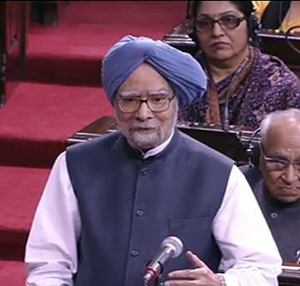
Singh, who spoke in the presence of Prime Minister Narendra Modi in Rajya Sabha, said the decision will result in decline of GDP by 2 per cent, it being an "under-estimate".

He hoped the Prime Minister will find a practical and pragmatic decision to mitigate the sufferings of the common man and the poor who have been in distress after the decision.

He said agriculture, unorganised sectors and small industry has also been hit hard by it and people were losing faith in the currency and banking system.

"These measures convinced me that the way the scheme has been implemented, it's a monumental management failure. And in fact, it is a case of organised loot and legalised plunder.

"It is not my intention to pick holes what this side or other side does. But I sincerely hope that the PM even in this late hour will help find us practical and pragmatic ways to provide relief to the suffering of the people of this country," he said in Rajya Sabha as the debate on the issue resumed after Modi came into the House.

Earlier, Leader of Opposition Ghulam Nabi Azad requested Chairman Hamid Ansari and Leader of the House Arun Jaitley that the Question Hour should not be taken up as the Prime Minister was present in the House and the debate be taken up.

Azad's request was readily accepted by the government with Jaitley saying that the debate should start immediately and Modi will certainly participate in it.

Participating in the resumed debate, Singh said it is important to take note of the grievances of the ordinary people who have suffered as a result of this imposition on the country "overnight" by the Prime Minister.

"My own feeling is that the national income, that is the GDP of the country, can decline by about 2 percentage points as a result of what has been done. This is an under-estimate and not an over-estimate.

"Therefore, I feel the Prime Minister must come with some constructive proposal on how we can implement the scheme and at the same time prevent the distrust that has been caused to the common people," Singh said.

The former Prime Minister did not agree with the Prime Minister's plea to wait for 50 days for the results of demonetisation to come about, saying no one knows about the final outcome of the decision.

"Well 50 days is a short period, but for those who are poor and deprived sections of the community even 50 days of torture can bring about disastrous effect. And that's why about 60 to 65 people have lost their lives. Maybe more.

"What is more is, what has been done can weaken and erode our people's confidence in the currency system and in the banking system," he said.

Asking Modi to spell out the names of countries where people have deposited their money in banks but are not allowed to withdraw their money, he said, "this alone I think is enough to condemn what has been done in the name of greater growth."

He said the scheme of demonetisation, the way it is being implemented, will hurt agricultural growth in our country, small industry and all those people who work in the informal sectors of the economy.

Singh, an eminent economist, criticised the government for issuing fresh instructions and modifying the rules every day on the conditions under which people can withdraw their money.

"That reflects very poorly on the Prime Minister's Office, the Finance Minister's office and on the Reserve Bank of India. I am very sorry that the Reserve Bank has been exposed to this kind of criticism which I think is fully justified," the former Prime Minister said.

He said though he agreed with the objectives of the scheme to demonetise currency notes of Rs 500 and Rs 1000 as spelt out by the Prime Minister, he wished to highlight the problems that the common people and poor have been subjected to by the move.

"But I do want to point out at least that in the process of demonetisation monumental mismanagement has been undertaken about which today there is no two opinions in the country as a whole," he said.

Referring to those saying that the move which was doing harm and creating distrust in the short run was good in the long run, Singh quoted John Maynard Keynes to say that "in the long run, all of us are dead".

"I urge upon the Prime Minister to find practical, pragmatic ways and measures to relieve the distress of the people, who happen to be a great majority of our people. After all 90 per cent of our people were in the informal sector, 55 per cent of our workers in agriculture are feeling distress," he said.

He also noted that the cooperative banking system which served large number of people in rural areas was non-functional and has been prevented from handling cash.

The senior Congress leader said though it is not his intention to pick holes in what this side or other side does, but hoped that the Prime Minister "even in this late hour will help find us practical and pragmatic ways to provide relief to the suffering of the people of this country".

Comments

Wonder Kotian
 - 
Thursday, 24 Nov 2016

Our Great Iron Man said correct, But he is trying \Dog's tail putting inside pipe\" but after removing same situation, Hindustan totally destroying already most of the business, Trading, Industry's totally loss point."

Add new comment

  • Coastaldigest.com reserves the right to delete or block any comments.
  • Coastaldigset.com is not responsible for its readers’ comments.
  • Comments that are abusive, incendiary or irrelevant are strictly prohibited.
  • Please use a genuine email ID and provide your name to avoid reject.
News Network
April 28,2020

Bengaluru, Apr 28: Karnataka has found that the rapid antibody test kits for COVID-19 that the Centre supplied to the state have only 47% sensitivity. The state will be returning the kits to the Indian Council of Medical Research (ICMR).

Karnataka had received 11,400 rapid antibody test kits from the ICMR a few days back, out of which it had sent around 200 of them to NIMHANS for validation.

After the ICMR, on Monday, sent a circular to all states to return the test kits to the suppliers, Dr CN Manjunath, Director, Jayadeva Institute of Cardiovascular Sciences and Research, and nodal officer for lab testing in the state's COVID-19 task force, said, "We have cancelled the orders we placed to Guangzhou Wondfo Biotech and Zhuhai Livzon Diagnostics for one lakh rapid antibody test kits. Since the ICMR supplied us with 11,400 kits out of the 6.5 lakh kits it procured, we will be returning the kits to them."

Manjunath told said that the validation at NIMHANS revealed the kits to have only 47% sensitivity. Sensitivity is the ability of a test to identify the true-positives in a population, i.e., the actual number of people who've been infected with the disease. With the rapid antibody testing kits being shelved, the state's plan to randomly test high risk groups has taken a backseat. 

So far, the state has tested 43,791 samples. 

Karnataka now has 22 testing facilities -- 14 government and seven private labs. Many private labs have not tested any samples so far because of the lack of test kits (the state has made it clear that it will not provide test kits to private labs). So, getting an ICMR approval for testing has become a moot point.p

Agreeing to the setback the state's plans of ramping up testing has taken, Manjunath said, "It is true that RT-PCR test kits are in shortage. Even Pune's Mylabs had a shortage in supplying test kits. But we are relying on institutes like Kidwai, Narayana Health and Biocon's Syngene that have received approval for testing. They're big institutes and we hope that they will test a large number of samples."

On reports that the Centre has RT-PCR test kits that will last for only a week, he said, "We have test kits that will last for eight to 10 days. We have ordered for more. We are hoping to receive them before the current kits run out."

Comments

Add new comment

  • Coastaldigest.com reserves the right to delete or block any comments.
  • Coastaldigset.com is not responsible for its readers’ comments.
  • Comments that are abusive, incendiary or irrelevant are strictly prohibited.
  • Please use a genuine email ID and provide your name to avoid reject.
coastaldigest.com news network
May 12,2020

Bengaluru, May 12: Karnataka sees the highest single day spike since the start of the pandemic in the state, higher than Sunday's spike in cases. 63 new cases have been reported in last 24 hours. 

With this, the total number of COVID-19 cases rises to 925, said the state health department's bulletin on Tuesday.

While 42 new positive cases reported from May 11, 5 pm to May 12, noon, another 21 fresh 21 cases reported by 5 pm on May 12.

To date, 921 COVID-19 positive cases have been confirmed. This includes 31 deaths and 426 discharged," the bulletin read further.

Morning Bulletin

New cases in Bengaluru Urban 3,  Yadgir 2, Bagalkote 15, Dakshina Kannada 2, Dharwad 9, Bidar 2, Hassan 5, Ballari, Mandya, Chikkaballapura, Kalaburagi (one each).  

Evening Bulletin

Cases in Gadag (3), Kolar (5), Bengaluru Urban (1) and Davangere (11) cases. 

Cases reported on 12 May: 63

Total cases in state: 925
 

Comments

Add new comment

  • Coastaldigest.com reserves the right to delete or block any comments.
  • Coastaldigset.com is not responsible for its readers’ comments.
  • Comments that are abusive, incendiary or irrelevant are strictly prohibited.
  • Please use a genuine email ID and provide your name to avoid reject.
Agencies
July 8,2020

The Central Board of Secondary Education (CBSE) has rationalised by up to 30 per cent the syllabus for classes 9 to 12 for the academic year 2020-21 to reduce course load on students amid the COVID-19 crisis, Union HRD Minister Ramesh Pokhriyal 'Nishank' announced on Tuesday.

The curriculum has been rationalised while retaining the core elements, the Human Resource Development said.

Among the chapters dropped after the rationalisation exercise are lessons on democracy and diversity, demonetisation, nationalism, secularism, India's relations with its neighbours and growth of local governments in India, among others.

"Looking at the extraordinary situation prevailing in the country and the world, CBSE was advised to revise the curriculum and reduce course load for the students of classes 9 to 12.

"To aid the decision, a few weeks back I also invited suggestions from all educationists on the reduction of syllabus for students and I am glad to share that we received more than 1.5K suggestions. Thank you, everyone, for the overwhelming response," Nishank tweeted.

"Considering the importance of learning achievement, it has been decided to rationalise syllabus up to 30 per cent by retaining the core concepts," he added.

The Union minister said the changes made in the syllabi have been finalised by the respective course committees with the approval of the curriculum committee and the Governing Body of the Board.

"The heads of schools and teachers have been advised by the board to ensure that the topics that have been reduced are also explained to the students to the extent required to connect different topics. However, the reduced syllabus will not be part of the topics for internal assessment and year-end board examination.

"Alternative academic calendar and inputs from the NCERT on transacting the curriculum using different strategies shall also be part of the teaching pedagogy in the affiliated schools," a senior official of the HRD ministry said.

For classes 1 to 8, the National Council of Education Research and Training (NCERT) has already notified an alternative calendar and learning outcomes.

According to the updated curriculum, among the chapters deleted from class 10 syllabus are-- democracy and diversity, gender, religion and caste, popular struggles and movement, challenges to democracy

For class 11, the deleted portions included chapters on federalism, citizenship, nationalism, secularism, growth of local governments in India.

Similarly, class 12 students will not be required to study chapters on India's relations with its neighbours, changing nature of India's economic development, social movements in India and demonetisation, among others.

Universities and schools across the country have been closed since March 16 when the central government announced a nationwide classroom shutdown as one of the measures to contain the COVID-19 outbreak.

A nationwide lockdown was announced on March 24, which came into effect the next day. While the government has eased several restrictions, schools and colleges continue to remain closed.

Comments

Add new comment

  • Coastaldigest.com reserves the right to delete or block any comments.
  • Coastaldigset.com is not responsible for its readers’ comments.
  • Comments that are abusive, incendiary or irrelevant are strictly prohibited.
  • Please use a genuine email ID and provide your name to avoid reject.