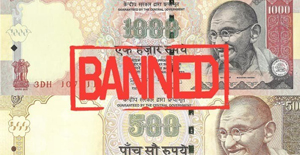
Demonetization: Govt refuses to give another chance to exchange old notes

Agencies
July 18, 2017

New Delhi, Jul 18: The Central government on Monday refused to give another opportunity to exchange demonetised currency notes of Rs 500 and 1,000 to those who couldn't do it by the deadline of December 30, 2016, saying this would defeat the very objective of eliminating black money.ban 2

In an affidavit filed in the Supreme Court, Finance Ministry Under Secretary T. Narasimha said: "The very object of demonetisation and elimination of black money will be defeated if a window is opened for a further period as people in possession of the SBNs (specified bank notes) would have had sufficient time and opportunity to carefully plan the reasons and executed for not depositing the SBNs within the permitted period of December 30, 2016.

"Any number of 'benami' transactions and proxy users for the purpose of producing and depositing the old notes would then arise and the departments would have great difficulty in deciding any genuine case from the numerous bogus ones, it said, and sought dismissal of petitions seeking another chance.

The government on Monday also said that even possessing the demonetised currency notes was an offence.

The Union Finance Ministry's stand came in response to the top court asking the Central government on July 4 to consider giving another opportunity to those who couldn't exchange their demonetised currency notes.

Even in the earlier hearings, the government had resisted the suggestion to give another opportunity to people who could not deposit their demonitised currency notes by December 30 saying t hat it has taken a "conscious decision" not to extend the period except for NRIs, and security personnel posted in remote areas, which ended on March 31.

The government had also said it was not legally bound to come out with a fresh notification to grant grace period or window for depositing scrapped currency notes.

The top court is hearing a batch of petitions challenging the government's decision not to allow the public at large to deposit demonetised currency notes till March 31 as promised by Prime Minister Narendra Modi and others as the window ended on December 30 last year.

The petitioner have also referred to Modi's speech on November 8, 2016 and subsequent notification of the Reserve Bank of India, holding that people may deposit demonetised currency notes at specific RBI branches up to March 31, 2017 after complying with certain procedural requirements.

Comments

Add new comment

  • Coastaldigest.com reserves the right to delete or block any comments.
  • Coastaldigset.com is not responsible for its readers’ comments.
  • Comments that are abusive, incendiary or irrelevant are strictly prohibited.
  • Please use a genuine email ID and provide your name to avoid reject.
News Network
May 20,2020

Bengaluru, May 20: Ride-sharing company Ola Cabs said on Wednesday it will lay off 1,400 of its employees due to business uncertainty caused by the coronavirus pandemic while the revenue has come down by 95 per cent in the past two months.

"The COVID crisis continues to unfold all around us causing unprecedented economic and social destruction. It has also become evident that the coronavirus will not be eliminated any time soon," wrote co-founder and CEO Bhavish Aggarwal to all Ola employees.

"In these circumstances, today I write to all of you with the toughest decision I have ever taken -- the need to downsize our organisation and let go of 1,400 of our valued employees," he said.

Aggarwal said the fallout of virus has been very tough for the cab aggregating industry in particular. "The company's revenue has come down by 95 per cent over the past two months," he said.

Initially, he said, the company hoped it would be a short-lived crisis and that its impact would be temporary. "But unfortunately, it is not been a short crisis. And the prognosis ahead for our business is very unclear and uncertain. It is going to take a long time for people to go out and about like before."
With more companies preferring to have a large number of employees work from home, air travel limited to essential trips and vacations being put off for better times, the impact of this crisis is definitely going to be long-drawn, said Aggarwal.

"The world is not going to revert to the pre-COVID era anytime soon. Social distancing, anxiety and an abundance of caution will be the operating principles for everyone," he told employees.

Aggarwal said the crisis necessitates the need to conserve cash aggressively so that Ola is able to invest in opportunities in the future, adding the downsizing exercise has been a very tough and sad decision for the management team to make.

"While we restructure our organisation to the new realities of our business, we are also going to recommit ourselves to strengthening our operational excellence and leverage a lot more technology to improve efficiencies and reduce cost across all parts of our business," he said.

Comments

Add new comment

  • Coastaldigest.com reserves the right to delete or block any comments.
  • Coastaldigset.com is not responsible for its readers’ comments.
  • Comments that are abusive, incendiary or irrelevant are strictly prohibited.
  • Please use a genuine email ID and provide your name to avoid reject.
coastaldigest.com news network
May 31,2020

Bengaluru, May 31: With places of worship expected to reopen on June 8, the Karnataka State Minorities Commission has released guidelines for mosques and dargahs, that include social distancing, temperature testing and compulsory hand washing.

Abdul Azeem, commission chairman said, "Everyone will have to maintain one-metre distance and carry their prayer mats. They will all be scanned and Farz prayers will be held for 10-15 minutes. Friday prayers should be completed within 20 minutes."

Distribution of tabarukh, shaking hands, and overcrowding inside mosques will not be allowed.  The Muzrai department also issued guidelines for temples, like mandatory face masks, sanitisation of sanctum sanctorum and thermal screening.

In a letter, the Hindu Religious Institutions and Charitable Endowment Department mentioned that while temple authorities and devotees should wear masks, priests, helpers and workers are exempt, in the core area of the temple.

"Devotees should be scanned using infrared thermometers at the temple entrance, and must be given hand sanitiser. The temple trust is expected to bear the expenses," it added.

Comments

Add new comment

  • Coastaldigest.com reserves the right to delete or block any comments.
  • Coastaldigset.com is not responsible for its readers’ comments.
  • Comments that are abusive, incendiary or irrelevant are strictly prohibited.
  • Please use a genuine email ID and provide your name to avoid reject.
Agencies
February 20,2020

India ranked 77th on a sustainability index that takes into account per capita carbon emissions and ability of children in a nation to live healthy lives and secures 131st spot on a flourishing ranking that measures the best chance at survival and well-being for children, according to a UN-backed report.

The report was released on Wednesday by a commission of over 40 child and adolescent health experts from around the world. It was commissioned by the World Health Organization (WHO), UN Children's Fund (UNICEF) and The Lancet medical journal.

In the report assessing the capacity of 180 countries to ensure that their youngsters can survive and thrive, India ranks 77th on the Sustainability Index and 131 on the Flourishing Index, it said.

Flourishing is the geometric mean of Surviving and Thriving. For Surviving, the authors selected maternal survival, survival in children younger than 5 years old, suicide, access to maternal and child health services, basic hygiene and sanitation, and lack of extreme poverty.

For Thriving, the domains were educational achievement, growth and nutrition, reproductive freedom, and protection from violence.

Under the Sustainability Index, the authors noted that promoting today's national conditions for children to survive and thrive must not come at the cost of eroding future global conditions for children's ability to flourish.

The Sustainability Index ranks countries on excess carbon emissions compared with the 2030 target. This provides a convenient and available proxy for a country's contribution to sustainability in future.

The report noted that under realistic assumptions about possible trajectories towards sustainable greenhouse gas emissions, models predict that global carbon emissions need to be reduced from 39·7 giga­ tonnes to 22·8 gigatonnes per year by 2030 to maintain even a 66 per cent chance of keeping global warming below 1·5°C.

It said that the world's survival depended on children being able to flourish, but no country is doing enough to give them a sustainable future.

"No country in the world is currently providing the conditions we need to support every child to grow up and have a healthy future," said Anthony Costello, Professor of Global Health and Sustainability at University College London, one of the lead authors of the report.

"Especially, they're under immediate threat from climate change and from commercial marketing, which has grown hugely in the last decade," said Costello – former WHO Director of Mother, Child and Adolescent health.

Norway leads the table for survival, health, education and nutrition rates - followed by South Korea and the Netherlands. Central African Republic, Chad and Somalia come at the bottom.

However, when taking into account per capita CO2 emissions, these top countries trail behind, with Norway 156th, the Republic of Korea 166th and the Netherlands 160th.

Each of the three emits 210 per cent more CO2 per capita than their 2030 target, the data shows, while the US, Australia, and Saudi Arabia are among the 10 worst emitters. The lowest emitters are Burundi, Chad and Somalia.

According to the report, the only countries on track to beat CO2 emission per capita targets by 2030, while also performing fairly – within the top 70 – on child flourishing measures are: Albania, Armenia, Grenada, Jordan, Moldova, Sri Lanka, Tunisia, Uruguay and Vietnam.

"More than 2 billion people live in countries where development is hampered by humanitarian crises, conflicts, and natural disasters, problems increasingly linked with climate change," said Minister Awa Coll-Seck from Senegal, Co-Chair of the commission.

The report also highlights the distinct threat posed to children from harmful marketing.

Evidence suggests that children in some countries see as many as 30,000 advertisements on television alone in a single year, while youth exposure to vaping (e-cigarettes) advertisements increased by more than 250 per cent in the US over two years, reaching more than 24 million young people.

Studies in Australia, Canada, Mexico, New Zealand and the US – among many others – have shown that self-regulation has not hampered commercial ability to advertise to children.

Children's exposure to commercial marketing of junk food and sugary beverages is associated with purchase of unhealthy foods and overweight and obesity, linking predatory marketing to the alarming rise in childhood obesity, it said.

The number of obese children and adolescents increased from 11 million in 1975 to 124 million in 2016 – an 11-fold increase, with dire individual and societal costs, the report said.

To protect children, the authors call for a new global movement driven by and for children.

Specific recommendations include stopping CO2 emissions with the utmost urgency, to ensure children have a future on this planet; placing children and adolescents at the centre of global efforts to achieve sustainable development, the report said.

New policies and investment in all sectors to work towards child health and rights; incorporating children's voices into policy decisions and tightening national regulation of harmful commercial marketing, supported by a new Optional Protocol to the UN Convention on the Rights of the Child, it said.


Comments

Add new comment

  • Coastaldigest.com reserves the right to delete or block any comments.
  • Coastaldigset.com is not responsible for its readers’ comments.
  • Comments that are abusive, incendiary or irrelevant are strictly prohibited.
  • Please use a genuine email ID and provide your name to avoid reject.