Demonetization may lead to riotous situation in the country: Poojary

[email protected] (CD Network | Suresh)
November 30, 2016

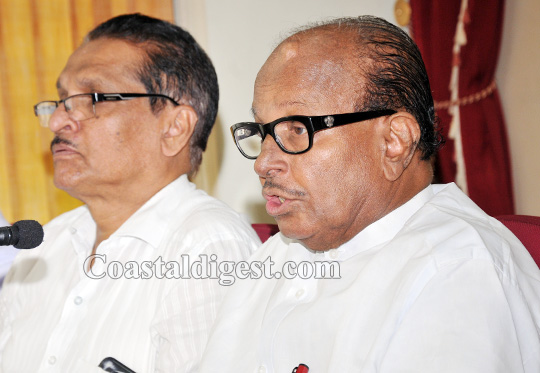
Mangaluru, Nov 30: Former union minister B Janardhana Poojary has warmed Prime Minister Narendra Modi that the latter's controversial demonetization drive may lead to a riotous situation in the country, as predicted by the Supreme Court.

poojary pm 1

Speaking to media persons here on Tuesday, the Congress leader also came down heavily against the central government for not accepting recommendations of the Supreme Court collegium, with regard to appointment of judges.

"A rift between the judiciary and the government has been created in the country. Appoint judges to courts as per the recommendations of the collegium, if you (Prime Minister) have commitment (to the judiciary)," Poojary added.

Yettinahole

Mr Poojary also demanded that Karnataka CM Siddaramaiah clarify rumours that three of his ministers have allegedly received kickbacks from a contractor in the Yettinahole project.

He said that highest bidder who received the contract of the project was blacklisted. Calling it a big scam, Poojary said, "It had appeared in all television channels that three ministers had received bribe to the tune of Rs 50 crore from a contractor. Let the CM reveal who these ministers are and how much they actually received."

Demanding action against the ministers, Poojary said, "You (Siddaramaiah) have the power to take action against the ministers. Stop justifying the actions of your colleagues and seek their resignation. Otherwise, people may suspect you too," Poojary said.
"No minister or leader is above the party. It is a matter of shame for the high command that allegations are levelled against ministers. It should direct Siddaramaiah to act against those ministers, no matter how influential they are," he said, adding that the project should be scrapped.

Comments

jj
 - 
Wednesday, 30 Nov 2016

Salute to Poojary's impartial comments.

jj
 - 
Wednesday, 30 Nov 2016

Salute to Poojary's impartial comments.

Add new comment

  • Coastaldigest.com reserves the right to delete or block any comments.
  • Coastaldigset.com is not responsible for its readers’ comments.
  • Comments that are abusive, incendiary or irrelevant are strictly prohibited.
  • Please use a genuine email ID and provide your name to avoid reject.
News Network
June 8,2020

Bengaluru, Jun 8: More than two months after the nationwide lockdown was imposed to curb the spread of coronavirus, people offered prayers at Bengaluru's Saint Mary's Church and Shree Dodda Ganapathi Temple as the government has allowed reopening of religious places from today.

Fewer devotees here visited Saint Mary's Church in Shivaji Nagar and were seen maintaining social distancing inside the church premises.

Meanwhile, people queued outside Shree Dodda Ganapathi Temple at Basavanagudi to offer prayers in the wee hours of Monday.

Floor markings have been made here to maintain social distancing.

Social distancing norms are also being followed in Hubli's Nagashetty Koppa where only a few devotees thronged the temple on Monday morning.

In Kalaburagi's Sharana Basaveshwara Temple the visiting hours for devotees have been fixed from 7 am to 10 am and three hours in the evening from 5 pm to 8 pm.

Thermal screening is being conducted here and a disinfectant tunnel has also been installed at the entry point.

Floor markings have also been made here to ensure social distancing while barricades have also been installed on the temple premises.

Comments

Add new comment

  • Coastaldigest.com reserves the right to delete or block any comments.
  • Coastaldigset.com is not responsible for its readers’ comments.
  • Comments that are abusive, incendiary or irrelevant are strictly prohibited.
  • Please use a genuine email ID and provide your name to avoid reject.
coastaldigest.com news network
May 18,2020

Bengaluru, May 18: With the detection of 99 fresh cases of COVID-19, highest single-day spike, including 24 from Bengaluru Urban district, the total number of persons contracted for the disease in the state has surged to 1,246.

Apart from 24 fresh cases in Bengaluru Urban district, Mandya recorded 17 cases followed by Uttara Kannada (09), Raichur (06), Yadagiri (06), Gadaga (05), Kalaburagi (10), Hassan (04), Koppal (03), Vijayapura (05), Mysuru (01), Belagavi (02), Ballari (01), Udupi (01), Kodagu (01) and Koppal (03).

So far 37 persons had succumbed to the virus in the state.

Comments

Add new comment

  • Coastaldigest.com reserves the right to delete or block any comments.
  • Coastaldigset.com is not responsible for its readers’ comments.
  • Comments that are abusive, incendiary or irrelevant are strictly prohibited.
  • Please use a genuine email ID and provide your name to avoid reject.
Media Release
February 14,2020

Veteran journalist P. Sainath has said that the nation is in a crisis. And this crisis is not limited to just the rural area. It has become a national crisis at various areas such as agriculture, education, economy, job creation etc.

He was delivering the endowment lecture on the topic ‘Indian democracy at the post-liberalization and post-truth era’ at Media Manthan 2020 organized by the PG department of journalism and mass communication at St Aloysius College (Autonomous). 

Mr Sainath said that the many policies adopted in the 90s led to India becoming unusually unequal. Referring to the speech Ambedkar had made at the Constituent Assembly while handing over the draft of the Constitution, Mr Sainath said, “Ambedkar had warned about the weakness of Indian democracy that liberty without equality allows the supremacy of a few over the multitude. Liberty, equality and fraternity must be kept together as we cannot have one without the other.” 

Mr Sainath stated that the agrarian crisis was no longer about the loss of productivity, employment or about farmer suicide; it was a societal, civilizational crisis. Commenting on the lopsided policies such as cow-slaughter ban, he explained how cow slaughter ban had adversely affected many industries due to their interdependency. While Muslims who slaughtered cows were rendered helpless, the cattle traders who were mostly OBCs lost their earnings as the cattle prices crashed. An important industry like Kolhapur sandals industry in Maharashtra went bankrupt as a result of the cow slaughter ban in Maharashtra. He said the policymakers had no idea how the rural industries were interconnected. Demonetisation too devastated the rural economy as 98 percent of rural transactions happen through cash. 

Mr Sainath also spoke about the crisis of inequality which affects the Dalits and the Adivasis far more than anyone else as 90 percent of the rural households take home less than Rs 10,000/- per month. “Women are yet another group whose labour is never counted in the gross domestic product. Women and girls globally do unpaid work which amounts to about 12.5 billion working hours per year. Monetarily speaking, this is worth 10.8 trillion dollars,” Mr Sainath added. 

Speaking about the crisis of jobs Mr Sainath said that major companies were laying off employees just to create more profits for the investors and the adoption of artificial intelligence in the industry would further destroy millions of jobs.

Rector of St Aloysius College Institutions Fr Dionysius Vaz SJ, Principal Dr (Fr) Praveen Martis SJ, HOD of Journalism and Mass Communication department Dr (Fr) Melwyn Pinto SJ were present.

‘Veerappan and Vijay Mallya’s business models are interesting!’

Addressing the gathering during his endowment lecture on Friday, Mr Sainath made an interesting comment on the so called ‘revenue model’. “Whenever I visit IIMs and IITs for lectures on my PARI project, the students there ask me what my revenue model for my project is. I tell them that I do not have a revenue model. In fact, journalism does not begin with a revenue model. Gandhiji, Ambedkar, Bhagat Singh were all great journalists. But they did not have a revenue model,” Mr Sainath said.

On a lighter note, he said that the best revenue model that he liked was that of forest brigand Veerappan and liquor baron Vijay Mallya. “Veerappan ruled the forest for forty years and from the top ministers to the villagers he could dictate terms and liver royally. Similarly, Mallya’s revenue model was to steal the banks and run away abroad and live like a king,” Mr Sainath added.

Journalism is not and can never be a business. It is a calling, he opined. While newspaper can be a business, television can be a business, journalism per se cannot be reduced to a business. “Unfortunately today, journalists are recruited on a contract basis and they have no bargaining power; and there are no unions to fight for their cause. Hence, they are at the mercy of the corporate media houses for their survival and are made to write stories that cannot be called journalism,” Mr Sainath said.

Answering a question as to the pressures he faced as a journalist, he said that external pressures from the government or others could be very well handled. It is the internal pressures from once own media house that journalists find it difficult to manage.


 

Comments

Add new comment

  • Coastaldigest.com reserves the right to delete or block any comments.
  • Coastaldigset.com is not responsible for its readers’ comments.
  • Comments that are abusive, incendiary or irrelevant are strictly prohibited.
  • Please use a genuine email ID and provide your name to avoid reject.