Discontent over cabinet rejig intensifies; Jaffer Sharief backs disgruntled group

June 23, 2016

Bengaluru, June 23: Discontent today snowballed in the ruling Congress over Karnataka's major ministry revamp as disgruntled party legislators decided to meet shortly to plan their next course of action, keeping the option open of pressing for leadership change.
congA series of meetings were being held for the past two days by several dropped ministers and ministerial berth aspirants after Chief Minister Siddaramaiah carried out a major rejig on Sunday, sacking 14 ministers and inducting 13 others to burnish the party's image with two years left for Assembly polls.

"...we will meet on Sunday or Monday. We will all sit together, whatever decision is taken there, is final. Now we have gone one step ahead. To save the party, if leadership change is needed, we are ready for it," senior Congress MLA from Yadagiri Malka Reddy told reporters after a meeting.

"We will fight being within the party. First option is to see if there is any chance to strengthening the party without leadership change. First, we will give medicine, if things are not solved, we will be open for surgery," he added.

Another MLA from Afzalpur Mallikayya Guttedar, sulking over not being given a ministerial berth, said "we will decide whether leadership change is needed."

The state Congress leadership continued its efforts to douse dissidence, with newly-appointed Working President Dinesh Gundu Rao seeking to pacify key sacked ministers like Ambareesh and Srinivasa Prasad, who have openly questioned Chief Minister Siddaramaiah's action of dropping them.

After meeting Ambareesh and Prasad, Rao said, "...he (Ambareesh) has no resentment against the party. I feel he will come out of these things soon, his support is needed for the party."

Senior leaders like Prasad, Qamarul Islam, Ambareesh, Baburao Chinchansoor who were dropped from the Ministry have openly criticised Siddaramaiah.

Ambareesh has even resigned as MLA, which has not been accepted.

Ministerial aspirants like Guttedar, Malka Reddy, S T Somashekar and Rajshekar Patil among others have made open remarks against Siddaramaiah and Mallikarjuna Kharge (Congress Leader in Lok Sabha), whose son Priyank Kharge has managed to find a ministerial slot.

Somashekar has claimed that eight legislators were contemplating resigning their Assembly membership in protest.

Sources said party's state in-charge Digvijay Singh is expected to visit here soon in order to control the growing resentment within the party.

Siddaramaiah had carried out the reshuffle after the Congress High Command gave its clearance for the major rejig, seen as an attempt to improve the party's image to retain power in the next polls in the only major bastion under its control after losing power in several states, most recently in Assam.

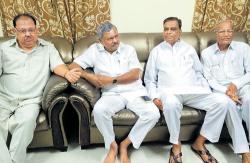
Meanwhile, former union minister C K Jaffer Sharief, who met Ambareesh, extended his support to the disgruntled group. He told reporters that Siddaramaiah was responsible for the crisis the party is witnessing.

Comments

SK
 - 
Thursday, 23 Jun 2016

As Ambarish said he is not a foot wear..... But ALL the politicians are worse than that.... The ministers should be rotated for every 2.5 years, so that others will get an opportunity to show their TALENT.... Cabinet is not their Father's property....Even Siddu has done BLUNDER by retaining other ministers like RAI..... these foot wears should be kicked out....like he changed his` car......

Abdullah
 - 
Thursday, 23 Jun 2016

This old buffalos should take rest and enjoy the rest of their life with family. How much money they want to earn???
And also they should give chance to youngsters.

Add new comment

  • Coastaldigest.com reserves the right to delete or block any comments.
  • Coastaldigset.com is not responsible for its readers’ comments.
  • Comments that are abusive, incendiary or irrelevant are strictly prohibited.
  • Please use a genuine email ID and provide your name to avoid reject.
News Network
March 3,2020

Dubai, Mar 3: Abu Dhabi-based Indian retail tycoon MA Yusuff Ali has become the first Indian to receive Saudi Arabia's premium residency, his office said in a statement on Monday.

Yusuff Ali, 64, is the chairman of the LuLu Group, who was ranked the richest expat in the UAE by the Forbes magazine last year.

The permit, informally known as Saudi Green Card, grants expatriates the right to live, work and own business and property in the Kingdom without need for a sponsor, the LULU group said in a statement.

The introduction of the Premium Residency comes as a part of Saudi Arabia's Vision 2030 reform plan, which was announced by Crown Prince Mohammed bin Salman to boost the Saudi economy, the statement said.

Yusuff Ali said "obviously a very proud and humbling moment in my life. This is a great honour not only for me but for the entire Indian expat community and I sincerely thank the HM the King Salman, HRH Crown Prince Mohamed bin Salman and the government of Saudi Arabia."

"@Yusuffali_MA , an investor from India, after obtaining Premium Residency in Saudi Arabia: ''The Kingdom became an attractive investment destination due to the remarkable growth in economy," Premium Residency tweeted on Monday.

Yusuff Ali said he was sure that this new permanent residency initiative will further boost Saudi Arabia's image as one of the key investments and business hubs of the region as well as attract and retain new investors.

This initiative is targeting key investors and prominent personalities from various fields, including sports, arts & culture, who have played a defining role in the nation building process.

The Lulu Group owns and operates more than 35 hypermarkets and supermarkets in Saudi Arabia, which includes ARAMCO Commissaries and National Guards super stores.

Comments

Add new comment

  • Coastaldigest.com reserves the right to delete or block any comments.
  • Coastaldigset.com is not responsible for its readers’ comments.
  • Comments that are abusive, incendiary or irrelevant are strictly prohibited.
  • Please use a genuine email ID and provide your name to avoid reject.
Ram Puniyani
June 29,2020

In Minneapolis, US an African American, George Floyd lost his life as the white policeman, Derek Chauvin, caught hold of him and put his knee on his neck. This is a technique developed by Israel police. For nine long minutes the knee of the while policeman was on the neck of George, who kept shouting, I can’t breathe.

Following this gruesome murder America erupted with protests, ‘Black lives matter’. The protestors were not just African Americans but also a large section of whites. Within US one police Chief apologized for the act of this. In a touching gesture of apology the police force came on its knees. This had reverberations in different parts of the World.

The act was the outcome of the remnants of the racial hatred against blacks by the whites. It is the hatred and the perceptions which are the roots of such acts of violence. What was also touching that the state of democracy in US is so deep that even the police apologized, the nation, whites and blacks, stood up as a sensitive collective against this violence.

US is not the only country where the brutal acts of violence torment the marginalized sections of society. In India there is a list of dalits, minorities and adivasis who are regularly subjected to such acts. But the reaction is very different. We have witnessed the case of Tabrez Ansari, who was tied to the pole by the mob and beaten ruthlessly. When he was taken to police station, police took enough time to take him to hospital and Tabrez died.

Mohsin Sheikh, a Pune techie was murdered by Hindu Rashtra Sena mob, the day Modi came to power in 2014. Afrazul was killed by Shambhulal Regar, videotaped the act released on social media. Regar believed that Muslims are indulging in love Jihad, so deserve such a fate. Mohammad Akhlaq is one among many names who were mob lynched on the issue of beef cow. The list can fill pages after pages.

Recently a young dalit boy was shot dead for the crime of entering a temple. In Una four dalits were stripped above waste and beaten mercilessly. Commenting on this act the Union Minister Ramvilas Paswan commented that it is a minor incident. Again the list of atrocities against dalits is long enough. The question is what Paswan is saying is the typical response to such gruesome murders and tortures. In US loss of one black life, created the democratic and humane response. In India there is a general silence in response to these atrocities. Some times after a good lapse of time, the Prime Minister will utter, ‘Mother Bharati has lost a son’. Most of the time victim is blamed. Some social groups raise their voice in some fora but by and large the deafening silence from the country is the norm.

India is regarded as the largest democracy. Democracy is the rule of law, and the ground on which the injustices are opposed. In America though the present President is insensitive person, but its institutions and processes of democratic articulations are strong. The institutions have deepened their roots and though prejudices may be guiding the actions of some of the officers like the killer of George, there are also police officers who can tell their President to shut up if he has nothing meaningful to say on the issue. The prejudices against Blacks may be prevalent and deep in character, still there are large average sections of society, who on the principles of ‘Black lives matter’. There are large sections of vocal population who can protest the violation of basic norms of democracy and humanism.

In India by contrast there are multiple reasons as to why the lives of Tabrez Ansari, Mohammad Akhlaq, Una dalit victims and their likes don’t matter. Though we claim that we are a democracy, insensitivity to injustices is on the rise. The strong propaganda against the people from margins has become so vicious during last few decades that any violence against them has become sort of a new normal. The large populace, though disturbed by such brutalities, is also fed the strong dose of biases against the victims. The communal forces have a great command over effective section of media and large section of social media, which generates Hate against these disadvantaged groups, thereby the response is muted, if at all.

As such also the process of deepening of our democracy has been weak. Democracy is a dynamic process; it’s not a fixed entity. Decades ago workers and dalits could protest for their rights. Now even if peasants make strong protests, dominant media presents it as blocking of traffic! How the roots of democracy are eroded and are visible in the form where the criticism of the ruling dispensation is labelled as anti National..

Our institutions have been eroded over a period of time, and these institutions coming to the rescue of the marginalized sections have been now become unthinkable. The outreach of communal, divisive ideology, the ideology which looks down on minorities, dalits and Adivasis has risen by leaps and bounds.

The democracy in India is gradually being turned in to a hollow shell, the rule of law being converted in to rule of an ideology, which does not have faith in Indian Constitution, which looks down upon pluralism and diversity of this country, which is more concerned for the privileges of the upper caste, rich and affluent. The crux of the matter is the weak nature of democracy, which was on way to become strong, but from decades of 1980s, as emotive issues took over, the strength of democracy started dwindling, and that’s when the murders of the types of George Floyd, become passé. One does complement the deeper roots of American democracy and its ability to protect the democratic institutions, which is not the case in India, where protests of the type, which were witnessed after George Floyd’s murder may be unthinkable, at least in the present times. 

Comments

Add new comment

  • Coastaldigest.com reserves the right to delete or block any comments.
  • Coastaldigset.com is not responsible for its readers’ comments.
  • Comments that are abusive, incendiary or irrelevant are strictly prohibited.
  • Please use a genuine email ID and provide your name to avoid reject.
News Network
March 6,2020

Ballari, Mar 6: Ballari Deputy Commissioner S S Nakul on Friday said that two persons who had shown symptoms of COVID-19 had been admitted to the district government hospital here.

Informing this to the presspersons here, Mr Nakul said that the cases were reported from Jindal village of K R Hospital taluk and another one from Hospet town in Ballari taluk.

He said a suspect returned from Dubai to Hospet last week and showed symptoms of COVID-19. Both suspected patients were admitted to special isolated ward in Ballari government hospital and their throat swab tests taken on Thursday had been sent to lab in Bangalore to check for COVID-19.

Comments

Add new comment

  • Coastaldigest.com reserves the right to delete or block any comments.
  • Coastaldigset.com is not responsible for its readers’ comments.
  • Comments that are abusive, incendiary or irrelevant are strictly prohibited.
  • Please use a genuine email ID and provide your name to avoid reject.