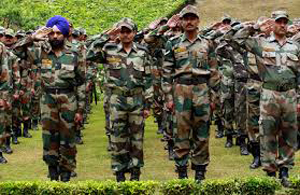
Discussions on surgical strikes will be insult to Army: BJP

October 5, 2016

New Delhi, Oct 5: Hitting out at those "seeking proof" of the surgical strikes in PoK, Union Minister M Venkaiah Naidu today said further discussions on the operations will be an "insult" to the "commendable" task carried out by the Army.

images 6"There is no need to respond to such irresponsible comments and demands. Fortunately, Congress has also realised its mistake and distanced itself from the comments of its leaders...AAP has also made it very clear," he told reporters on the sidelines of an event here.

He said nobody has any doubt about the "credentials and commitment" of the Indian Army which has done a "commendable" job and further discussions on the operations will be an "insult" to the force.

"I don't think any Indian citizen has got any doubt. Nobody is doubting the credentials and commitment of the Indian Army. It did a commendable job...It would be an insult to the Army if we further discuss," he said.

Naidu said the Director General Military Operations (DGMO) himself had given the statement about the operations in full details and also shared the information at an all-party meeting.

He wondered if giving further details will be in the interest of the nation. Observing that entire country is happy about the surgical strikes, he said the world has also acknowledge the step taken by India.

"Only Pakistan is saying something because they have to say something. They are not in a position to conduct funeral or last rites of their own citizens...This is their culture," he said.

Earlier, addressing the event, the minister said India does not want war with anybody, but will give a befitting reply if continuously provoked.

"...We never want a war with anybody. If somebody continuously provokes us, we will give them a befitting reply like our jawans gave the reply recently," he said.

Congress leader Sanjay Nirupam had accused the BJP of indulging in politics over national interest and called the surgical strikes on terror camps as fake, the comments which were slammed by his own party.

Congress leader P Chidmabaram had also reportedly said it was up to the government to give proof of the surgical strikes in which seven terror launch pads in Pakistan-occupied-Kashmir were destroyed by the Army.

Also, Delhi Chief Minister Arvind Kejriwal had on Monday released a video message "saluting" Prime Minister Narendra Modi for the surgical strikes across the LoC and urging him to "unmask" Pakistan's propaganda.

Pakistan has denied that the Indian Army conducted surgical strikes against terrorist units on its side of the border on the intervening night of September 28 and 29.

Comments

Rashid
 - 
Wednesday, 5 Oct 2016

You already made a lot of damage to the credentials of army by dragging it to your political gain. now international media also shown some sign of suspicion

Add new comment

  • Coastaldigest.com reserves the right to delete or block any comments.
  • Coastaldigset.com is not responsible for its readers’ comments.
  • Comments that are abusive, incendiary or irrelevant are strictly prohibited.
  • Please use a genuine email ID and provide your name to avoid reject.
Agencies
June 30,2020

United Nations, Jun 30: India accounts for 45.8 million of the world's 142.6 million "missing females" over the past 50 years, a report by the United Nations said on Tuesday, noting that the country along with China form the majority of such women globally.

The State of World Population 2020 report released on Tuesday by the United Nations Population Fund (UNFPA), the world organisation's sexual and reproductive health agency, said that the number of missing women has more than doubled over the past 50 years - from 61 million in 1970 to a cumulative 142.6 million in 2020.

Of this global figure, India accounted for 45.8 million missing females as of 2020 and China accounted for 72.3 million.

Missing females are women missing from the population at given dates due to the cumulative effect of postnatal and prenatal sex selection in the past, the agency said.

Between 2013 and 2017, about 460,000 girls in India were missing' at birth each year. According to one analysis, gender-biased sex selection accounts for about two-thirds of the total missing girls, and post-birth female mortality accounts for about one-third, the report said.

Citing data by experts, it said that China and India together account for about 90-95 per cent of the estimated 1.2 million to 1.5 million missing female births annually worldwide due to gender-biased (prenatal) sex selection.

The two countries also account for the largest number of births each year, it said.

The report cites data by Alkema, Leontine and others, 2014 National, Regional, and Global Sex Ratios of Infant, Child, and under-5 Mortality and Identification of Countries with Outlying Ratios: A Systematic Assessment' from The Lancet Global Health.

According to their analysis, India has the highest rate of excess female deaths, 13.5 per 1,000 female births, which suggests that an estimated one in nine deaths of females below the age of 5 may be attributed to postnatal sex selection.

The report notes that governments have also taken action to address the root causes of sex selection. India and Vietnam have included campaigns that target gender stereotypes to change attitudes and open the door to new norms and behaviours.

They spotlight the importance of daughters and highlight how girls and women have changed society for the better. Campaigns that celebrate women's progress and achievements may resonate more where daughter-only families can be shown to be prospering, it said.

The report said that successful education-related interventions include the provision of cash transfers conditional on school attendance; or support to cover the costs of school fees, books, uniforms and supplies, taking note of successful cash-transfer initiatives such as Apni Beti Apna Dhan' in India.

It said that preference for a male child manifested in sex selection has led to dramatic, long-term shifts in the proportions of women and men in the populations of some countries.

This demographic imbalance will have an inevitable impact on marriage systems. In countries where marriage is nearly universal, many men may need to delay or forego marriage because they will be unable to find a spouse, the report said.

This so-called "marriage squeeze", where prospective grooms outnumber prospective brides, has already been observed in some countries and affects mostly young men from lower economic strata.

"At the same time, the marriage squeeze could result in more child marriages, the report said citing experts.

Some studies suggest that the marriage squeeze will peak in India in 2055. The proportion of men who are still single at the age of 50 is forecast to rise after 2050 in India to 10 per cent, it said.

The UN report said that every year, millions of girls globally are subjected to practices that harm them physically and emotionally, with the full knowledge and consent of their families, friends and communities.

At least 19 harmful practices, ranging from breast ironing to virginity testing, are considered human rights violations, according to the UNFPA report, which focuses on the three most prevalent ones: female genital mutilation, child marriage, and extreme bias against daughters in favour of sons.

Harmful practices against girls cause profound and lasting trauma, robbing them of their right to reach their full potential, says UNFPA Executive Director Dr. Natalia Kanem.

This year, an estimated 4.1 million girls will be subjected to female genital mutilation. Today, 33,000 girls under age 18 will be forced into marriages, usually to much older men and an extreme preference for sons over daughters in some countries has fuelled gender-biased sex selection or extreme neglect that leads to their death as children, resulting in the 140 million missing females.

The report said that ending child marriage and female genital mutilation worldwide is possible within 10 years by scaling up efforts to keep girls in school longer and teach them life skills and to engage men and boys in social change.

Investments totalling USD 3.4 billion a year through 2030 would end these two harmful practices and end the suffering of an estimated 84 million girls, it said.

A recent analysis revealed that if services and programmes remain shuttered for six months due to the COVID-19 pandemic, an additional 13 million girls may be forced into marriage and 2 million more girls may be subjected to female genital mutilation between now and 2030.

The pandemic both makes our job harder and more urgent as so many more girls are now at risk, Kanem said.


Comments

Add new comment

  • Coastaldigest.com reserves the right to delete or block any comments.
  • Coastaldigset.com is not responsible for its readers’ comments.
  • Comments that are abusive, incendiary or irrelevant are strictly prohibited.
  • Please use a genuine email ID and provide your name to avoid reject.
News Network
May 8,2020

New Delhi, May 8: The Supreme Court on Friday suggested that states should consider indirect sale and home delivery of liquor as per its statute and law to avoid crowding at liquor shops amid the ongoing coronavirus-induced lockdown.

A bench headed by Justice Ashok Bhushan refused to pass any orders on a public interest litigation (PIL) seeking clarity on the sale of liquor and to ensure social distancing while it is being sold in liquor shops during the lockdown.

"We will not pass any order but the states should consider indirect sale/home delivery of liquor to maintain social distancing norms and standards," Justice Ashok Bhushan said while disposing of the petition.

The PIL, filed by one Sai Deepak, sought directions for closure of liquor shops for failing to enforce social distancing, which is essential to prevent the spread of coronavirus.

The petitioner told the apex court that he only wants that the life of common people is not affected because of crowding at liquor shops during COVID-19.

Justice Sanjay Kishan Kaul, another judge in the bench, said that discussion on home delivery is already going on.

The top court, after hearing the petition complaining about flouting of safety norms at liquor shops, observed that it cannot pass any orders to different states but they should consider online sale and home delivery of liquor.

Comments

Add new comment

  • Coastaldigest.com reserves the right to delete or block any comments.
  • Coastaldigset.com is not responsible for its readers’ comments.
  • Comments that are abusive, incendiary or irrelevant are strictly prohibited.
  • Please use a genuine email ID and provide your name to avoid reject.
Agencies
May 26,2020

New Delhi, May 26: As India ranked 10th in the global infection list, overtaking Iran, which was an early hotspot of coronavirus, India's top medical body has said the human trials of COVID-19 vaccine may begin at least in six months.

Dr. Rajni Kant, Director Regional Medical Research Centre and Head at the Indian Council of Medical Research (ICMR) said, "The virus strain isolated at the National Institute of Virology (NIV) laboratory in Pune will be used to develop the vaccine, and this strain has been successfully transferred to the Bharat Biotech International Ltd. (BBIL). It is expected that the human trials of the vaccine will begin in at least six months."

Queried on the focus areas as India inches closer to 1.4 lakh COVID-19 cases, Kant said we should not get anxious about the rapid increase in numbers, especially in the past week, which saw 5,000 Covid-19 cases daily, instead focus on protecting the most vulnerable group.

"We should not fear from increasing Covid-19 cases. The elderly and people with comorbidities need protection. This is the highly vulnerable group, and we need to deploy resources and develop strategies to keep the mortality rate as low as possible in this group," said Kant.

Initially, it was assumed that the country would require thousands of ventilators, but last week, the health ministry said only 0.45 per cent of COVID-19 cases need ventilator support.

Kant insisted the focus should be on five per cent to 10 per cent serious patients. "We are testing more than one lakh daily and our case fatality rate is already one of the lowest in the world. In absence of vaccine, people should follow social distancing guidelines," he added

On the significance of the recovery rate, Kant said the increasing recovery rate of the COVID-19 patients, which is at 41 per cent, is a bright spot in India's fight against deadly viral infection.

Queried on large scale COVID-19 cases in Mumbai, Delhi and Ahmedabad, Kant said the population density in these regions is very high, which proves to be the just right environment for the viral infection.

He insisted on developing robust cluster management strategies in the hard-hit coronavirus spots, and the movement of people should be curtailed in these areas.

"Currently, a lot of people are moving around easily and avoiding social distancing norms. The first phase of the lockdown was very effective, but now things have changed," added Kant.

Comments

Add new comment

  • Coastaldigest.com reserves the right to delete or block any comments.
  • Coastaldigset.com is not responsible for its readers’ comments.
  • Comments that are abusive, incendiary or irrelevant are strictly prohibited.
  • Please use a genuine email ID and provide your name to avoid reject.