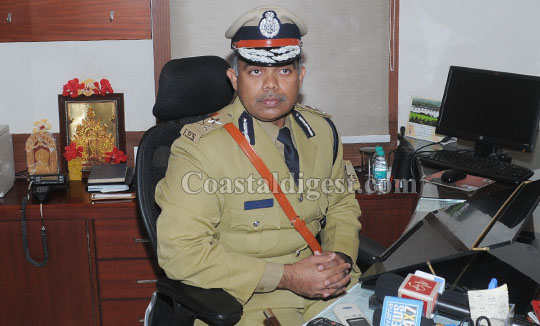
District Police Complaints Authority given more power

[email protected] (CD Network)
February 15, 2016

Mangaluru, Feb 15: The Karnataka government has now given more power to District Police Complaints Authority (DPCA) by appointing the chiefs of city police commissionerates in the state as its member secretaries.

chandrasekhar

Accordingly, M Chandra Sekhar, police commissioner of Mangaluru will be the member secretary for Dakshina Kannada Authority. The regional commissioner, Mysuru will be the chairperson of the authority as per government order dated February 4, 2016.

The DPCA was set up following a government order dated October 20, 2014 after increasing complaints of police atrocities.

The authority is empowered to inquire into custodial deaths, grievous injuries, rape and such other serious offences committed under officers of the rank of deputy superintendents/ assistant commissioners of police and below them.

It also has the powers to inquire into misbehaviour and misuse of power by such officials. Complaints against officers above the rank of DySP/ ACP would have to be submitted to the State Police Complaints Authority.

Dakshina Kannada Authority

The Dakshina Kannada Authority may be contacted at the office of the Commissioner of Police, Mangaluru City, Mangaluru 575001, phone 0824-2220801.

The State authority may be contacted at Room No. 36, Ground Floor, Vikasa Soudha, Bengaluru 560001, phone 080 22386063, 22034220, said an official release here.

Comments

abdul
 - 
Monday, 15 Feb 2016

Actually in any Government office not to keep any religion photo or Status in govt office (As per indian Constituency

Add new comment

  • Coastaldigest.com reserves the right to delete or block any comments.
  • Coastaldigset.com is not responsible for its readers’ comments.
  • Comments that are abusive, incendiary or irrelevant are strictly prohibited.
  • Please use a genuine email ID and provide your name to avoid reject.
News Network
January 30,2020

Bengaluru, Jan 30: There are around 3 lakh Bangladeshis across Karnataka and around 3,000 of them left Bengaluru following the recent crackdown, according to Bhaskar Rao, Bengaluru city police commissioner.

It's the first time a high-ranking official has put a number to Bangladeshis in Karnataka following the debate over the new citizenship law.

At a conclave on 'Construction Workers Safety, Health and Welfare' organised by the labour department and IIMB here, he said the estimate was arrived at based on information sourced from Bangladeshis deported recently.

There's been no study to ascertain the Bangladeshi population in the state, Rao said, adding that most illegal Bangladeshis in Bengaluru are victims of human trafficking.

"They come to Bengaluru for employment. Unlike other cities, Bengaluru has a lot of job potential and pays good salaries too. There are a lot of Bangladeshis working in the construction industry," Rao said.

Workers from Bangladesh demand lower wages. While other labourers demand around Rs 500 to Rs 600 per day, Bangladeshi workers don’t complain about being paid around Rs 100-150,” Rao said, adding that this has encouraged human traffickers to increasingly bring in Bangladeshis.

Suresh Hari, chairman, Confederation of Real Estate Developers Association of India, however, said they’re not aware of the nationality of their workers as contractors bring workers registered for tasks. “It’s difficult to say where they are from as there’s also construction work outside Credai’s purview,” Hari said.

Comments

Add new comment

  • Coastaldigest.com reserves the right to delete or block any comments.
  • Coastaldigset.com is not responsible for its readers’ comments.
  • Comments that are abusive, incendiary or irrelevant are strictly prohibited.
  • Please use a genuine email ID and provide your name to avoid reject.
News Network
March 15,2020

While it makes perfect sense for IT employees to work from remote locations via video conferencing and collaboration tools seamlessly - especially in the case of tech giants like Google or Microsoft -- workers from the non-IT companies and small and medium enterprises (SMBs) are the worst-hit in India as most of them have little or no clue about how these messaging and collaboration tools work amid the coronavirus pandemic.

Small companies -- from corporate to education verticals -- are scrambling to get their act together as new coronavirus threat has reached their premises, prompting them to send employees home who have age-old laptops, poor network and connectivity with no UPS backups and little knowledge about how to handle group chat and collaboration software like Zoom, Google Hangouts Meet, Microsoft Teams and Flock etc.

Instead of halting operations, however, businesses can choose to shift towards remote working methods with teaching non-IT staff on how to use the latest digital software to connect and work, say industry experts.

The training will take some time and may hamper productivity in the short run but is a win-win situation for the non-tech companies in the long run, in case any such global emergency arises in the future.

According to a latest report by Gartner, 54 per cent of HR leaders have cited that poor technology and/or infrastructure for remote working is the biggest barrier to effective remote working.

Sandy Shen, Senior Director Analyst, Gartner, says that with COVID-19 disrupting the business landscape, CIOs should relook at the digital fulfillment of market demand.

"The value of digital channels, products and operations is immediately obvious to companies everywhere right now. This is a wake-up call for organisations that have placed too much focus on daily operational needs at the expense of investing in digital business and long-term resilience," warned Shen.

Businesses that can shift technology capacity and investments to digital platforms will mitigate the impact of the outbreak and keep their companies running smoothly now, and over the long term.

"Videoconferencing, messaging, collaboration tools and document sharing are just a few examples of technologies that facilitate remote work. Additional bandwidth and network capacity may also be needed, given the increasing number of users and volume of communications," informed Shen.

The IT industry's apex body Nasscom has asked the government to relax norms for a month to allow work-from-home for technology and back-office employees as a measure to deal with the spread of Covid-19 in India.

Networking giant Cisco said that it has seen "significant growth" in the usage of its web conferencing and video-conferencing service Webex in India.

According to Muneer Ahmad, Business Head, ViewSonic India, due to COVID-19 pandemic, the corporate and educational sector is severely getting affected in the country.

"ViewSonic IFP has a cloud-based software which help teachers and corporates to connect through video conferencing to multiple people at the same time and can split the screen into six screens. It can also connect with various tools like Skype, Cisco WebEx, Zoom, Google Hangouts and GoToMeeting," Ahmad told IANS.

Co-working sector has also taken a hit and the industry is looking at several measures to tackle it -- from ensuring supply of juices rich in Vitamin C to supply of disinfectants and giving work from home facilities.

"The scheduled visits of the clients at our co-working offices have been postponed. Few of our clients have cancelled their outstation meetings and have now started audio/video conferencing for virtual meetings," said Nakul Mathur, MD, Avanta India.

According to reports, India has approximately 1,000 co-working locations (as of September 2019) and is the second-largest market for the co-working industry after China.

As India's first licensed B2B Virtual Network Operator, CloudConnect Communications offers a collaborative platform that allows companies to overcome the COVID-19 threat while maintaining seamless business continuity and optimum employee productivity.

"We offer a secure, robust, reliable, scalable and trackable mobile-first unified communication infrastructure that aids remote teleworking so that businesses can continue operating even under any unforeseen circumstances," said Gokul Tandon, Executive Chairman, CloudConnect Communications.


Comments

Add new comment

  • Coastaldigest.com reserves the right to delete or block any comments.
  • Coastaldigset.com is not responsible for its readers’ comments.
  • Comments that are abusive, incendiary or irrelevant are strictly prohibited.
  • Please use a genuine email ID and provide your name to avoid reject.
News Network
May 5,2020

Bengaluru, May 5: The Karnataka excise department booked a case against a wine shop owner in this tech city for allegedly selling more liquor than permitted under the law to a buyer on the first day of shops reopening for business after 40-day lockdown on Monday, an official said on Tuesday.

"We have booked a case against licensed shop owner S. Venkatesh for reportedly selling Indian made liquor (IML) and beer to a buyer on Monday more than he is permitted under the Karnataka Excise Act section 36," Bengaluru South Excise Deputy Commissioner A. Giri told media persons.

The alleged sale came to light when the unidentified customer posted in the social media a receipt showing he bought liquor worth Rs 52,841 from Vanilla Spirit Zone in the city''s south-eastern suburb on Monday afternoon.

"Preliminary investigation revealed that 17.4 litres of IML was sold against the permissible limit of 2.3 litres and 35.1 litres of beer against the legal limit of 18.2 litres," Giri said.

Venkatesh, however, told Giri that the buyer paid for the liquor bought by him and seven of his colleagues at the same time from the shop as they entered together.

"We are investigating to ascertain if Venkatesh violated the license conditions by paying for liquor bought by his friends with him at the same time," Giri added.

Comments

Add new comment

  • Coastaldigest.com reserves the right to delete or block any comments.
  • Coastaldigset.com is not responsible for its readers’ comments.
  • Comments that are abusive, incendiary or irrelevant are strictly prohibited.
  • Please use a genuine email ID and provide your name to avoid reject.