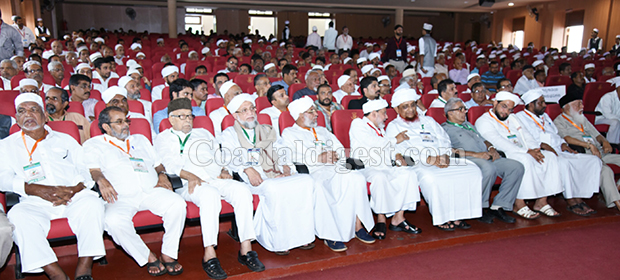
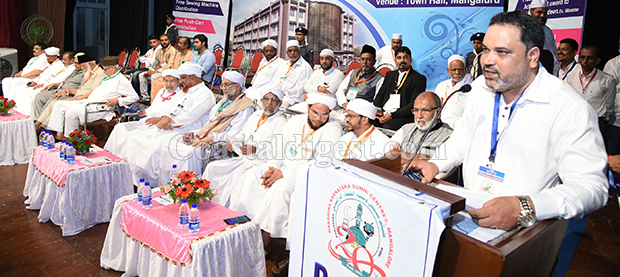
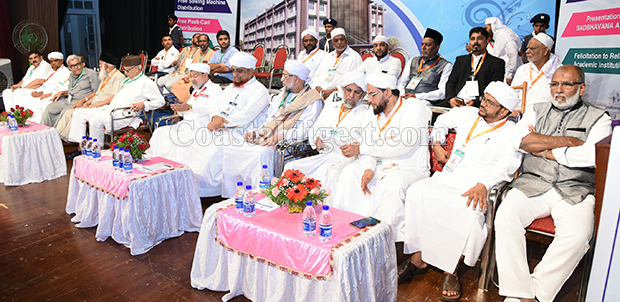
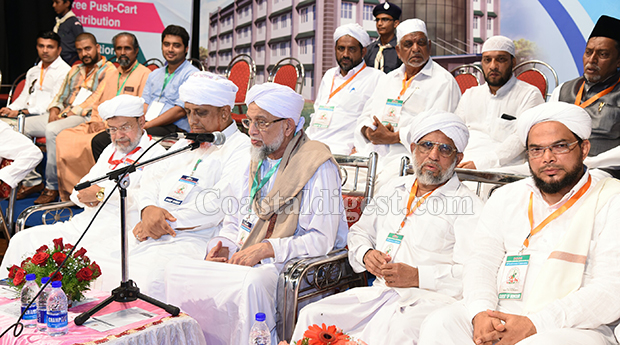
DKSC celebrates 20th anniversary; clerics lay emphasis on education

[email protected] (CD Network | Chakravarthi)
September 22, 2016

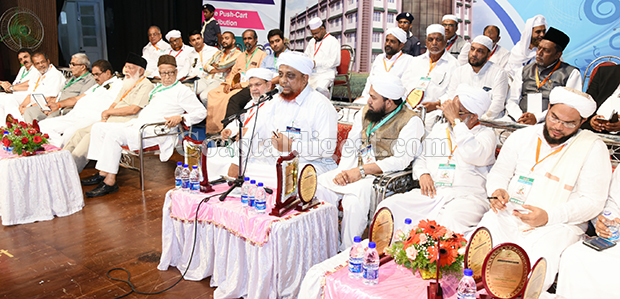
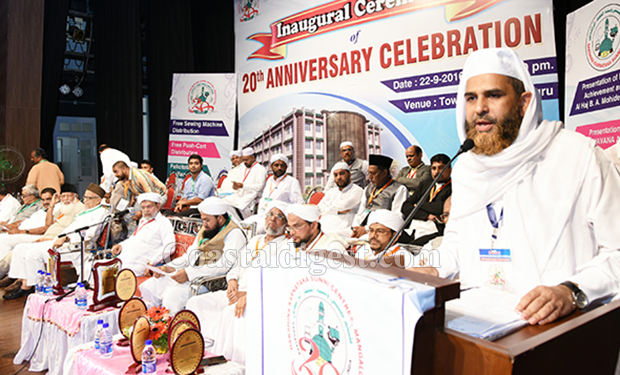
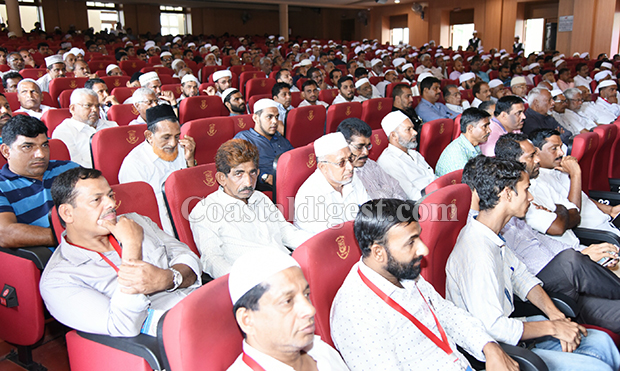
Mangaluru, Sep 22: Ibrahim Musliyar Bekal, a prominent Sunni cleric of coastal Karnataka and the Khazi of Udupi district has called upon the madrasa students not to ignore the material education.

1t

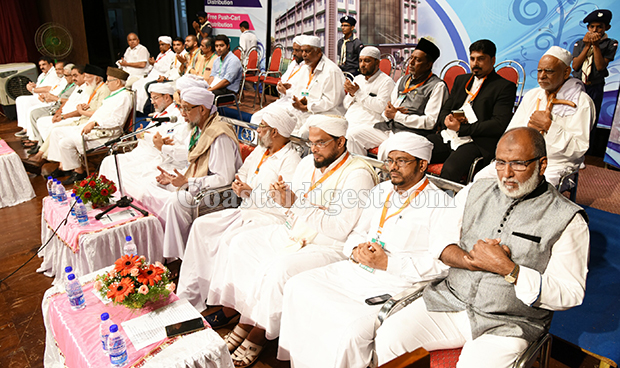
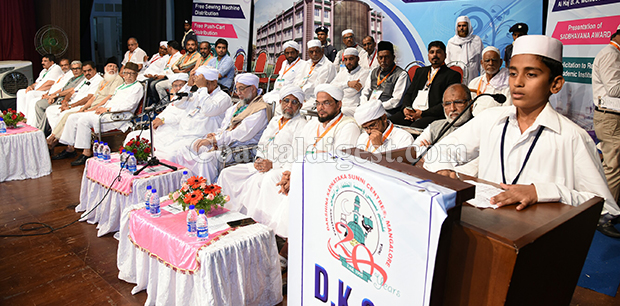
Inaugurating the 20th anniversary of Dakshina Karnataka Sunni Centre (DKSC), Ibrahim Musliyar said that one should acquire material education along with religious education.

He said that DKSC was formed two decades ago by a group of visionary scholars and leaders with an intention to give more priority to education of Muslim children. “It has been moving on the right direction and achieved its cause,” he said.

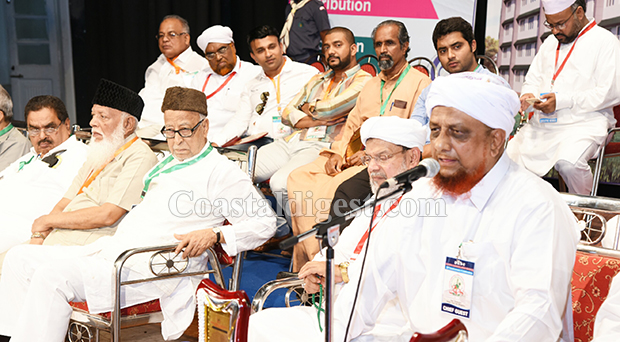
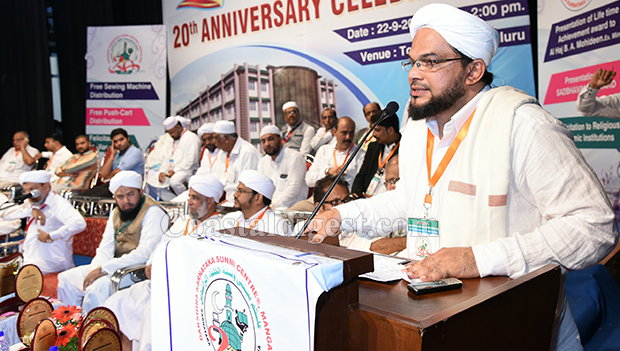
Delivering the keynote address Abdul Azeez Darimi, Khatheeb of Chokkabettu mosque, exhorted the people to take care of the health' of the society.

Communal hatred is one of the dangerous diseases of the society. It is our responsibility to eradicate such diseases through spreading knowledge,' he said.

Abdul Rasheed Zaini, general secretary, Markazul Huda Kumbra, presented the message of DKSC.

Awards

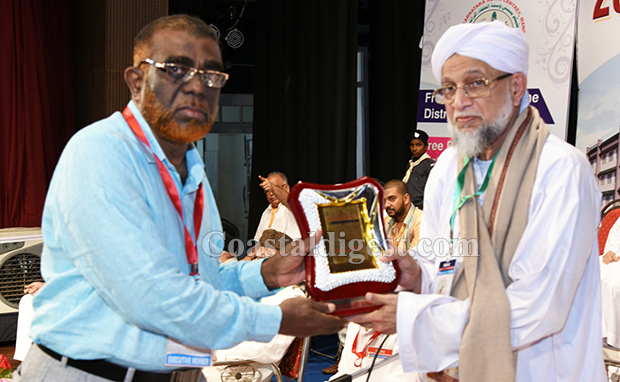
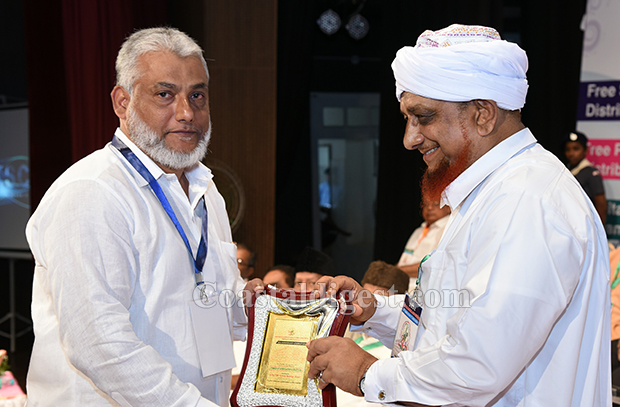
On the same occasion former education minister and Beary stalwart B A Mohideen was conferred with the DKSC lifetime achievement award.

DKSC goodwill awards were conferred on educationist Dr M Mohan Alva, industrialist Abdul Rawoof Puthige and UC Poulos for the relentless efforts to spread communal harmony.

Sewing machines

B Ramanath Rai, the district in charge minister for Dakshina Kannada, who was one of the chief guests, distributed sewing machines to 20 odd women on behalf of DKSC.

On the same occasion 20 educational institutions were awarded and 20 clerics who served for over 20 years in any one mosque were felicitated.

Thwaka Ahmed Musliyar, Khazi of Dakshina Kannada offered dua. Syed Atakoya Thangal Kumbol, presided over the event. Mumtaz Ali, reception committee president, welcomed. UD Abdul Hameed, DKSC working president proposed vote of thanks.

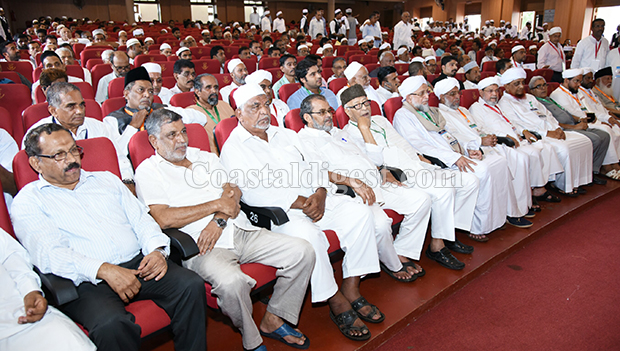
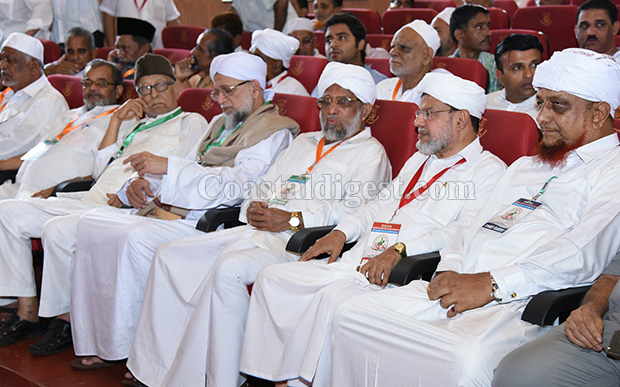
UT Khader, Y Mohammed Kunhi, SM Rasheed Haji, Zakariya Jokatte, Ibrahim Kodichal were present among others.

townhallS 1

townhallS 2

townhallS 3

townhallS 4

townhallS 5

townhallS 6

townhallS 7

townhallS 8

townhallS 9

townhallS 10

townhallS 11

townhallS 12

townhallS 13

townhallS 14

townhallS 15

townhallS 16

townhallS 17

townhallS 18

townhallS 19

townhallS 20

townhallS 21

Comments

Umar Farook
 - 
Monday, 26 Sep 2016

A million thanks to CD team for the nice coverage. DKSC is a mammoth Organisation in GCC countries Sand I really salute them for arranging a much awaited program having all sections of SUNNIS associated together in SINGLE dias. This can be achieved only by DKSC. 5 points program they released during the inaugural function was very superb. Keep it up.

Abdul aziz Muloor
 - 
Sunday, 25 Sep 2016

Masha Allha Dksc zindhabaad good coverage hats off CD jazhakallha kair C D groups

Abdullah
 - 
Friday, 23 Sep 2016

Good coverage. nice photos and report. thanks a lot CD

Rumi ahmed
 - 
Thursday, 22 Sep 2016

Salams to all education is a must to know something so that it becomes a means to earn our livelyhood and be aware of our duties and environment in general religion is a must and a guidance for right living knowing our creator and what he expects from us it helps In banishment of ignorance and blindly following powerful religious clergy god-men and political power.

Add new comment

  • Coastaldigest.com reserves the right to delete or block any comments.
  • Coastaldigset.com is not responsible for its readers’ comments.
  • Comments that are abusive, incendiary or irrelevant are strictly prohibited.
  • Please use a genuine email ID and provide your name to avoid reject.
News Network
July 28,2020

Hounde, Jul 28: Coronavirus and its restrictions are pushing already hungry communities over the edge, killing an estimated 10,000 more young children a month as meager farms are cut off from markets and villages are isolated from food and medical aid, the United Nations warned Monday.

In the call to action shared with The Associated Press ahead of publication, four UN agencies warned that growing malnutrition would have long-term consequences, transforming individual tragedies into a generational catastrophe.

Hunger is already stalking Haboue Solange Boue, an infant from Burkina Faso who lost half her former body weight of 5.5 pounds (2.5 kilograms) in just a month. Coronavirus restrictions closed the markets, and her family sold fewer vegetables. Her mother was too malnourished to nurse.

“My child,” Danssanin Lanizou whispered, choking back tears as she unwrapped a blanket to reveal her baby's protruding ribs.

More than 550,000 additional children each month are being struck by what is called wasting, according to the UN — malnutrition that manifests in spindly limbs and distended bellies. Over a year, that's up 6.7 million from last year's total of 47 million. Wasting and stunting can permanently damage children physically and mentally.

“The food security effects of the COVID crisis are going to reflect many years from now,” said Dr. Francesco Branca, the WHO head of nutrition. “There is going to be a societal effect.”

From Latin America to South Asia to sub-Saharan Africa, more poor families than ever are staring down a future without enough food.

In April, World Food Program head David Beasley warned that the coronavirus economy would cause global famines “of biblical proportions” this year. There are different stages of what is known as food insecurity; famine is officially declared when, along with other measures, 30% of the population suffers from wasting.

The World Food Program estimated in February that one Venezuelan in three was already going hungry, as inflation rendered salaries nearly worthless and forced millions to flee abroad. Then the virus arrived.

“Every day we receive a malnourished child,” said Dr. Francisco Nieto, who works in a hospital in the border state of Tachira.

In May, Nieto recalled, after two months of quarantine, 18-month-old twins arrived with bodies bloated from malnutrition. The children's mother was jobless and living with her own mother. She told the doctor she fed them only a simple drink made with boiled bananas.

“Not even a cracker? Some chicken?” he asked.

“Nothing,” the children's grandmother responded. By the time the doctor saw them, it was too late: One boy died eight days later.

The leaders of four international agencies — the World Health Organization, UNICEF, the World Food Program and the Food and Agriculture Organization — have called for at least dollar 2.4 billion immediately to address global hunger.

But even more than lack of money, restrictions on movement have prevented families from seeking treatment, said Victor Aguayo, the head of UNICEF's nutrition program.

“By having schools closed, by having primary health care services disrupted, by having nutritional programs dysfunctional, we are also creating harm,” Aguayo said. He cited as an example the near-global suspension of Vitamin A supplements, which are a crucial way to bolster developing immune systems.

In Afghanistan, movement restrictions prevent families from bringing their malnourished children to hospitals for food and aid just when they need it most. The Indira Gandhi hospital in the capital, Kabul, has seen only three or four malnourished children, said specialist Nematullah Amiri. Last year, there were 10 times as many.

Because the children don't come in, there's no way to know for certain the scale of the problem, but a recent study by Johns Hopkins University indicated an additional 13,000 Afghans younger than 5 could die.

Afghanistan is now in a red zone of hunger, with severe childhood malnutrition spiking from 690,000 in January to 780,000 — a 13% increase, according to UNICEF.

In Yemen, restrictions on movement have blocked aid distribution, along with the stalling of salaries and price hikes. The Arab world's poorest country is suffering further from a fall in remittances and a drop in funding from humanitarian agencies.

Yemen is now on the brink of famine, according to the Famine Early Warning Systems Network, which uses surveys, satellite data and weather mapping to pinpoint places most in need.

Some of the worst hunger still occurs in sub-Saharan Africa. In Sudan, 9.6 million people live from one meal to the next — a 65% increase from the same time last year.

Lockdowns across Sudanese provinces, as around the world, have dried up work and incomes for millions. With inflation hitting 136%, prices for basic goods have more than tripled.

“It has never been easy but now we are starving, eating grass, weeds, just plants from the earth,” said Ibrahim Youssef, director of the Kalma camp for internally displaced people in war-ravaged south Darfur.

Adam Haroun, an official in the Krinding camp in west Darfur, recorded nine deaths linked with malnutrition, otherwise a rare occurrence, over the past two months — five newborns and four older adults, he said.

Before the pandemic and lockdown, the Abdullah family ate three meals a day, sometimes with bread, or they'd add butter to porridge. Now they are down to just one meal of “millet porridge” — water mixed with grain. Zakaria Yehia Abdullah, a farmer now at Krinding, said the hunger is showing “in my children's faces.”

“I don't have the basics I need to survive,” said the 67-year-old, who who hasn't worked the fields since April. “That means the 10 people counting on me can't survive either.”


Comments

Add new comment

  • Coastaldigest.com reserves the right to delete or block any comments.
  • Coastaldigset.com is not responsible for its readers’ comments.
  • Comments that are abusive, incendiary or irrelevant are strictly prohibited.
  • Please use a genuine email ID and provide your name to avoid reject.
News Network
March 18,2020

Bengaluru, Mar 18: Karnataka Congress President DK Shivakumar on Wednesday met the Director-General of Police in Bengaluru and demanded police protection for Madhya Pradesh Congress MLAs and the removal of BJP workers from the hotel in Bengaluru, where the legislators are currently lodged.

"The (Madhya Pradesh) legislators have come here and have requested police protection, that is all. Let the police give them protection, our candidate (Digvijaya Singh) has come, let him meet the legislators. Why are BJP workers protecting them? We know that they are under threat and hence we need to vacate them (BJP workers)," Shivakumar told reporters here after the meeting.

"We will give protection to our men and that is why we are telling them they cannot stop us. They should be in a free and fair position. I have communicated to DGP that BJP needs to vacate," he added.

Earlier today, Congress' Rajya Sabha candidate from Madhya Pradesh and former chief minister Digvijaya Singh was placed under preventive arrest after he sat on a dharna near Ramada Hotel here, allegedly for not being allowed by police to meet the 21 Congress rebel MLAs lodged in a hotel.

"I am a Rajya Sabha candidate from Madhya Pradesh, voting is scheduled for March 26. My MLAs have been kept here, they want to speak to me, their phones have been snatched, the police is not letting me speak to them saying there is a security threat to MLAs," Singh told reporters.

Singh who sat on the dharna with a face mask on said: "We were expecting them to come back, but when we saw they're being held back, messages came from their families...I personally spoke to five MLAs, they said they're captive, phones snatched away, there is Police in front of every room. They're being followed 24/7," Singh said.

The development comes amid the political crisis in Madhya Pradesh after the exit of Jyotiraditya Scindia from the Congress party.

Scindia's departure was followed by 22 Congress MLAs resigning from the party as well as from the state legislative Assembly.

The resignation of these MLAs has left the Kamal Nath government below the majority mark.

Comments

Add new comment

  • Coastaldigest.com reserves the right to delete or block any comments.
  • Coastaldigset.com is not responsible for its readers’ comments.
  • Comments that are abusive, incendiary or irrelevant are strictly prohibited.
  • Please use a genuine email ID and provide your name to avoid reject.
News Network
July 6,2020

Bengaluru, Jul 6: Criminal cases will be registered against private hospitals that refuse treatment to COVID-19 patients, Medical Education Minister Dr K Sudhakar said on Sunday.

Addressing a press conference here at Vidhana Soudha, he said: "No hospital should refuse to admit patients and if any hospital is found denying treatment criminal cases will be registered against them."

He spoke to media persons after returning from his surprise visit to Jayanagar General Hospital and Rajiv Gandhi Chest Hospital responded to the questions regarding private hospitals refusing to treat covid patients.

"The government has come up with 6 different systems for treatment of COVID-19 patients. COVID care centres, government medical colleges, private medical college, government hospitals, corporate hospitals and home isolation with proper facilities and according to government guidelines," the minister added.

Dr Sudhakar gave the statistics of 4 metropolitan cities in the country including Delhi, Mumbai, Chennai and Bengaluru.

"Bengaluru's and the mortality rate is the lowest at 1.46%. The aim is to increase testing by optimal utilisation of capacity especially in private labs. Once we increase testing, it is natural that the positive cases will also increase," he said.

"So citizens need not panic due to this but should take all precautionary measures. He advised to get tested in the nearest fever clinics as soon as any symptoms like cough, fever etc are found. Guidelines regarding the home isolation will be released soon," the minister said.

He announced that 400 ambulances will be deployed in Bengaluru and 2 each for every ward.

He said that the government recommended patients at private hospitals will be provided with insurance under Suvarna Arogya Suraksha Trust.

"If private hospitals refuse to admit the patients, call 1912 helpline to get assistance. If admitted in Private hospital voluntarily the treatment cost will be borne by patients as per the rates fixed by the government," Sudhakar said.

He said that the cost of testing at private labs has been capped at Rs 2,200 as per test.

Comments

Add new comment

  • Coastaldigest.com reserves the right to delete or block any comments.
  • Coastaldigset.com is not responsible for its readers’ comments.
  • Comments that are abusive, incendiary or irrelevant are strictly prohibited.
  • Please use a genuine email ID and provide your name to avoid reject.