


Don't mess with govt image: Modi's message to Smriti Irani

July 6, 2016

New Delhi, Jul 6: In the high decibel din of the Cabinet expansion and reshuffle of portfolios in the Narendra Modi government, the media seems to have forgotten about a certain BJP maverick MP – Subramanian Swamy – who until recently was its obsession. Where is he now in this celebration?
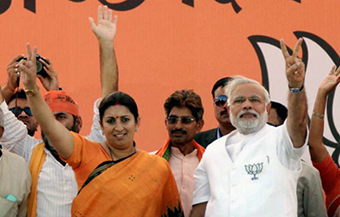
modisairathSwamy neither figures in the list of new inductees, nor does he seem to be throwing tantrums over his exclusion. Evidently, Swamy's antics of attacking the likes of RBI governor Raghuram Rajan, economic advisor Arvind Subramanian and other officials of the Finance Ministry turned out to be a misadventure. His snide remarks against Finance Minister Arun Jaitley was the final nail in the coffin of his aspirations to be a Union minister.

In his attempt to rejig the Cabinet, Prime Minister Narendra Modi has shown a distinct distaste for those with a penchant for courting controversy. Swamy's exclusion and Smriti Irani's removal from the human resource development (HRD) Ministry are indicative of a pattern.

Though unlike Swamy, Irani never crossed the Rubicon line of party discipline. Yet she found herself in the midst of many controversies related to her haughtiness with bureaucrats and academics – with Dalit scholar Rohith Vemula's suicide in Hyderabad and the JNU row marking crucial blows in her two-year tenure as HRD minister.

Though senior BJP leaders, including Modi, are quite impressed by Irani's political pugnacity, she seems to have lost out on moderation. In a recent conference of vice-chancellors of central universities, she ticked off seasoned academics in a very unpleasant manner.

Apparently the minister's conduct could not endear her to the bureaucracy and academics. On some occasions, she was seen courting controversies that may suit the image of a street-fighter, but not of a Union minister.

Contrast this with Prakash Javadekar, an unassuming leader from Maharashtra, who is the only one elevated in this Cabinet expansion – he is now the HRD minister, after relieving his post as the Environment Minister. All this, with Javadekar maintaining a low-profile while facilitating the industry to negotiate with environmental concerns.

Insiders say that Javadekar very deftly handled his assignment of aligning the regulatory regime of the environment Ministry with developmental concerns. He was rewarded with the HRD portfolio for efficiently implementing the government's agenda and for his pro-active role in the climate change talks in Paris. Given Javadekar's own training as Swayamsevak, his new assignment would only get wide approval within the Sangh Parivar.

If the reshuffle is any indication, then it is clear that the prime minister did not hesitate to clip the wings of those found falling short of his expectations. For instance, the communication portfolio was taken away from a voluble Ravi Shankar Prasad and given to Minister of State for Railway Manoj Sinha, as additional responsibility.

Sinha, an engineering graduate from Banaras Hindu University, won unqualified admiration for his efficiency, while maintaining a low-profile. Prasad was, however, given back the charge of the Law Ministry in view of his background as a lawyer – he replaced DV Sadananda Gowda, who had taken over the law ministry from Prasad back in 2014.

Modi has also plugged gaps in certain portfolios by appointing MJ Akbar in the Foreign Ministry and by deploying Ananth Kumar as Parliamentary Affairs Minister, along with SS Ahluwalia, to mobilise support from non-congress parties for the smooth conduct of Parliament.

The underlying theme of the Cabinet reshuffle is quite Biblical – 'meek shall inherit the earth'. This is the precise reason why Swami is left sulking. Similarly, a powerful leader like Yogi Adityanath in eastern UP was ignored, though the Cabinet expansion saw the accommodation of several leaders with influence at the local level. Modi also did not hesitate to axe Ram Shankar Katheria – as the junior HRD minister – as his controversial utterances had caused much consternation.

Taken together, the whole exercise conveyed that those inducted within the government would not be allowed to mess around with its image, either by their conduct or by their utterances.

The implied message was clear – that those having self-inflated notions about themselves can enjoy all the freedom of speech and expression, but while sitting outside the government.

Comments

Satyameva jayate
 - 
Thursday, 7 Jul 2016

This shows how modijis govt failed for the last two years with useless ministers.........they gave positions to the modijis schela' s and now suffering......let's see after two years what will be the change....may be this party will change the PM candidate itself......

Add new comment

  • Coastaldigest.com reserves the right to delete or block any comments.
  • Coastaldigset.com is not responsible for its readers’ comments.
  • Comments that are abusive, incendiary or irrelevant are strictly prohibited.
  • Please use a genuine email ID and provide your name to avoid reject.
News Network
February 2,2020

New Delhi, Feb 2: Budget 2020 announcement that insurance behemoth LIC will be listed was well received by market participants who said this will be "IPO of the decade" akin to the Saudi Aramco listing.

Finance Minister Nirmala Sitharaman on Saturday said Life Insurance Corporation (LIC) will be listed as part of the government disinvestment initiative.

A "highlight of the budget is the LIC IPO, which is akin to the Saudi Aramco listing for Indian capital markets, and will be IPO of the decade," Vijay Bhushan, President, Association of National Exchanges Members of India (ANMI) said.

According to Krishna Kumar Karwa, Managing Director, Emkay Global Financial Services, the LIC IPO will be a big positive for corporate governance and transparency and will open up one more avenue for fund raising for the government over the years.

Metropolitan Stock Exchange, Interim CEO, Balu Nair said: "The LIC listing will be eagerly awaited by investors and will provide huge fillip to capital raising through the primary market." The government proposes to sell a part of its holding in LIC through an initial public offer, Sitharaman said while presenting Budget 2020-21.

"The government will sell part of LIC through its listing in the stock market which is also a positive trigger for the market," Amit Gupta, CO-Founder and CEO, TradingBells.

Jaideep Hansraj, MD and CEO of Kotak Securities said listing of LIC would help bridge a gap in the Fiscal Deficit for FY21.

Currently, the government owns the entire 100 per cent stake in LIC.

Saudi Aramco shares were listed in December last year.

Comments

Add new comment

  • Coastaldigest.com reserves the right to delete or block any comments.
  • Coastaldigset.com is not responsible for its readers’ comments.
  • Comments that are abusive, incendiary or irrelevant are strictly prohibited.
  • Please use a genuine email ID and provide your name to avoid reject.
News Network
May 12,2020

New Delhi, May 12: Minorities are "flourishing" in India and have been an equal partner in development without discrimination under the Modi government, Union Minister Mukhtar Abbas Naqvi said on Tuesday, dismissing allegations of Islamophobia as an attempt to defame the country.

The "Narendra Modi phobia club” has been unable to digest the inclusive growth under the prime minister and is engaged in a "nefarious campaign" in India and abroad through fake propaganda alleging "intolerance, communalism and discrimination" against minorities in India, Naqvi said.

In a blog titled "Islamophobia -- Bogey of Bogus Bashing Brigade", the minority affairs minister argued that the "Modi phobia club" is playing the “Islamophobia card" to harm the pluralistic fabric of India, but will not succeed.

Naqvi's remarks come days after a wave of angry reactions on Twitter by citizens and rights activists from various Arab countries following allegations that Muslims are being blamed for spreading COVID-19 in parts of India.

Also, the 57-member prominent international Mulim grouping, the Organisation of Islamic Cooperation, recently accused India of "Islamophobia".

India has dismissed all such allegations.

"Minorities in India are flourishing equally with all the citizens with a sense of equality, security and prosperity. Misinformation against such a gracious and tolerant country and its effective leadership is nothing but the height of ignorance and mental bankruptcy," Naqvi said.

He claimed that no riot took place in last 5 years of the Modi government and it was after "nefarious preaching" by those who were irked by this that the Delhi riots happened.

Naqvi said the women who sat on protests at Shaheen Bagh cannot be termed "anti-nationals" but they had been "misguided by the bogus bashing brigade”.

This brigade pushed these women on a path which had an “entry gate” but no “exit gate”, the minister said.

This was a “calculated conspiracy” by the brigade that wants to defame and disgrace Modi and India, Naqvi said.

He also argued that for the "first time since Independence", India has forged close and strong ties with nearly all Islamic nations and countries such as Saudi Arabia, the UAE, Afghanistan, Russia, Palestine, Mauritius and the Maldives have conferred Modi with their highest civilian awards.

"The United Nations has also conferred Narendra Modi with the prestigious 'Champions of the Earth Award'. Prime Minister Narendra Modi's global acceptance and popularity doesn't need any certificate," Naqvi said.

The Modi government never planned development on the basis of Hindus, Muslims, Sikhs, Christians or on region and caste, and its priority has been the poor and deprived, Naqvi said, adding that still some people with a “prejudiced mindset” are trying to defame India by raising the bogey of Islamophobia.

There is not a single incident of discrimination against any section of the society, including minorities under the Modi government, the minister asserted.

All sections, including minorities, are strongly moving forward on the path of “development with dignity” under the Modi government, he said.

When the challenges due to the coronavirus were in initial stages across the world in early January and several countries, including Pakistan, had not taken care of their people abroad, it was the Modi government that brought back thousands of Indians stranded in Wuhan (China), Iran, Iraq, Saudi Arabia and other countries, Naqvi said, adding that a majority of these people were Muslims.

In the recent Vande Bharat Mission also, the Indian government is bringing back thousands of Indians from countries such as the Maldives, the UAE, Saudi Arabia, Iran, Qatar and other countries which include a large number of Muslims, he pointed out.

"Strong eternal commitment of my country will defeat and demolish the fake and fabricated Islamophobia card of the 'India bashing brigade'," Naqvi said in his blog.

Comments

Add new comment

  • Coastaldigest.com reserves the right to delete or block any comments.
  • Coastaldigset.com is not responsible for its readers’ comments.
  • Comments that are abusive, incendiary or irrelevant are strictly prohibited.
  • Please use a genuine email ID and provide your name to avoid reject.
Agencies
July 5,2020

The deadly coronavirus that entered India while there was still nip in the air has beaten rising mercury, humid conditions, unique Indian genome and has entered monsoon season with more potency as fresh cases are only breaking all records in the country.

India recorded a single-day spike of record 24,850 new coronavirus cases on Sunday, taking its total tally to 6.73 lakh corona-positive cases.

Top Indian microbiologists were hopeful in March that after the 21-day lockdown, as summer approaches, the rise in temperature would play an important role in preventing the drastic spread of COVID-19 virus in India.

Several virologists hinted that by June this year, the impact of COVID-19 would be less than what it appeared in March-April.

The claims have fallen flat as the virus is mutating fast, becoming more potent than ever.

According to experts, the novel coronavirus is a new virus whose seasonality and response to hot humid weather was never fully understood.

"The theory was based on the fact that high temperatures can kill the virus as in sterilisation techniques used in healthcare. But these are controlled environment conditions. There are many other factors besides temperature, humidity which influence the transmission rate among humans," Dr Anu Gupta, Head, Microbiologist and Infection Control, Fortis Escorts Heart Institute, told IANS.

There is no built-up immunity to COVID-19 in humans.

"Also, asymptomatic people might be passing it to many others unknowingly. New viruses tend not to follow the seasonal trend in their first year," Gupta emphasized.

Globally, as several countries are now experiencing hot weather, the World Health Organization (WHO) reported a record hike in the number of coronavirus cases, with the total rising by 2,12,326 in 24 hours in the highest single-day increase since COVID-19 broke out.

So far over 11 million people worldwide have tested positive for the disease which has led to over 5,25,000 deaths, according to data from Johns Hopkins University. The US remained the worst-hit country with over 28 lakh cases, followed by Brazil with 15.8 lakh.

According to Sandeep Nayar, Senior Consultant and HOD, Respiratory Medicine, Allergy & Sleep Disorders, BLK Super Speciality Hospital in New Delhi, whether temperature plays a role in COVID-19 infection is highly debated.

One school of thought said in the tropical regions of South Asia, the virus might not thrive longer.

"On the other hand, another school of thought has found that novel Coronavirus can survive in a hot and humid environment and tropical climate does not make a difference to the virus. According to them, this is what distinguishes the novel coronavirus from other common viruses, which usually wane in hot weather," stressed Nayar.

Not much has been studied in the past and no definite treatment or vaccine is available to date.

"Every day, new properties and manifestation of the disease come up. As of now, the only way to prevent this monster is by taking appropriate precautions. Hand hygiene, social distancing, cough etiquette and face masks definitely reduce spread of COVID-19 infection," Nayar told IANS.

Not just top Indian health experts, even Indian-American scientists had this theory in mind that sunshine and summer may ebb the spread of the coronavirus.

Ravi Godse, Director of Discharge Planning, UPMC Shadyside Pennsylvania in the US told IANS in April: "In the summer, the humidity can go up as well, meaning more water drops in the air. If the air is saturated with water and somebody sneezes virus droplets into such air, it is likely that the droplets will fall to the ground quicker, making them less infectious. So the short answer is yes, summer/sunshine could be bettera.

According to Dr Puneet Khanna, Head of Respiratory Medicine and Pulmonology, Manipal Hospital, Delhi, COVID-19 death rates are not too different in tropical countries but since the disease affected them late it was yet to show its peak in these areas.

"The virus can survive well in hot and humid countries and this is proven now," he stressed.

Comments

Add new comment

  • Coastaldigest.com reserves the right to delete or block any comments.
  • Coastaldigset.com is not responsible for its readers’ comments.
  • Comments that are abusive, incendiary or irrelevant are strictly prohibited.
  • Please use a genuine email ID and provide your name to avoid reject.