


Don't mess with govt image: Modi's message to Smriti Irani

July 6, 2016

New Delhi, Jul 6: In the high decibel din of the Cabinet expansion and reshuffle of portfolios in the Narendra Modi government, the media seems to have forgotten about a certain BJP maverick MP – Subramanian Swamy – who until recently was its obsession. Where is he now in this celebration?
modisairathSwamy neither figures in the list of new inductees, nor does he seem to be throwing tantrums over his exclusion. Evidently, Swamy's antics of attacking the likes of RBI governor Raghuram Rajan, economic advisor Arvind Subramanian and other officials of the Finance Ministry turned out to be a misadventure. His snide remarks against Finance Minister Arun Jaitley was the final nail in the coffin of his aspirations to be a Union minister.

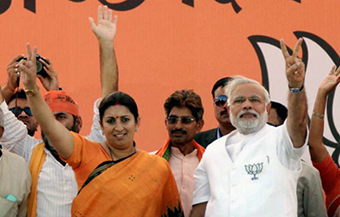
In his attempt to rejig the Cabinet, Prime Minister Narendra Modi has shown a distinct distaste for those with a penchant for courting controversy. Swamy's exclusion and Smriti Irani's removal from the human resource development (HRD) Ministry are indicative of a pattern.

Though unlike Swamy, Irani never crossed the Rubicon line of party discipline. Yet she found herself in the midst of many controversies related to her haughtiness with bureaucrats and academics – with Dalit scholar Rohith Vemula's suicide in Hyderabad and the JNU row marking crucial blows in her two-year tenure as HRD minister.

Though senior BJP leaders, including Modi, are quite impressed by Irani's political pugnacity, she seems to have lost out on moderation. In a recent conference of vice-chancellors of central universities, she ticked off seasoned academics in a very unpleasant manner.

Apparently the minister's conduct could not endear her to the bureaucracy and academics. On some occasions, she was seen courting controversies that may suit the image of a street-fighter, but not of a Union minister.

Contrast this with Prakash Javadekar, an unassuming leader from Maharashtra, who is the only one elevated in this Cabinet expansion – he is now the HRD minister, after relieving his post as the Environment Minister. All this, with Javadekar maintaining a low-profile while facilitating the industry to negotiate with environmental concerns.

Insiders say that Javadekar very deftly handled his assignment of aligning the regulatory regime of the environment Ministry with developmental concerns. He was rewarded with the HRD portfolio for efficiently implementing the government's agenda and for his pro-active role in the climate change talks in Paris. Given Javadekar's own training as Swayamsevak, his new assignment would only get wide approval within the Sangh Parivar.

If the reshuffle is any indication, then it is clear that the prime minister did not hesitate to clip the wings of those found falling short of his expectations. For instance, the communication portfolio was taken away from a voluble Ravi Shankar Prasad and given to Minister of State for Railway Manoj Sinha, as additional responsibility.

Sinha, an engineering graduate from Banaras Hindu University, won unqualified admiration for his efficiency, while maintaining a low-profile. Prasad was, however, given back the charge of the Law Ministry in view of his background as a lawyer – he replaced DV Sadananda Gowda, who had taken over the law ministry from Prasad back in 2014.

Modi has also plugged gaps in certain portfolios by appointing MJ Akbar in the Foreign Ministry and by deploying Ananth Kumar as Parliamentary Affairs Minister, along with SS Ahluwalia, to mobilise support from non-congress parties for the smooth conduct of Parliament.

The underlying theme of the Cabinet reshuffle is quite Biblical – 'meek shall inherit the earth'. This is the precise reason why Swami is left sulking. Similarly, a powerful leader like Yogi Adityanath in eastern UP was ignored, though the Cabinet expansion saw the accommodation of several leaders with influence at the local level. Modi also did not hesitate to axe Ram Shankar Katheria – as the junior HRD minister – as his controversial utterances had caused much consternation.

Taken together, the whole exercise conveyed that those inducted within the government would not be allowed to mess around with its image, either by their conduct or by their utterances.

The implied message was clear – that those having self-inflated notions about themselves can enjoy all the freedom of speech and expression, but while sitting outside the government.

Comments

Satyameva jayate
 - 
Thursday, 7 Jul 2016

This shows how modijis govt failed for the last two years with useless ministers.........they gave positions to the modijis schela' s and now suffering......let's see after two years what will be the change....may be this party will change the PM candidate itself......

Add new comment

  • Coastaldigest.com reserves the right to delete or block any comments.
  • Coastaldigset.com is not responsible for its readers’ comments.
  • Comments that are abusive, incendiary or irrelevant are strictly prohibited.
  • Please use a genuine email ID and provide your name to avoid reject.
Agencies
February 20,2020

New Delhi, Feb 20: Microsoft has begun testing its free open-source software called "ElectionGuard" in a small Wisconsin town in the US that aims to make voting more secure, verifiable and efficient.

"ElectionGuard" will enable end-to-end verification of elections, open results to third-party organisations for secure validation, and allow individual voters to confirm their votes were correctly counted.

It enables government entities, news outlets, human rights organisations or anyone else to build additional verifiers that independently can certify election results have been accurately counted and have not been altered, according to the company.

The software would create a paper trail and assure voters their votes were properly tallied.

"On Tuesday, Fulton residents are using the technology while choosing who will join the local school board and hold a seat on Wisconsin's state Supreme Court," reports CNBC.

With the test, the company aims to see if voters like the experience and make sure everything works fine.

In May last year, Microsoft CEO Satya Nadella announced "ElectionGuard".

According to Tom Burt, Corporate Vice President, Customer Security and Trust, voting system manufacturers will be free to build ElectionGuard into their systems in a variety of ways.

"These are exciting steps that enable individual voters to confirm their vote was properly counted, and assures those voters using an ElectionGuard system of the most secure and trustworthy vote in the history of the US," Burt said in a recent blog post.

"ElectionGuard" is not intended to replace paper ballots but rather to supplement and improve systems that rely on them, and it is not designed to support internet voting.

The software provides each voter a tracker with a unique code that can be used to follow an encrypted version of the vote through the entire election process via a web portal provided by election authorities.

During the process of vote-casting, voters have an optional step that allows them to confirm that their trackers and encrypted votes accurately reflect their selections.

But once a vote is cast, neither the tracker nor any data provided through the web portal can be used to reveal the contents of the vote.

After the election is complete, the tracker codes can be used by voters to confirm that their votes were not altered or tampered with and that they were properly counted, said Microsoft.

On the security front, "ElectionGuard" uses something called homomorphic encryption - which enables mathematical procedures "like counting - to be done with fully encrypted data".

Comments

Add new comment

  • Coastaldigest.com reserves the right to delete or block any comments.
  • Coastaldigset.com is not responsible for its readers’ comments.
  • Comments that are abusive, incendiary or irrelevant are strictly prohibited.
  • Please use a genuine email ID and provide your name to avoid reject.
News Network
June 10,2020

Bengaluru, June 10: The Department of Primary and Secondary Education of Government of Karnataka today ordered a ban on online classes for children from KG to class 5.

The decision was taken following a report based on the report submitted by director NIMHANS, recommending online classes only above the age of 6 years and also following the complaints from several parents about online classes conducted by private schools even for kindergarten kids.

Briefing the media soon after the meeting with department officials, S Suresh Kumar, primary and secondary education minister said, "We have taken two major decisions today. The online classes for LKG, UKG and primary classes should be stopped immediately."

Even collecting fees in the name of online classes should be stopped, said the minister. "We have already issued a circular about it insisting that schools not collect fees in the name of online classes and also requesting schools not to increase fees for the 2020-21 academic year considering financial constraints of several people due to the COVID-19 pandemic," said the minister.

The department, however, also discussed how to engage children during this period as there was no clarity over the reopening of schools for the 2020-21 academic year. "We have constituted a committee to prepare guidelines on how to engage students and increase their knowledge. The committee is headed by Prof. MK Sridhar," he said.

Before taking this decision, the department had three rounds of discussions with various experts, including Prof. MK Sridhar, Prof. VP Niranjanaradhya, Dr John Vijay Sagar and other departments, including the home and health departments.

Comments

Add new comment

  • Coastaldigest.com reserves the right to delete or block any comments.
  • Coastaldigset.com is not responsible for its readers’ comments.
  • Comments that are abusive, incendiary or irrelevant are strictly prohibited.
  • Please use a genuine email ID and provide your name to avoid reject.
News Network
January 19,2020

Mysuru, Jan 19: The 'City of Palaces', for the first time in history, got a Muslim woman as its first citizen, on Saturday.

Tasneem, a JD(S) Corporator, is elected as the 22nd Mayor of Mysuru. The 34-year-old Tasneem is a second-time corporator, representing Ward number, 26. She defeated BJP candidate Geetha Yogananda, representing Ward no 65 of Srirampura, by a margin of 24 votes. Out of 70 members, who were present during the election, 47 voted for Tasneem, 23 for Geetha Yogananda.

Tasneem thanking the party leaders said the JD(S) gave her an opportunity to serve the city and its people. JD(S) gives more priority for minorities. The party facilitated the first Muslim Mayor, Arif Hussian, in 1996. Later, Congress corporator Ayub Khan served as mayor in 2008.

Women from different communities had served as mayor of the city, but, Tasneem is the first Muslim woman to be elected as Mayor of Mysuru.

Tasneem, a BA Graduate from Maharani's College, was proud for being the first citizen and thanked party supremo H D Deve Gowda, leaders H D Kumaraswamy, MLAs Sa Ra Mahesh, G T Devegowda, K S Rangappa, and her colleagues in the Mysuru City Corporation. Tasneem extended her gratitude to her voters, who voted her for the second time.  

'Mysuru is known for cleanliness. Thus, my first priority is to maintain cleanliness and I will work towards retaining the 'Clean city' tag. The city is facing issues related to street lights among others for many days. I will make prompt attempts to resolve them,' she said.

JD(S) city president K T Cheluvegowda said the party nominated Tasneem for mayor's post as per the suggestion from the party supremo H D Deve Gowda and other leaders. There were other aspirants, but, they were convinced and nominated Tasneem, he said.

Comments

Add new comment

  • Coastaldigest.com reserves the right to delete or block any comments.
  • Coastaldigset.com is not responsible for its readers’ comments.
  • Comments that are abusive, incendiary or irrelevant are strictly prohibited.
  • Please use a genuine email ID and provide your name to avoid reject.