


Don't mess with govt image: Modi's message to Smriti Irani

July 6, 2016

New Delhi, Jul 6: In the high decibel din of the Cabinet expansion and reshuffle of portfolios in the Narendra Modi government, the media seems to have forgotten about a certain BJP maverick MP – Subramanian Swamy – who until recently was its obsession. Where is he now in this celebration?
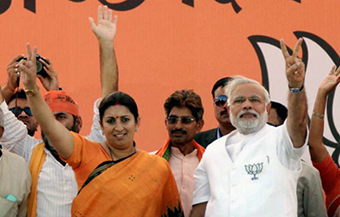
modisairathSwamy neither figures in the list of new inductees, nor does he seem to be throwing tantrums over his exclusion. Evidently, Swamy's antics of attacking the likes of RBI governor Raghuram Rajan, economic advisor Arvind Subramanian and other officials of the Finance Ministry turned out to be a misadventure. His snide remarks against Finance Minister Arun Jaitley was the final nail in the coffin of his aspirations to be a Union minister.

In his attempt to rejig the Cabinet, Prime Minister Narendra Modi has shown a distinct distaste for those with a penchant for courting controversy. Swamy's exclusion and Smriti Irani's removal from the human resource development (HRD) Ministry are indicative of a pattern.

Though unlike Swamy, Irani never crossed the Rubicon line of party discipline. Yet she found herself in the midst of many controversies related to her haughtiness with bureaucrats and academics – with Dalit scholar Rohith Vemula's suicide in Hyderabad and the JNU row marking crucial blows in her two-year tenure as HRD minister.

Though senior BJP leaders, including Modi, are quite impressed by Irani's political pugnacity, she seems to have lost out on moderation. In a recent conference of vice-chancellors of central universities, she ticked off seasoned academics in a very unpleasant manner.

Apparently the minister's conduct could not endear her to the bureaucracy and academics. On some occasions, she was seen courting controversies that may suit the image of a street-fighter, but not of a Union minister.

Contrast this with Prakash Javadekar, an unassuming leader from Maharashtra, who is the only one elevated in this Cabinet expansion – he is now the HRD minister, after relieving his post as the Environment Minister. All this, with Javadekar maintaining a low-profile while facilitating the industry to negotiate with environmental concerns.

Insiders say that Javadekar very deftly handled his assignment of aligning the regulatory regime of the environment Ministry with developmental concerns. He was rewarded with the HRD portfolio for efficiently implementing the government's agenda and for his pro-active role in the climate change talks in Paris. Given Javadekar's own training as Swayamsevak, his new assignment would only get wide approval within the Sangh Parivar.

If the reshuffle is any indication, then it is clear that the prime minister did not hesitate to clip the wings of those found falling short of his expectations. For instance, the communication portfolio was taken away from a voluble Ravi Shankar Prasad and given to Minister of State for Railway Manoj Sinha, as additional responsibility.

Sinha, an engineering graduate from Banaras Hindu University, won unqualified admiration for his efficiency, while maintaining a low-profile. Prasad was, however, given back the charge of the Law Ministry in view of his background as a lawyer – he replaced DV Sadananda Gowda, who had taken over the law ministry from Prasad back in 2014.

Modi has also plugged gaps in certain portfolios by appointing MJ Akbar in the Foreign Ministry and by deploying Ananth Kumar as Parliamentary Affairs Minister, along with SS Ahluwalia, to mobilise support from non-congress parties for the smooth conduct of Parliament.

The underlying theme of the Cabinet reshuffle is quite Biblical – 'meek shall inherit the earth'. This is the precise reason why Swami is left sulking. Similarly, a powerful leader like Yogi Adityanath in eastern UP was ignored, though the Cabinet expansion saw the accommodation of several leaders with influence at the local level. Modi also did not hesitate to axe Ram Shankar Katheria – as the junior HRD minister – as his controversial utterances had caused much consternation.

Taken together, the whole exercise conveyed that those inducted within the government would not be allowed to mess around with its image, either by their conduct or by their utterances.

The implied message was clear – that those having self-inflated notions about themselves can enjoy all the freedom of speech and expression, but while sitting outside the government.

Comments

Satyameva jayate
 - 
Thursday, 7 Jul 2016

This shows how modijis govt failed for the last two years with useless ministers.........they gave positions to the modijis schela' s and now suffering......let's see after two years what will be the change....may be this party will change the PM candidate itself......

Add new comment

  • Coastaldigest.com reserves the right to delete or block any comments.
  • Coastaldigset.com is not responsible for its readers’ comments.
  • Comments that are abusive, incendiary or irrelevant are strictly prohibited.
  • Please use a genuine email ID and provide your name to avoid reject.
News Network
April 3,2020

Bengaluru, April 3: Messages have been displayed outside mosques in Shivajinagar requesting people to offer Friday prayers at home during the lockdown imposed in the wake of the COVID-19 threat.

In light of the coronavirus outbreak, several Muslim organisations and mosques across various states have temporarily halted the congregational prayers.

The usually bustling Jama Masjid area, today, wore a deserted look.

One new positive case of COVID-19 was reported in Karnataka on Friday.

The patient is a 75-year-old man from Bagalkot and has been isolated at a designated hospital in Bagalkot, the state government said.

"Till date, 125 COVID-19 cases have been confirmed in the state, this includes three deaths and 11 discharges," it added.

The total number of coronavirus positive cases rose to 2301 in India on Friday, including 156 cured/discharged, 56 deaths and 1 migrated, as per the data provided by the Ministry of Health and Family Welfare.

Comments

Add new comment

  • Coastaldigest.com reserves the right to delete or block any comments.
  • Coastaldigset.com is not responsible for its readers’ comments.
  • Comments that are abusive, incendiary or irrelevant are strictly prohibited.
  • Please use a genuine email ID and provide your name to avoid reject.
News Network
June 9,2020

Bengaluru, Jun 9: A 42-year-old founding director of an engineering consultancy firm lost Rs 65,000 to online fraudsters who posed as representatives of a mobile service provider and lured him with the offer of a fancy number recently.

Asif (name changed) received a text message on May 19, informing him that a platinum number, 9099999999, was available and interested people could dial a mobile number to avail it.

“Asif, who runs a mechanical, electrical, plumbing (MEP) engineering consultancy near Shivajinagar, decided to get the fancy mobile number. He called the number and the receiver said they would generate an invoice for his request. After a fake invoice for Rs 64,900 was generated, Asif paid the money through online transaction that day. Asif waited for two weeks for the SIM card with the fancy number to reach him,” an officer said.

East CEN Crime police registered a case of cheating under section 420 of IPC and sections under the Information Technology Act after Asif lodged a complaint on June 6.

Comments

Add new comment

  • Coastaldigest.com reserves the right to delete or block any comments.
  • Coastaldigset.com is not responsible for its readers’ comments.
  • Comments that are abusive, incendiary or irrelevant are strictly prohibited.
  • Please use a genuine email ID and provide your name to avoid reject.
Agencies
July 8,2020

The Central Board of Secondary Education (CBSE) has rationalised by up to 30 per cent the syllabus for classes 9 to 12 for the academic year 2020-21 to reduce course load on students amid the COVID-19 crisis, Union HRD Minister Ramesh Pokhriyal 'Nishank' announced on Tuesday.

The curriculum has been rationalised while retaining the core elements, the Human Resource Development said.

Among the chapters dropped after the rationalisation exercise are lessons on democracy and diversity, demonetisation, nationalism, secularism, India's relations with its neighbours and growth of local governments in India, among others.

"Looking at the extraordinary situation prevailing in the country and the world, CBSE was advised to revise the curriculum and reduce course load for the students of classes 9 to 12.

"To aid the decision, a few weeks back I also invited suggestions from all educationists on the reduction of syllabus for students and I am glad to share that we received more than 1.5K suggestions. Thank you, everyone, for the overwhelming response," Nishank tweeted.

"Considering the importance of learning achievement, it has been decided to rationalise syllabus up to 30 per cent by retaining the core concepts," he added.

The Union minister said the changes made in the syllabi have been finalised by the respective course committees with the approval of the curriculum committee and the Governing Body of the Board.

"The heads of schools and teachers have been advised by the board to ensure that the topics that have been reduced are also explained to the students to the extent required to connect different topics. However, the reduced syllabus will not be part of the topics for internal assessment and year-end board examination.

"Alternative academic calendar and inputs from the NCERT on transacting the curriculum using different strategies shall also be part of the teaching pedagogy in the affiliated schools," a senior official of the HRD ministry said.

For classes 1 to 8, the National Council of Education Research and Training (NCERT) has already notified an alternative calendar and learning outcomes.

According to the updated curriculum, among the chapters deleted from class 10 syllabus are-- democracy and diversity, gender, religion and caste, popular struggles and movement, challenges to democracy

For class 11, the deleted portions included chapters on federalism, citizenship, nationalism, secularism, growth of local governments in India.

Similarly, class 12 students will not be required to study chapters on India's relations with its neighbours, changing nature of India's economic development, social movements in India and demonetisation, among others.

Universities and schools across the country have been closed since March 16 when the central government announced a nationwide classroom shutdown as one of the measures to contain the COVID-19 outbreak.

A nationwide lockdown was announced on March 24, which came into effect the next day. While the government has eased several restrictions, schools and colleges continue to remain closed.

Comments

Add new comment

  • Coastaldigest.com reserves the right to delete or block any comments.
  • Coastaldigset.com is not responsible for its readers’ comments.
  • Comments that are abusive, incendiary or irrelevant are strictly prohibited.
  • Please use a genuine email ID and provide your name to avoid reject.