


Don't mess with govt image: Modi's message to Smriti Irani

July 6, 2016

New Delhi, Jul 6: In the high decibel din of the Cabinet expansion and reshuffle of portfolios in the Narendra Modi government, the media seems to have forgotten about a certain BJP maverick MP – Subramanian Swamy – who until recently was its obsession. Where is he now in this celebration?
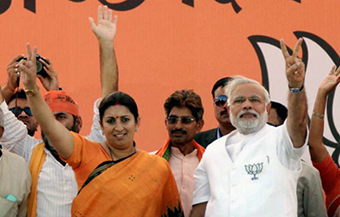
modisairathSwamy neither figures in the list of new inductees, nor does he seem to be throwing tantrums over his exclusion. Evidently, Swamy's antics of attacking the likes of RBI governor Raghuram Rajan, economic advisor Arvind Subramanian and other officials of the Finance Ministry turned out to be a misadventure. His snide remarks against Finance Minister Arun Jaitley was the final nail in the coffin of his aspirations to be a Union minister.

In his attempt to rejig the Cabinet, Prime Minister Narendra Modi has shown a distinct distaste for those with a penchant for courting controversy. Swamy's exclusion and Smriti Irani's removal from the human resource development (HRD) Ministry are indicative of a pattern.

Though unlike Swamy, Irani never crossed the Rubicon line of party discipline. Yet she found herself in the midst of many controversies related to her haughtiness with bureaucrats and academics – with Dalit scholar Rohith Vemula's suicide in Hyderabad and the JNU row marking crucial blows in her two-year tenure as HRD minister.

Though senior BJP leaders, including Modi, are quite impressed by Irani's political pugnacity, she seems to have lost out on moderation. In a recent conference of vice-chancellors of central universities, she ticked off seasoned academics in a very unpleasant manner.

Apparently the minister's conduct could not endear her to the bureaucracy and academics. On some occasions, she was seen courting controversies that may suit the image of a street-fighter, but not of a Union minister.

Contrast this with Prakash Javadekar, an unassuming leader from Maharashtra, who is the only one elevated in this Cabinet expansion – he is now the HRD minister, after relieving his post as the Environment Minister. All this, with Javadekar maintaining a low-profile while facilitating the industry to negotiate with environmental concerns.

Insiders say that Javadekar very deftly handled his assignment of aligning the regulatory regime of the environment Ministry with developmental concerns. He was rewarded with the HRD portfolio for efficiently implementing the government's agenda and for his pro-active role in the climate change talks in Paris. Given Javadekar's own training as Swayamsevak, his new assignment would only get wide approval within the Sangh Parivar.

If the reshuffle is any indication, then it is clear that the prime minister did not hesitate to clip the wings of those found falling short of his expectations. For instance, the communication portfolio was taken away from a voluble Ravi Shankar Prasad and given to Minister of State for Railway Manoj Sinha, as additional responsibility.

Sinha, an engineering graduate from Banaras Hindu University, won unqualified admiration for his efficiency, while maintaining a low-profile. Prasad was, however, given back the charge of the Law Ministry in view of his background as a lawyer – he replaced DV Sadananda Gowda, who had taken over the law ministry from Prasad back in 2014.

Modi has also plugged gaps in certain portfolios by appointing MJ Akbar in the Foreign Ministry and by deploying Ananth Kumar as Parliamentary Affairs Minister, along with SS Ahluwalia, to mobilise support from non-congress parties for the smooth conduct of Parliament.

The underlying theme of the Cabinet reshuffle is quite Biblical – 'meek shall inherit the earth'. This is the precise reason why Swami is left sulking. Similarly, a powerful leader like Yogi Adityanath in eastern UP was ignored, though the Cabinet expansion saw the accommodation of several leaders with influence at the local level. Modi also did not hesitate to axe Ram Shankar Katheria – as the junior HRD minister – as his controversial utterances had caused much consternation.

Taken together, the whole exercise conveyed that those inducted within the government would not be allowed to mess around with its image, either by their conduct or by their utterances.

The implied message was clear – that those having self-inflated notions about themselves can enjoy all the freedom of speech and expression, but while sitting outside the government.

Comments

Satyameva jayate
 - 
Thursday, 7 Jul 2016

This shows how modijis govt failed for the last two years with useless ministers.........they gave positions to the modijis schela' s and now suffering......let's see after two years what will be the change....may be this party will change the PM candidate itself......

Add new comment

  • Coastaldigest.com reserves the right to delete or block any comments.
  • Coastaldigset.com is not responsible for its readers’ comments.
  • Comments that are abusive, incendiary or irrelevant are strictly prohibited.
  • Please use a genuine email ID and provide your name to avoid reject.
Media Release
February 14,2020

Veteran journalist P. Sainath has said that the nation is in a crisis. And this crisis is not limited to just the rural area. It has become a national crisis at various areas such as agriculture, education, economy, job creation etc.

He was delivering the endowment lecture on the topic ‘Indian democracy at the post-liberalization and post-truth era’ at Media Manthan 2020 organized by the PG department of journalism and mass communication at St Aloysius College (Autonomous). 

Mr Sainath said that the many policies adopted in the 90s led to India becoming unusually unequal. Referring to the speech Ambedkar had made at the Constituent Assembly while handing over the draft of the Constitution, Mr Sainath said, “Ambedkar had warned about the weakness of Indian democracy that liberty without equality allows the supremacy of a few over the multitude. Liberty, equality and fraternity must be kept together as we cannot have one without the other.” 

Mr Sainath stated that the agrarian crisis was no longer about the loss of productivity, employment or about farmer suicide; it was a societal, civilizational crisis. Commenting on the lopsided policies such as cow-slaughter ban, he explained how cow slaughter ban had adversely affected many industries due to their interdependency. While Muslims who slaughtered cows were rendered helpless, the cattle traders who were mostly OBCs lost their earnings as the cattle prices crashed. An important industry like Kolhapur sandals industry in Maharashtra went bankrupt as a result of the cow slaughter ban in Maharashtra. He said the policymakers had no idea how the rural industries were interconnected. Demonetisation too devastated the rural economy as 98 percent of rural transactions happen through cash. 

Mr Sainath also spoke about the crisis of inequality which affects the Dalits and the Adivasis far more than anyone else as 90 percent of the rural households take home less than Rs 10,000/- per month. “Women are yet another group whose labour is never counted in the gross domestic product. Women and girls globally do unpaid work which amounts to about 12.5 billion working hours per year. Monetarily speaking, this is worth 10.8 trillion dollars,” Mr Sainath added. 

Speaking about the crisis of jobs Mr Sainath said that major companies were laying off employees just to create more profits for the investors and the adoption of artificial intelligence in the industry would further destroy millions of jobs.

Rector of St Aloysius College Institutions Fr Dionysius Vaz SJ, Principal Dr (Fr) Praveen Martis SJ, HOD of Journalism and Mass Communication department Dr (Fr) Melwyn Pinto SJ were present.

‘Veerappan and Vijay Mallya’s business models are interesting!’

Addressing the gathering during his endowment lecture on Friday, Mr Sainath made an interesting comment on the so called ‘revenue model’. “Whenever I visit IIMs and IITs for lectures on my PARI project, the students there ask me what my revenue model for my project is. I tell them that I do not have a revenue model. In fact, journalism does not begin with a revenue model. Gandhiji, Ambedkar, Bhagat Singh were all great journalists. But they did not have a revenue model,” Mr Sainath said.

On a lighter note, he said that the best revenue model that he liked was that of forest brigand Veerappan and liquor baron Vijay Mallya. “Veerappan ruled the forest for forty years and from the top ministers to the villagers he could dictate terms and liver royally. Similarly, Mallya’s revenue model was to steal the banks and run away abroad and live like a king,” Mr Sainath added.

Journalism is not and can never be a business. It is a calling, he opined. While newspaper can be a business, television can be a business, journalism per se cannot be reduced to a business. “Unfortunately today, journalists are recruited on a contract basis and they have no bargaining power; and there are no unions to fight for their cause. Hence, they are at the mercy of the corporate media houses for their survival and are made to write stories that cannot be called journalism,” Mr Sainath said.

Answering a question as to the pressures he faced as a journalist, he said that external pressures from the government or others could be very well handled. It is the internal pressures from once own media house that journalists find it difficult to manage.


Comments

Add new comment

  • Coastaldigest.com reserves the right to delete or block any comments.
  • Coastaldigset.com is not responsible for its readers’ comments.
  • Comments that are abusive, incendiary or irrelevant are strictly prohibited.
  • Please use a genuine email ID and provide your name to avoid reject.
News Network
March 3,2020

Bengaluru, Mar 3: Bengaluru mayor Gautam Kumar on Tuesday said that the decision to ban protests in front of Town Hall was made by the council and not only by him.

"The decision to ban the protest in front of the Town Hall was made by the entire council and not only my decision. Also, the things which are approved by the councillor are also read by the ruling party leaders," Bengaluru mayor told media.

"Still it is the discretion of the Commissioner to take a call after the council also. As of now, we have banned any protests in front of Town Hall," he added.

Meanwhile, Congress leaders staged a protest against Bruhat Bengaluru Mahanagara Palike (BBMP) Mayor Gautam Kumar and BJP at Council BBMP building against the decision.

"If people will start protesting, it will badly affect the traffic of the city," said Kumar, while commenting on the protest. If they want to talk about the matter, let us have a healthy discussion. I don't have a problem with and I don't think the ruling party has a problem too," he added.

On Sunday, pro-Kannada activist and former MLA Vatal Nagraj staged a protest in front of Sir KP Puttanna Chetty Town Hall (Bangalore Town Hall) against the decision taken by Bengaluru mayor.

Talking to reporters, Nagraj had said: "He does not know the history of the Town Hall. It is a historic building and protests can be staged there."

"Mayor's decision is against Bengaluru's tradition and culture, that's why we are condemning it and are protesting against this decision. We will not allow Mayor's programs in Bengaluru and he will be shown black flags", he added.

Comments

Add new comment

  • Coastaldigest.com reserves the right to delete or block any comments.
  • Coastaldigset.com is not responsible for its readers’ comments.
  • Comments that are abusive, incendiary or irrelevant are strictly prohibited.
  • Please use a genuine email ID and provide your name to avoid reject.
News Network
January 7,2020

Bengaluru, Jan 7: The Central Crime Branch (CCB) sleuths held an international bookie in connection with the Karnataka Premier League (KPL) betting scam and spot-fixing racket, police said on Tuesday.

The bookie was identified as Jitin Sait (32), a native of Sonipat in Haryana.

'We had obtained and issued a Look Out Circular (LOC) against Sait, and on Sunday, he was caught after he landed at the Kempegowda International Airport from the Netherlands.

Comments

Add new comment

  • Coastaldigest.com reserves the right to delete or block any comments.
  • Coastaldigset.com is not responsible for its readers’ comments.
  • Comments that are abusive, incendiary or irrelevant are strictly prohibited.
  • Please use a genuine email ID and provide your name to avoid reject.