


Don't mess with govt image: Modi's message to Smriti Irani

July 6, 2016

New Delhi, Jul 6: In the high decibel din of the Cabinet expansion and reshuffle of portfolios in the Narendra Modi government, the media seems to have forgotten about a certain BJP maverick MP – Subramanian Swamy – who until recently was its obsession. Where is he now in this celebration?
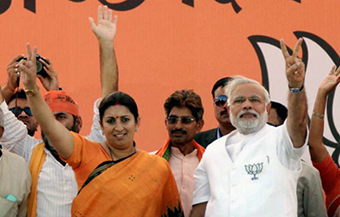
modisairathSwamy neither figures in the list of new inductees, nor does he seem to be throwing tantrums over his exclusion. Evidently, Swamy's antics of attacking the likes of RBI governor Raghuram Rajan, economic advisor Arvind Subramanian and other officials of the Finance Ministry turned out to be a misadventure. His snide remarks against Finance Minister Arun Jaitley was the final nail in the coffin of his aspirations to be a Union minister.

In his attempt to rejig the Cabinet, Prime Minister Narendra Modi has shown a distinct distaste for those with a penchant for courting controversy. Swamy's exclusion and Smriti Irani's removal from the human resource development (HRD) Ministry are indicative of a pattern.

Though unlike Swamy, Irani never crossed the Rubicon line of party discipline. Yet she found herself in the midst of many controversies related to her haughtiness with bureaucrats and academics – with Dalit scholar Rohith Vemula's suicide in Hyderabad and the JNU row marking crucial blows in her two-year tenure as HRD minister.

Though senior BJP leaders, including Modi, are quite impressed by Irani's political pugnacity, she seems to have lost out on moderation. In a recent conference of vice-chancellors of central universities, she ticked off seasoned academics in a very unpleasant manner.

Apparently the minister's conduct could not endear her to the bureaucracy and academics. On some occasions, she was seen courting controversies that may suit the image of a street-fighter, but not of a Union minister.

Contrast this with Prakash Javadekar, an unassuming leader from Maharashtra, who is the only one elevated in this Cabinet expansion – he is now the HRD minister, after relieving his post as the Environment Minister. All this, with Javadekar maintaining a low-profile while facilitating the industry to negotiate with environmental concerns.

Insiders say that Javadekar very deftly handled his assignment of aligning the regulatory regime of the environment Ministry with developmental concerns. He was rewarded with the HRD portfolio for efficiently implementing the government's agenda and for his pro-active role in the climate change talks in Paris. Given Javadekar's own training as Swayamsevak, his new assignment would only get wide approval within the Sangh Parivar.

If the reshuffle is any indication, then it is clear that the prime minister did not hesitate to clip the wings of those found falling short of his expectations. For instance, the communication portfolio was taken away from a voluble Ravi Shankar Prasad and given to Minister of State for Railway Manoj Sinha, as additional responsibility.

Sinha, an engineering graduate from Banaras Hindu University, won unqualified admiration for his efficiency, while maintaining a low-profile. Prasad was, however, given back the charge of the Law Ministry in view of his background as a lawyer – he replaced DV Sadananda Gowda, who had taken over the law ministry from Prasad back in 2014.

Modi has also plugged gaps in certain portfolios by appointing MJ Akbar in the Foreign Ministry and by deploying Ananth Kumar as Parliamentary Affairs Minister, along with SS Ahluwalia, to mobilise support from non-congress parties for the smooth conduct of Parliament.

The underlying theme of the Cabinet reshuffle is quite Biblical – 'meek shall inherit the earth'. This is the precise reason why Swami is left sulking. Similarly, a powerful leader like Yogi Adityanath in eastern UP was ignored, though the Cabinet expansion saw the accommodation of several leaders with influence at the local level. Modi also did not hesitate to axe Ram Shankar Katheria – as the junior HRD minister – as his controversial utterances had caused much consternation.

Taken together, the whole exercise conveyed that those inducted within the government would not be allowed to mess around with its image, either by their conduct or by their utterances.

The implied message was clear – that those having self-inflated notions about themselves can enjoy all the freedom of speech and expression, but while sitting outside the government.

Comments

Satyameva jayate
 - 
Thursday, 7 Jul 2016

This shows how modijis govt failed for the last two years with useless ministers.........they gave positions to the modijis schela' s and now suffering......let's see after two years what will be the change....may be this party will change the PM candidate itself......

Add new comment

  • Coastaldigest.com reserves the right to delete or block any comments.
  • Coastaldigset.com is not responsible for its readers’ comments.
  • Comments that are abusive, incendiary or irrelevant are strictly prohibited.
  • Please use a genuine email ID and provide your name to avoid reject.
News Network
February 17,2020

Abu Dhabi, Feb 17: NMC Health Plc, a hospital operator targeted by short-seller Muddy Waters, said founder Bavaguthu Raghuram Shetty resigned amid investor concern he faced a margin call and misrepresented his stake.

The board asked for Co-Chairman Shetty’s resignation and it takes effect immediately, according to a person with knowledge of the situation. NMC has lost four board members since Friday, including Vice Chairman Khaleefa Butti, whose holdings are also being probed. The stock, the worst performer on the FTSE-100 Index this year, fell as much as 9.2 percent Monday morning and then rebounded.

“The resignation of senior board members should be viewed positively,” said Abdulla Nahlawi, an analyst at Rasmala Investment Bank in Dubai. “The credibility of the current board has been jeopardized with the unfolding of the recent events.”

NMC shares lost almost half their value the first week of February on speculation the company’s main investors faced a margin call, in which banks seize shares pledged as collateral. NMC said Friday that First Abu Dhabi Bank and Al Salam Bank Bahrain obtained 20 million shares in the company from BRS International Holding, an investment vehicle of NMC’s top shareholders. The banks sold more than 8 million of those shares as “enforcement of security,” NMC said.

NMC operates the largest medical network in the United Arab Emirates and in 2012 became the first Abu Dhabi company to list in London. The shares started teetering in mid-December when Muddy Waters alleged that NMC manipulated its balance sheet and inflated the prices of companies it acquired.

Shetty, 77, was born in India and founded NMC in the 1970s after moving to Abu Dhabi. His spokesman said a legal review of the situation is ongoing and declined further comment.

Chief Investment Officer Hani Buttikhi and board member Abdulrahman Basaddiq also stepped down because they were appointees of Shetty and Butti, NMC said, adding that they had no knowledge of the share transfers.

Questions remain over the role of Shetty’s family at the company. His wife and son-in-law both hold roles in senior management.

Almost 10 per cent of NMC’s freely traded shares are shorted, according to Markit Securities data. In mid-December about a third of them were.

Last week GKSD Investment, an investment company backed by hospital investors, said it’s studying a possible offer for NMC. Under U.K. takeover rules, it has until March 9 to make a bid.

NMC has said Muddy Waters’s claims are false and the company hired former FBI Director Louis Freeh to conduct an independent review. The review is due to be completed before the company issues its financial results in March, the person said.

NMC said Mark Tompkins will continue as the company’s sole chairman.

Comments

sunita kejriwal
 - 
Monday, 17 Feb 2020

BRS could not fool all the people all the time!


Bhakth
 - 
Monday, 17 Feb 2020

Illegal way of earning will not last for long. 

Add new comment

  • Coastaldigest.com reserves the right to delete or block any comments.
  • Coastaldigset.com is not responsible for its readers’ comments.
  • Comments that are abusive, incendiary or irrelevant are strictly prohibited.
  • Please use a genuine email ID and provide your name to avoid reject.
News Network
June 7,2020

Mangaluru, Jun 7: The Sri Krishna temple at Udupi would not re-open on June 8 although permission has been given to all temples to allow devotees for darshan, Admaru mutt junior seer Paryaya Swami Ishapriya Teertha said on Saturday. He told reporters in Udupi that the mutt has decided not to allow devotees at present to join the fight against COVID-19 by the government, health department and the police.

The seer said the situation would be assessed in the next 20-30 days after which a decision to re-open the place of worship would be taken.

The health of the devotees and the staff at the mutt and temple would have to be protected.

However, pujas and rituals would continue to be held at the temple, he said.

Meanwhile, Dharmasthala dharmadhikari D Veerendra Heggade said in a press release that the Lord Manjunatheshwara temple in Dharmasthala in Dakshina Kannada district would open for devotees from June 8. He said 800-1,000 devotees would be allowed to have darshan at the temple every day, keeping with the regulations of the government.

Mass-feeding (annadhanam) in the Annapoorna hall would also be organised, maintaining social distance in view of the virus spread.

Comments

Add new comment

  • Coastaldigest.com reserves the right to delete or block any comments.
  • Coastaldigset.com is not responsible for its readers’ comments.
  • Comments that are abusive, incendiary or irrelevant are strictly prohibited.
  • Please use a genuine email ID and provide your name to avoid reject.
News Network
April 2,2020

The current physical distancing guidelines provided by the World Health Organisation (WHO) and by the US Centers for Disease Control and Prevention (CDC) may not be adequate to curb the coronavirus spread, according to a research which says the gas cloud from a cough or sneeze may help virus particles travel up to 8 metres. The research, published in the Journal of the American Medical Association, noted that the the current guidelines issued by the WHO and CDC are based on outdated models from the 1930s of how gas clouds from a cough, sneeze, or exhalation spread.

Study author, MIT associate professor Lydia Bourouiba, warned that droplets of all sizes can travel 23 to 27 feet, or 7-8 metres, carrying the pathogen.

According to Bourouiba, the current guidelines are based on "arbitrary" assumptions of droplet size, "overly simplified", and "may limit the effectiveness of the proposed interventions" against the deadly pandemic.

 She explained that the old guidelines assume droplets to be one of two categories, small or large, taking short-range semi-ballistic trajectories when a person exhales, coughs, or sneezes.

However based on more recent discoveries, the MIT scientist said, sneezes and coughs are made of a puff cloud that carries ambient air, transporting within it clusters of droplets of a wide range of sizes.

Bourouiba warned that this puff cloud, with ambient air entrapped in it, can offer the droplets moisture and warmth that can prevent it from evaporation in the outer environment.

"The locally moist and warm atmosphere within the turbulent gas cloud allows the contained droplets to evade evaporation for much longer than occurs with isolated droplets," she said.

"Under these conditions, the lifetime of a droplet could be considerably extended by a factor of up to 1000, from a fraction of a second to minutes," the researcher explained in the study.

The MIT scientist, who has researched the dynamics of coughs and sneezes for years, added that these droplets settle along the trajectory of a cough or sneeze contaminating surfaces, with their residues staying suspended in the air for hours.

"Even when maximum containment policies were enforced, the rapid international spread of COVID-19 suggests that using arbitrary droplet size cutoffs may not accurately reflect what actually occurs with respiratory emissions, possibly contributing to the ineffectiveness of some procedures used to limit the spread of respiratory disease," Bourouiba wrote in the study

Comments

Add new comment

  • Coastaldigest.com reserves the right to delete or block any comments.
  • Coastaldigset.com is not responsible for its readers’ comments.
  • Comments that are abusive, incendiary or irrelevant are strictly prohibited.
  • Please use a genuine email ID and provide your name to avoid reject.