


Don't mess with govt image: Modi's message to Smriti Irani

July 6, 2016

New Delhi, Jul 6: In the high decibel din of the Cabinet expansion and reshuffle of portfolios in the Narendra Modi government, the media seems to have forgotten about a certain BJP maverick MP – Subramanian Swamy – who until recently was its obsession. Where is he now in this celebration?
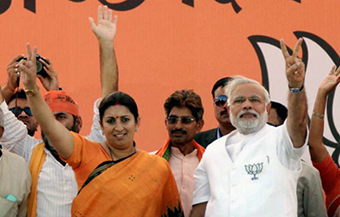
modisairathSwamy neither figures in the list of new inductees, nor does he seem to be throwing tantrums over his exclusion. Evidently, Swamy's antics of attacking the likes of RBI governor Raghuram Rajan, economic advisor Arvind Subramanian and other officials of the Finance Ministry turned out to be a misadventure. His snide remarks against Finance Minister Arun Jaitley was the final nail in the coffin of his aspirations to be a Union minister.

In his attempt to rejig the Cabinet, Prime Minister Narendra Modi has shown a distinct distaste for those with a penchant for courting controversy. Swamy's exclusion and Smriti Irani's removal from the human resource development (HRD) Ministry are indicative of a pattern.

Though unlike Swamy, Irani never crossed the Rubicon line of party discipline. Yet she found herself in the midst of many controversies related to her haughtiness with bureaucrats and academics – with Dalit scholar Rohith Vemula's suicide in Hyderabad and the JNU row marking crucial blows in her two-year tenure as HRD minister.

Though senior BJP leaders, including Modi, are quite impressed by Irani's political pugnacity, she seems to have lost out on moderation. In a recent conference of vice-chancellors of central universities, she ticked off seasoned academics in a very unpleasant manner.

Apparently the minister's conduct could not endear her to the bureaucracy and academics. On some occasions, she was seen courting controversies that may suit the image of a street-fighter, but not of a Union minister.

Contrast this with Prakash Javadekar, an unassuming leader from Maharashtra, who is the only one elevated in this Cabinet expansion – he is now the HRD minister, after relieving his post as the Environment Minister. All this, with Javadekar maintaining a low-profile while facilitating the industry to negotiate with environmental concerns.

Insiders say that Javadekar very deftly handled his assignment of aligning the regulatory regime of the environment Ministry with developmental concerns. He was rewarded with the HRD portfolio for efficiently implementing the government's agenda and for his pro-active role in the climate change talks in Paris. Given Javadekar's own training as Swayamsevak, his new assignment would only get wide approval within the Sangh Parivar.

If the reshuffle is any indication, then it is clear that the prime minister did not hesitate to clip the wings of those found falling short of his expectations. For instance, the communication portfolio was taken away from a voluble Ravi Shankar Prasad and given to Minister of State for Railway Manoj Sinha, as additional responsibility.

Sinha, an engineering graduate from Banaras Hindu University, won unqualified admiration for his efficiency, while maintaining a low-profile. Prasad was, however, given back the charge of the Law Ministry in view of his background as a lawyer – he replaced DV Sadananda Gowda, who had taken over the law ministry from Prasad back in 2014.

Modi has also plugged gaps in certain portfolios by appointing MJ Akbar in the Foreign Ministry and by deploying Ananth Kumar as Parliamentary Affairs Minister, along with SS Ahluwalia, to mobilise support from non-congress parties for the smooth conduct of Parliament.

The underlying theme of the Cabinet reshuffle is quite Biblical – 'meek shall inherit the earth'. This is the precise reason why Swami is left sulking. Similarly, a powerful leader like Yogi Adityanath in eastern UP was ignored, though the Cabinet expansion saw the accommodation of several leaders with influence at the local level. Modi also did not hesitate to axe Ram Shankar Katheria – as the junior HRD minister – as his controversial utterances had caused much consternation.

Taken together, the whole exercise conveyed that those inducted within the government would not be allowed to mess around with its image, either by their conduct or by their utterances.

The implied message was clear – that those having self-inflated notions about themselves can enjoy all the freedom of speech and expression, but while sitting outside the government.

Comments

Satyameva jayate
 - 
Thursday, 7 Jul 2016

This shows how modijis govt failed for the last two years with useless ministers.........they gave positions to the modijis schela' s and now suffering......let's see after two years what will be the change....may be this party will change the PM candidate itself......

Add new comment

  • Coastaldigest.com reserves the right to delete or block any comments.
  • Coastaldigset.com is not responsible for its readers’ comments.
  • Comments that are abusive, incendiary or irrelevant are strictly prohibited.
  • Please use a genuine email ID and provide your name to avoid reject.
coastaldigest.com news network
January 21,2020

Mangaluru, Jan 21: The city police arrested the auto driver of the auto-rickshaw allegedly used by the suspect to place the Improvised Explosive Device (IED) at Mangaluru International Airport.

The identity of the auto driver is yet to be ascertained.

The police are currently interrogating the auto driver to obtain details about the suspect, according to reports.

The IED recovered from a bag at the airport was defused in an open field by the personnel of the bomb disposal squad yesterday.

The visuals of the suspect have also been shared by the police for his identification. 

Comments

Add new comment

  • Coastaldigest.com reserves the right to delete or block any comments.
  • Coastaldigset.com is not responsible for its readers’ comments.
  • Comments that are abusive, incendiary or irrelevant are strictly prohibited.
  • Please use a genuine email ID and provide your name to avoid reject.
News Network
May 7,2020

Bengaluru, May 7: Karnataka has revised its standard operating procedure (SOP) for international passengers. The first group of passengers will arrive in the state on May 8.

The number of categories has been reduced to two from three. Category A includes passengers symptomatic on arrival while Category B passengers are those asymptomatic on arrival. These are passengers who are either healthy or those having co-morbidities.

As per the revised SOP, the passenger will be released on the seventh day, if tested negative, to strict home quarantine for another seven days with stamping.

This norm is in contradiction to the Ministry of Home Affairs’ SOP for international passengers. As per the MHA’s SOP, the passengers (asymptomatic) will be under institutional quarantine for 14 days. Testing negative after 14 days, they will be allowed to go home and will undertake self-monitoring of their health for 14 more days.

On the contradiction, Pandey said, "We don't take chances as we rely on tests instead of just quarantining. Other states may be depending on just 14-day institutional quarantine."

"GOI SOP doesn't talk about Covid tests on international passengers. We have put an additional safety layer of three Covid tests on returnees -- one on arrival, second from 5-7 days and last on 12th day. This will ensure definite identification of positive cases even if they are asymptomatic and their subsequent treatment. We should look at the spirit behind the order," he added.

On the 14-day additional reporting period for category B, he said, "It is implied as category B patients should report to us for 14 days after their first 14-day quarantine period is over."

Medical Education Minister Dr K Sudhakar said that the State would follow the Centre’s norms.

Till Tuesday, Karnataka’s SOP had three categories. Under Category A (symptomatic), 14-day institutional quarantine at COVID-19 Health Care Centre was mandatory followed by 14-day reporting period. Under Category B (asymptomatic above 60 years with co-morbidities), seven-day institutional quarantine at hotel/hostel followed by seven-day home quarantine and 14-day reporting period had been recommended. The 14-day home quarantine and 14-day reporting period was mandatory for Category C (asymptomatic).

Comments

Add new comment

  • Coastaldigest.com reserves the right to delete or block any comments.
  • Coastaldigset.com is not responsible for its readers’ comments.
  • Comments that are abusive, incendiary or irrelevant are strictly prohibited.
  • Please use a genuine email ID and provide your name to avoid reject.
coastaldigest.com news network
May 22,2020

It has been 33 years since the night of 22 May, 1987 when nearly 50 Muslim men from Hashimpura, a settlement in Meerut were rounded up and packed into the rear of a truck of the Provincial Armed Constabulary (PAC), an armed police of Uttar Pradesh. It was the blessed month of Ramadan and all the Muslims were fasting.

That night 42 of those on board the truck were killed in two massacres in neighbouring Ghaziabad district. One along the Upper Ganga canal near Muradnagar, the other along the Hindon canal in Makanpur, on the border with Delhi.

The cops had returned home after dumping the dead bodies into the canal. A few days later, the dead bodies were found floating in the canal and a case of murder was registered. 

Vir Bahadur Singh was the chief minister of Uttar Pradesh and Rajiv Gandhi was the prime minister of India when this incident took place. 

Not much has changed for the survivors and the relatives of the victims even today. The wounds are still fresh. Hashimpura remains devoid of basic municipal amenities, the erring silence on the narrow lanes of the locality amid the activities of a daily life speaks of the horror of the fateful day in 1987.

The massacre was the result of one among the many outcomes of the decision taken by the Rajiv Gandhi government to open the locks of Babri Masjid. After a month of rioting, the situation was tense in various parts of Meerut, and a lot spilled over in the nearby areas.

Timeline

May 22, 1987

Nearly 50 Muslims picked up by the PAC personnel from Hashimpura village in Meerut, Uttar Pradesh.
Victims later shot and bodies thrown into a canal. 42 persons declared dead.

1988

UP government orders CB-CID probe in the case.

February 1994

CB-CID submits inquiry report indicting over 60 PAC and police personnel of all ranks.

May 20, 1996

Charge sheet filed against 19 accused before Chief Judicial Magistrate, Ghaziabad by CB-CID of Uttar Pradesh police. 161 people listed as witnesses.

September 2002

Case transferred to Delhi by the Supreme Court on a petition by the families of victims and survivors.

July 2006

Delhi court frames charges of murder, attempt to murder, tampering with evidence and conspiracy under the IPC against 17 accused.

March 8, 2013

Trial court dismisses Subramanian Swamy's plea seeking probe into the alleged role of P Chidambaram, then Minister of State for Home, in the matter.

January 22, 2015

Trial court reserves judgement.

March 21, 2015

Court acquits 16 surviving accused giving them benefit of doubt regarding their identity.

May 18, 2015

Trial court decision challenged in the Delhi HC by the victims' families and eyewitnesses who survived the incident.

May 29, 2015

HC issues notice to the 16 PAC personnel on Uttar Pradesh government's appeal against the trial court verdict.

December 2015

National Human Rights Commission is impleaded in the matter. NHRC also seeks further probe into the massacre.

February 17, 2016

HC tags Swamy's appeal with the other petitions in the matter.

September 6, 2018

Delhi HC reserves verdict in the case.

October 31, 2018

Delhi HC convicts 16 former PAC personnel for life after finding them guilty of the murder of 42 people.

Comments

Add new comment

  • Coastaldigest.com reserves the right to delete or block any comments.
  • Coastaldigset.com is not responsible for its readers’ comments.
  • Comments that are abusive, incendiary or irrelevant are strictly prohibited.
  • Please use a genuine email ID and provide your name to avoid reject.