


Don't tolerate cow vigilantism: Centre tells State govts

[email protected] (CD Network)
August 9, 2016

New Delhi, Aug 9: Cracking the whip on cow vigilantism, the Centre tonight asked all states not to tolerate anyone taking law into their hands in the name of protecting cow and take prompt action against such offenders.
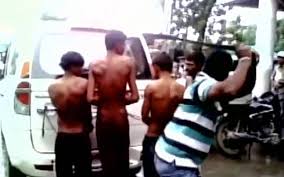
cowHome Ministry advisory came two days after Prime Minister Narendra Modi denounced cow vigilantes and asked people to beware of its 'fake' protectors trying to divide society and the country and asked the states to severely punish them.

The advisory said historically cattle have a very special, respected and venerated status in Indian culture and history and even the father of the nation had stated that 'cow protection to me is not mere protection of cow, it means protection of that (which) lives, is helpless and weak in the world'.

However, that does not entitle any individual or group of persons to take action on their own to prevent the alleged slaughter or punish the alleged wrong doers.

"Recently, some incidents have been reported where certain persons or groups have taken law into their hands in the name of protecting cows and have committed crimes in pursuance thereof. This is not an acceptable situation.

"The states are, therefore, enjoined upon, and expected to ensure that any person who takes law into his/ her own hands is dealt with prompt, and punished as per law. There should be no tolerance at all for such persons and full majesty of law must come to bear on them, without exception," it said.

The advisory said no person can, under any circumstances, take the law into their hands and any person, or persons, doing so have to be dealt with strictly under the relevant laws, and brought to justice in the quickest possible fashion, for the strictest punishment.

The central government initiative came at a time when the Modi government and BJP are facing flak over incidents of violence against Dalits and Muslims by cow vigilantes in various states including Uttar Pradesh, Gujarat and Madhya Pradesh.

Quoting the Directive Principles of State Policy, which provides for the preservation of cows, the Home Ministry advisory said the state shall endeavour to organise agriculture and animal husbandry on modern and scientific lines and shall in particular, take steps for preserving and improving the breeds, and prohibiting the slaughter of cows and calves and other milch and draught cattle.

Entry 15 of the State list of the 7th Schedule allocates the work of 'Preservation, protection and improvement of stock and preservation; veterinary training and practice' to the states, it said.

Consequently laws pertaining to cow preservation on prohibition of slaughter vary from state to state.

"In states where slaughter of cows is prohibited by law, such slaughtering would be in violation of law and an offence.

"However, that does not entitle any individual or group of persons to take action on their own to prevent the alleged slaughter or punish the alleged wrong doers," it said.

The advisory said Section 39 of the CrPC requires that any person aware of the commission of certain offences or intention thereof, is required to give information to the nearest magistrate or police officer of such commission or intention.

"Therefore, if an offence is committed, or about to be committed, such an offence, or possibility of offence is required to be brought to the notice of the concerned police authorities or magistrate for appropriate action as per law," it said.

Comments

Abdul Latif
 - 
Tuesday, 9 Aug 2016

now people will realize that Government has wake up from 'HIGH SLEEP'

Add new comment

  • Coastaldigest.com reserves the right to delete or block any comments.
  • Coastaldigset.com is not responsible for its readers’ comments.
  • Comments that are abusive, incendiary or irrelevant are strictly prohibited.
  • Please use a genuine email ID and provide your name to avoid reject.
News Network
June 10,2020

Bengaluru, Jun 10: Internet connectivity, provided under the central government's BharatNet initiative, will be improved in rural areas of Karnataka in the next two to three months, said Deputy Chief Minister CN Ashwath Narayan.

After video conferencing with heads of different agencies and officials, on improving the quality of internet in rural areas, Ashwath Narayan said, "I reviewed the progress of the BharatNet implementation and the steps to be taken to improve the quality of internet connectivity in the next two to three months."

"We also discussed the possibility of giving the implementation of BharatNet to a different agency. We will seek permission from the central government and continue the project. We will ease communication with rural people by ensuring quality and high-speed internet to all Gram Panchayats," he added.

When BSNL officials and other agency representatives who attended the video conference shared their problems, the Deputy Chief Minister assured to solve them through proper coordination.

"Through BharatNet, several government schemes are being implemented in rural areas. Civic service centres are issuing birth and death certificates, Aadhaar cards and social security pensions among others. Of the total 6,000 Gram Panchayats in the state, 4,000 have high-speed internet connectivity, and the remaining will be provided with better internet connectivity through a new agency,'' said Ashwath Narayan.

Additional Secretary (e-governance) Rajeev Chawla, Additional Chief Secretary (IT-BT) EV Ramana Reddy, Principal Secretary (RDPR) Uma Mahadevan, Director (IT) Meena Nagaraj, Collegiate Education Director Pradeep and other senior officials were present in the meeting.

Comments

Add new comment

  • Coastaldigest.com reserves the right to delete or block any comments.
  • Coastaldigset.com is not responsible for its readers’ comments.
  • Comments that are abusive, incendiary or irrelevant are strictly prohibited.
  • Please use a genuine email ID and provide your name to avoid reject.
Ram Puniyani
February 10,2020

Noam Chomsky is one of the leading peace workers in the world. In the wake of America’s attack on Vietnam, he brought out his classic formulation, ‘manufacturing consent’. The phrase explains the state manipulating public opinion to have the public approve of it policies—in this case, the attack of the American state on Vietnam, which was then struggling to free itself from French colonial rule.

In India, we are witness to manufactured hate against religious minorities. This hatred serves to enhance polarisation in society, which undermines India’s democracy and Constitution and promotes support for a Hindu nation. Hate is being manufactured through multiple mechanisms. For example, it manifests in violence against religious minorities. Some recent ghastly expressions of this manufactured hate was the massive communal violence witnessed in Mumbai (1992-93), Gujarat (2002), Kandhamal (2008) and Muzaffarnagar (2013). Its other manifestation was in the form of lynching of those accused of having killed a cow or consumed beef. A parallel phenomenon is the brutal flogging, often to death, of Dalits who deal with animal carcasses or leather.

Yet another form of this was seen when Shambhulal Regar, indoctrinated by the propaganda of Hindu nationalists, burned alive Afrazul Khan and shot the video of the heinous act. For his brutality, he was praised by many. Regar was incited into the act by the propaganda around love jihad. Lately, we have the same phenomenon of manufactured hate taking on even more dastardly proportions as youth related to Hindu nationalist organisations have been caught using pistols, while police authorities look on.

Anurag Thakur, a BJP minster in the central government recently incited a crowd in Delhi to complete his chant of what should happen to ‘traitors of the country...” with a “they should be shot”. Just two days later, a youth brought a pistol to the site of a protest at Jamia Millia Islamia university and shouted “take Azaadi!” and fired it. One bullet hit a student of Jamia. This happened on 30 January, the day Nathuram Godse had shot Mahatma Gandhi in 1948. A few days later, another youth fired near the site of protests against the CAA and NRC at Shaheen Bagh. Soon after, he said that in India, “only Hindus will rule”.

What is very obvious is that the shootings by those associated with Hindu nationalist organisations are the culmination of a long campaign of spreading hate against religious minorities in India in general and against Muslims in particular. The present phase is the outcome of a long and sustained hate campaign, the beginning of which lies in nationalism in the name of religion; Muslim nationalism and Hindu nationalism. This sectarian nationalism picked up the communal view of history and the communal historiography which the British introduced in order to pursue their ‘divide and rule’ policy.

In India what became part of “social common sense” was that Muslim kings had destroyed Hindu temples, that Islam was spread by force, and that it is a foreign religion, and so on. Campaigns, such as the one for a temple dedicated to the Hindu god Rama to be built at the site where the Babri masjid once stood, further deepened the idea of a Muslim as a “temple-destroyer”. Aurangzeb, Tipu Sultan and other Muslim kings were tarnished as the ones who spread Islam by force in the subcontinent. The tragic Partition, which was primarily due to British policies, and was well-supported by communal streams also, was entirely attributed to Muslims. The Kashmir conflict, which is the outcome of regional, ethnic and other historical issues, coupled with the American policy of supporting Pakistan’s ambitions of regional hegemony, (which also fostered the birth of Al-Qaeda), was also attributed to the Muslims.

With recurring incidents of communal violence, these falsehoods went on going deeper into the social thinking. Violence itself led to ghettoisation of Muslims and further broke inter-community social bonds. On the one hand, a ghettoised community is cut off from others and on the other hand the victims come to be presented as culprits. The percolation of this hate through word-of-mouth propaganda, media and re-writing of school curricula, had a strong impact on social attitudes towards the minorities.

In the last couple of decades, the process of manufacturing hate has been intensified by the social media platforms which are being cleverly used by the communal forces. Swati Chaturvedi’s book, I Am a Troll: Inside the Secret World of the BJP’s Digital Army, tells us how the BJP used social media to spread hate. Whatapp University became the source of understanding for large sections of society and hate for the ‘Other’, went up by leaps and bounds. To add on to this process, the phenomenon of fake news was shrewdly deployed to intensify divisiveness.

Currently, the Shaheen Bagh movement is a big uniting force for the country; but it is being demonised as a gathering of ‘anti-nationals’. Another BJP leader has said that these protesters will indulge in crimes like rape. This has intensified the prevalent hate.

While there is a general dominance of hate, the likes of Shambhulal Regar and the Jamia shooter do get taken in by the incitement and act out the violence that is constantly hinted at. The deeper issue involved is the prevalence of hate, misconceptions and biases, which have become the part of social thinking.

These misconceptions are undoing the amity between different religious communities which was built during the freedom movement. They are undoing the fraternity which emerged with the process of India as a nation in the making. The processes which brought these communities together broadly drew from Gandhi, Bhagat Singh and Ambedkar. It is these values which need to be rooted again in the society. The communal forces have resorted to false propaganda against the minorities, and that needs to be undone with sincerity.

Combating those foundational misconceptions which create hatred is a massive task which needs to be taken up by the social organisations and political parties which have faith in the Indian Constitution and values of freedom movement. It needs to be done right away as a priority issue in with a focus on cultivating Indian fraternity yet again.

Comments

Add new comment

  • Coastaldigest.com reserves the right to delete or block any comments.
  • Coastaldigset.com is not responsible for its readers’ comments.
  • Comments that are abusive, incendiary or irrelevant are strictly prohibited.
  • Please use a genuine email ID and provide your name to avoid reject.
News Network
May 6,2020

Bengaluru, May 6: Karnataka has reported 20 new cases of coronavirus taking total number of cases in the state to 693.

The state health department said in a bulletin on Wednesday that 20 new cases have been confirmed for COVID-19 in the state. "The total number of cases in the state is 693," it said.

The count includes 354 patients who have been discharged and 29 patients who succumbed to the disease.

Out of the remaining cases, 303 patients are in isolation at designated hospitals while six patients are in ICU. The bulletin has also reported one death due to non-COVID cause.

The number of COVID-19 cases in the country reached 49,391, according to the Ministry of Health and Family Welfare on Wednesday morning.

This includes 33,514 active cases and 1,694 deaths due to infection so far.

A total of 14,182 persons have been cured and discharged so far, according to the Health Ministry. One patient has migrated.

Comments

Add new comment

  • Coastaldigest.com reserves the right to delete or block any comments.
  • Coastaldigset.com is not responsible for its readers’ comments.
  • Comments that are abusive, incendiary or irrelevant are strictly prohibited.
  • Please use a genuine email ID and provide your name to avoid reject.