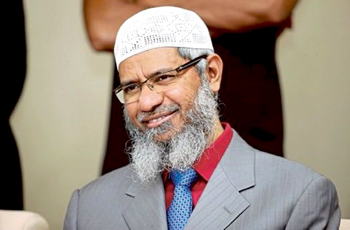
Dr Zakir Naik files defamation case against 10 media houses

[email protected] (CD Network)
July 16, 2016

zakirfr

Mumbai, Jul 16: Dr Zakir Naik, who is known as the authority on comparative religion, has reportedly filed defamation case against 10 media houses for making baseless allegations against him and airing his video clips out of context to mislead people.

When asked about his plans to return to India this year, he said: “For media trial? I can answer to allegations in a better way from where I am. I have served defamation on ten media houses. No investigating agency or officer has approached me till now,” said Dr Naik.

“I have again and again said that killing an innocent is like killing entire humanity. I condemn terrorism and also the attack in France though I am yet to get more information on it,” said Naik as he started his conference.

On people who were part of his organisation but were questioned or youths that went missing had met him, Naik said, “I meet thousands of people and they take pictures with me. How am I supposed to know about each of them.”

Comments

Siraj Hussain
 - 
Wednesday, 3 Aug 2016

Well Done Dr. Zakir Naik. We had enough of this media misrepresenting the facts to please the people who are in power & spread the hate in common man, and help the fulfillment of the Hidden agenda of the corrupt politicians. Thanks for taking this great step. A peace loving man of any religion will support you...... Insha Allah Victory will be yours.

mono
 - 
Sunday, 17 Jul 2016

Please watch his team member junaid khan recent interview about his income and behavior with others
Even his conversion is well planned drama

This bussiness is much better than dargah bussiness

Rajesh Sequira
 - 
Sunday, 17 Jul 2016

It is good that the media houses are being sued for defamation. Media should stop slandering and making false stories against people. Only when an FIR / case is registered, should they break the story.

This has been going on for such a long time and a stop has to be put. Arnab Goswami and his type have taken a beating out of this case. Even the government has lost a lot of credibility because of this case.

monu
 - 
Sunday, 17 Jul 2016

As per naik media aired his videos which are out of context to mislead the people!!!!!!
If so my question is then why zakir naik blind followers are urging other people to watch his videos in youtube if dey are out off context?...as per his followers if some1 converts to islam after watching his videos then its good for socity if he becomes terrorist den its out of context...hahaha

babu bajarangi
 - 
Sunday, 17 Jul 2016

Shame on RSS agent Arnab Go cow swami,
you will not come up'' time will come your realy face will come out and public will spit your face,for money and power not lift up god know the reality and he is the planer.

I Support Dr. …
 - 
Sunday, 17 Jul 2016

Well done.. WE ARE WIth U Dr. Zakir Naik...
People are Fooled since decades with manipulating the facts and presenting to the public...
Presenting news with suits and ties and make up doesnt make anybody Good and Trust worthy... We should look at who is behind it... there are many corporations who play with the minds of people... who lobby all this evil propagands even the cheddis have fallen to this category.
We should teach this decievers a lesson...

But ALLAH has power over all things... Those who know ALLAH, will never be in FEAR of any situation.. May ALLAH make us one of them.. it is the greatest blessing from the CREATOR of all the Exists.

SK
 - 
Sunday, 17 Jul 2016

Insha Allah, you will suceed Zakir Saab, These dogs like Arnab gooo sami, Naren should be taught a lesson for ever...... WELL DONE. WE WISH GOOD LUCK....

Add new comment

  • Coastaldigest.com reserves the right to delete or block any comments.
  • Coastaldigset.com is not responsible for its readers’ comments.
  • Comments that are abusive, incendiary or irrelevant are strictly prohibited.
  • Please use a genuine email ID and provide your name to avoid reject.
News Network
March 15,2020

While it makes perfect sense for IT employees to work from remote locations via video conferencing and collaboration tools seamlessly - especially in the case of tech giants like Google or Microsoft -- workers from the non-IT companies and small and medium enterprises (SMBs) are the worst-hit in India as most of them have little or no clue about how these messaging and collaboration tools work amid the coronavirus pandemic.

Small companies -- from corporate to education verticals -- are scrambling to get their act together as new coronavirus threat has reached their premises, prompting them to send employees home who have age-old laptops, poor network and connectivity with no UPS backups and little knowledge about how to handle group chat and collaboration software like Zoom, Google Hangouts Meet, Microsoft Teams and Flock etc.

Instead of halting operations, however, businesses can choose to shift towards remote working methods with teaching non-IT staff on how to use the latest digital software to connect and work, say industry experts.

The training will take some time and may hamper productivity in the short run but is a win-win situation for the non-tech companies in the long run, in case any such global emergency arises in the future.

According to a latest report by Gartner, 54 per cent of HR leaders have cited that poor technology and/or infrastructure for remote working is the biggest barrier to effective remote working.

Sandy Shen, Senior Director Analyst, Gartner, says that with COVID-19 disrupting the business landscape, CIOs should relook at the digital fulfillment of market demand.

"The value of digital channels, products and operations is immediately obvious to companies everywhere right now. This is a wake-up call for organisations that have placed too much focus on daily operational needs at the expense of investing in digital business and long-term resilience," warned Shen.

Businesses that can shift technology capacity and investments to digital platforms will mitigate the impact of the outbreak and keep their companies running smoothly now, and over the long term.

"Videoconferencing, messaging, collaboration tools and document sharing are just a few examples of technologies that facilitate remote work. Additional bandwidth and network capacity may also be needed, given the increasing number of users and volume of communications," informed Shen.

The IT industry's apex body Nasscom has asked the government to relax norms for a month to allow work-from-home for technology and back-office employees as a measure to deal with the spread of Covid-19 in India.

Networking giant Cisco said that it has seen "significant growth" in the usage of its web conferencing and video-conferencing service Webex in India.

According to Muneer Ahmad, Business Head, ViewSonic India, due to COVID-19 pandemic, the corporate and educational sector is severely getting affected in the country.

"ViewSonic IFP has a cloud-based software which help teachers and corporates to connect through video conferencing to multiple people at the same time and can split the screen into six screens. It can also connect with various tools like Skype, Cisco WebEx, Zoom, Google Hangouts and GoToMeeting," Ahmad told IANS.

Co-working sector has also taken a hit and the industry is looking at several measures to tackle it -- from ensuring supply of juices rich in Vitamin C to supply of disinfectants and giving work from home facilities.

"The scheduled visits of the clients at our co-working offices have been postponed. Few of our clients have cancelled their outstation meetings and have now started audio/video conferencing for virtual meetings," said Nakul Mathur, MD, Avanta India.

According to reports, India has approximately 1,000 co-working locations (as of September 2019) and is the second-largest market for the co-working industry after China.

As India's first licensed B2B Virtual Network Operator, CloudConnect Communications offers a collaborative platform that allows companies to overcome the COVID-19 threat while maintaining seamless business continuity and optimum employee productivity.

"We offer a secure, robust, reliable, scalable and trackable mobile-first unified communication infrastructure that aids remote teleworking so that businesses can continue operating even under any unforeseen circumstances," said Gokul Tandon, Executive Chairman, CloudConnect Communications.


Comments

Add new comment

  • Coastaldigest.com reserves the right to delete or block any comments.
  • Coastaldigset.com is not responsible for its readers’ comments.
  • Comments that are abusive, incendiary or irrelevant are strictly prohibited.
  • Please use a genuine email ID and provide your name to avoid reject.
Media Release
February 14,2020

Veteran journalist P. Sainath has said that the nation is in a crisis. And this crisis is not limited to just the rural area. It has become a national crisis at various areas such as agriculture, education, economy, job creation etc.

He was delivering the endowment lecture on the topic ‘Indian democracy at the post-liberalization and post-truth era’ at Media Manthan 2020 organized by the PG department of journalism and mass communication at St Aloysius College (Autonomous). 

Mr Sainath said that the many policies adopted in the 90s led to India becoming unusually unequal. Referring to the speech Ambedkar had made at the Constituent Assembly while handing over the draft of the Constitution, Mr Sainath said, “Ambedkar had warned about the weakness of Indian democracy that liberty without equality allows the supremacy of a few over the multitude. Liberty, equality and fraternity must be kept together as we cannot have one without the other.” 

Mr Sainath stated that the agrarian crisis was no longer about the loss of productivity, employment or about farmer suicide; it was a societal, civilizational crisis. Commenting on the lopsided policies such as cow-slaughter ban, he explained how cow slaughter ban had adversely affected many industries due to their interdependency. While Muslims who slaughtered cows were rendered helpless, the cattle traders who were mostly OBCs lost their earnings as the cattle prices crashed. An important industry like Kolhapur sandals industry in Maharashtra went bankrupt as a result of the cow slaughter ban in Maharashtra. He said the policymakers had no idea how the rural industries were interconnected. Demonetisation too devastated the rural economy as 98 percent of rural transactions happen through cash. 

Mr Sainath also spoke about the crisis of inequality which affects the Dalits and the Adivasis far more than anyone else as 90 percent of the rural households take home less than Rs 10,000/- per month. “Women are yet another group whose labour is never counted in the gross domestic product. Women and girls globally do unpaid work which amounts to about 12.5 billion working hours per year. Monetarily speaking, this is worth 10.8 trillion dollars,” Mr Sainath added. 

Speaking about the crisis of jobs Mr Sainath said that major companies were laying off employees just to create more profits for the investors and the adoption of artificial intelligence in the industry would further destroy millions of jobs.

Rector of St Aloysius College Institutions Fr Dionysius Vaz SJ, Principal Dr (Fr) Praveen Martis SJ, HOD of Journalism and Mass Communication department Dr (Fr) Melwyn Pinto SJ were present.

‘Veerappan and Vijay Mallya’s business models are interesting!’

Addressing the gathering during his endowment lecture on Friday, Mr Sainath made an interesting comment on the so called ‘revenue model’. “Whenever I visit IIMs and IITs for lectures on my PARI project, the students there ask me what my revenue model for my project is. I tell them that I do not have a revenue model. In fact, journalism does not begin with a revenue model. Gandhiji, Ambedkar, Bhagat Singh were all great journalists. But they did not have a revenue model,” Mr Sainath said.

On a lighter note, he said that the best revenue model that he liked was that of forest brigand Veerappan and liquor baron Vijay Mallya. “Veerappan ruled the forest for forty years and from the top ministers to the villagers he could dictate terms and liver royally. Similarly, Mallya’s revenue model was to steal the banks and run away abroad and live like a king,” Mr Sainath added.

Journalism is not and can never be a business. It is a calling, he opined. While newspaper can be a business, television can be a business, journalism per se cannot be reduced to a business. “Unfortunately today, journalists are recruited on a contract basis and they have no bargaining power; and there are no unions to fight for their cause. Hence, they are at the mercy of the corporate media houses for their survival and are made to write stories that cannot be called journalism,” Mr Sainath said.

Answering a question as to the pressures he faced as a journalist, he said that external pressures from the government or others could be very well handled. It is the internal pressures from once own media house that journalists find it difficult to manage.


Comments

Add new comment

  • Coastaldigest.com reserves the right to delete or block any comments.
  • Coastaldigset.com is not responsible for its readers’ comments.
  • Comments that are abusive, incendiary or irrelevant are strictly prohibited.
  • Please use a genuine email ID and provide your name to avoid reject.
News Network
July 9,2020

New Delhi, Jul 9: The Central Board of Secondary Education has strongly defended its decision to drop topics like democratic rights, citizenship, federalism, secularism etc in the name of reducing the syllabus for Classes 9 to 12 due to COVID-19 pandemic. 

The board has claimed that the dropped lessons "are either being covered by the rationalised syllabus or in the Alternative Academic Calendar of NCERT".

The CBSE said it had to come up with the clarification after realizing its decision was "interpreted differently".

"The rationalisation of syllabus up to 30 per cent has been undertaken by the Board for nearly 190 subjects of class 9 to 12 for the academic session 2020-21 as a one-time measure only. The objective is to reduce the exam stress of students due to the prevailing health emergency situation and prevent learning gaps," it said.

While it has said that no questions can be asked from the reduced syllabus in the next board exams, the CBSE has also directed schools to follow alternative calendars prepared by the NCERT.

"Therefore each of the topics that have been wrongly mentioned in media as deleted have been covered under Alternative Academic Calendar of NCERT which is already in force for all the affiliated schools of the Board," it clarified.

On Wednesday, West Bengal CM Mamata Banerjee tweeted: "Shocked to know that the central Government has dropped topics like citizenship, federalism, secularism and partisan in the name of reducing CBSE course during the COVID crisis."

"We strongly object to this and appeal the HRD Ministry to ensure these vital lessons aren't curtailed at any cost," Banerjee added.

Comments

Add new comment

  • Coastaldigest.com reserves the right to delete or block any comments.
  • Coastaldigset.com is not responsible for its readers’ comments.
  • Comments that are abusive, incendiary or irrelevant are strictly prohibited.
  • Please use a genuine email ID and provide your name to avoid reject.