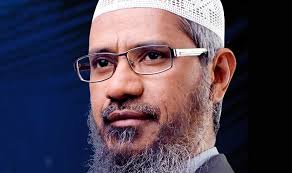
Dr Zakir Naik’s passport revoked after NIA’s request

Agencies
July 18, 2017

Mumbai, Jul 18: The external affairs ministry has revoked the passport of Zakir Naik, the physician turned Islamic preacher, who is accused by a section of media of promoting terrorism.

drzakir"The Mumbai Regional Passport Office has approved the NIA's request to revoke Zakir Naik's passport," a spokesperson for the anti-terror agency said today.

The 51-year-old televangelist, who is currently abroad, is being probed by the National Investigation Agency (NIA) for unproven charges related to terror and money laundering.

Dr Naik had his passport renewed in January last year and it was valid for 10 years.

The NIA had on November 18, 2016, registered a case against Dr Naik at its Mumbai branch under various sections of the Indian Penal Code and Unlawful Activities (Prevention) Act.

His Mumbai-based NGO, Islamic Research Foundation (IRF), has already been declared an unlawful association by the Modi government.

The preacher has been accused by India’s ruling party and mainstream media of spreading hatred, delivering provocative speeches, funding terrorists and laundering several crores of rupees over the years.

Dr Naik, a medical doctor-turned preacher, during his interactions with the Indian media from his haven abroad has repeatedly denied all charges. He was served a show-cause notice by the passport authorities asking as to why his travel document should not be revoked.

The Interpol was approached against Naik after a year- long probe during which the NIA gathered evidence of his IRF and Peace TV being used to allegedly promote hatred between different religious groups.

Besides banning his NGO, the central government has taken his TV channel off air.

Comments

IMTIAZ
 - 
Friday, 21 Jul 2017

break his hands.....parade him on street,,,, such a disgusting act...
shame on this guy.....uncle g popikaaala

qasim
 - 
Friday, 21 Jul 2017

Inna lillahi va inna elahi rajioon

Arshi
 - 
Thursday, 20 Jul 2017

Hahahaa..... truth is bitter

shamon
 - 
Thursday, 20 Jul 2017

Is this institution Kerala Nadvathul Mujahideen is run by name sake muslims or pro sangh parivar staff. If a Muslim women is not allowed to wear hijab in a muslim run organisation, what is the use of naming the organisation as Nadvathul Mujahideen. Better change the name as Nadvathul sangh parivar or Nadvathul Seculardeen. shame to hear such news.

Add new comment

  • Coastaldigest.com reserves the right to delete or block any comments.
  • Coastaldigset.com is not responsible for its readers’ comments.
  • Comments that are abusive, incendiary or irrelevant are strictly prohibited.
  • Please use a genuine email ID and provide your name to avoid reject.
News Network
January 23,2020

Bengaluru, Jan 23: City civic body Bruhat Bengaluru Mahanagara Palike (BBMP) levied a penalty of Rs 50,000 on the Karnataka State Cricket Association (KSCA) for using single-use plastic cups during the recent India-Australia one-day international match at the M Chinnaswamy Stadium in Bengaluru.

"Despite many awareness meetings, BBMP has found that single-use plastic cups were used during yesterday's cricket match and has fined KSCA Rs 50,000 as penalty," tweeted the civic body commissioner BH Anil Kumar.

The state cricket association treasurer Vinaya Mruthyunjaya said the civic body gave a general notice without detailed information on plastic use.

"We have been environmentally friendly for the last many years and at all gates, security has made sure no plastic or flex was allowed inside the stadium," Mruthyunjaya told media.

Mruthyunjaya said KSCA sought information from the civic body as to where the single-use plastic cups were found in the stadium during the India-Australia match.

On January 16, KSCA president Roger Binny inaugurated a plastic bottle shredder at the Chinnaswamy Stadium, in addition to other green initiatives at the cricket ground such as solar panels, sub-air system, biogas unit, rainwater harvesting and others. 

Similarly, in December 2019, BBMP cracked down on popular fast food eatery – Adyar Anand Bhavan in HSR Layout and fined the establishment Rs 1 lakh for plastic use.

In October, the BBMP fined eateries including McDonald's in central Bengaluru for using plastic.

Comments

Add new comment

  • Coastaldigest.com reserves the right to delete or block any comments.
  • Coastaldigset.com is not responsible for its readers’ comments.
  • Comments that are abusive, incendiary or irrelevant are strictly prohibited.
  • Please use a genuine email ID and provide your name to avoid reject.
Agencies
February 6,2020

Even more than three years after demonetisation and all-out efforts to make most transactions through electronic, cash is still king, as it thrives in a digital India, said fintech start-up Paytm founder Vijay Sekhar Sharma.

"While cashless economy is not possible in India, less cash economy will be in the future. Less cash is the only solution, not the elimination of cash," Sharma told IANS in an interview after unveiling an all-in-one payment gateway on Tuesday.

Asserting that it would take 5-10 years for India to make the transition to digital payments from the traditional mode of cash, Sharma, 41, said the e-payment industry benefitted more from the November 8, 2016 note ban and withdrawal of old Rs 1,000 and Rs 500 denominations.

"I think it (demonetisation) helped the industry despite lack of specific help. But the world has changed since then. It is about the scale of distribution of merchants that is what is propelling digital payments," said Sharma.

Most of the cash not only came back into circulation, but also remains as the mode of payment for the majority due to its convenience for the people used to such transactions.

Expounding Paytm's zero service charge, Sharma said the strategy is sustainable as it leads to acquiring more customers and merchants, enabling newer business opportunities.

Paytm also does not levy a service charge to small merchants for its payments services, unlike organised players like Uber.

"Though there is a monetisation model, the merchants who are small shopkeepers, become our financial services customers as they open a bank account, which is profitable."

Paytm secured a Payments Bank license from the Reserve Bank of India to offer a savings bank account, Rupay debit card and money transfer services.

"We are banking on payment services acquiring customers and merchants who avail banking, lending, insurance, wealth and software services like billing software and business ledger software services eventually," Sharma noted.

The mobile first bank services include zero balance and zero digital transaction charge accounts.

"Basically, payments, cloud, commerce and financial services are a cohort we follow. So, payments is our customer as well as merchant acquisition. If it breaks even, we are happy because other line items make more money, he affirmed.

Noting that in a market like India, one cannot price services at a premium unlike in a developed country like the US, the billionaire businessman said a consumer in a developing country would not be able to afford such a hefty charge.

Forbes ranked Sharma as India's youngest billionaire in 2017, with a net worth of $2.1 billion.

While several countries operate on the model of higher service charges, Sharma said newer business models have to be discovered in India, as customer lifecycle value is accounted for more stages than in other nations.

Asked about an upscale retailer like Zara not giving a wallet payment option during its recent end of season sale in Bengaluru, Sharma said Paytm was addressing such hiccups with its all-in-one payment solutions.

"It's an opportunity, because if the retailer has our all-in-one point of sale machine, where in they enter the amount, it shows both the Quick Response code (QR) and card payment options," he observed.

Sharma compared older swiping payment machine to feature phones and modern ones to feature-rich smartphones.

"If you notice, they look like feature phones and the modern day card machine is more a smartphone like. You can add the smatphone components, which can add the features," reiterated Sharma.

Though Paytm's all-in-one QR point of sale machine integrates the billing system, its chief executive said it was not ideal to have an independent QR feature.

Paytm has 16 million strong merchant user base, which Sharma aims to raise to 26 million base in the next one year.

Sharma has launched in this tech city an all-in-one payment gateway and Paytm Business Payments solution, which enable digital payments through multiple methods for small and medium enterprises (SMEs) and an Android point of sale machine.

With the new gateway solution, collecting digital payments through multiple methods can be achieved seamlessly while Paytm Business Payments solution enables automated vendor payments, including employee salaries and customer refunds among others.

The One97 Communications-owned Paytm aims to help SMEs streamline and digitise their business activities using its new solutions, which enhance the overall efficiency of both accepting and making payments.

Paytm has a data bank of over 200 million saved cards and bank accounts, a feature which enables partner apps to shorten transaction times and propel faster conversions while using the all-in-one payment gateway.

Complementing the two solutions, Sharma also launched an all-in-one Android point of sale machine, which can accept payments through all forms such as cards, wallets, UPI apps and even cash.

The device has a QR code that supports all contact and contactless payments, coming with integrated billing software customized solutions for different sectors such as catering, ticketing, parking and others.

The handheld Android device is equipped with an in-built printer, scanner and can also generate bills.

Valued at $16 billion, Paytm is not alone in the fiercely competitive Indian fintech space where a dozen players like PhonePe, MobiKwik, Kotak 811 and deep pocketed international giants Google Pay and Amazon Pay are in the fray.


Comments

Add new comment

  • Coastaldigest.com reserves the right to delete or block any comments.
  • Coastaldigset.com is not responsible for its readers’ comments.
  • Comments that are abusive, incendiary or irrelevant are strictly prohibited.
  • Please use a genuine email ID and provide your name to avoid reject.
coastaldigest.com news network
May 20,2020

Mangaluru/Udupi, May 20: Islamic scholars belonging to different schools of thoughts including two prominent Qadis have issued special guidelines asking all Muslims in the region to offer prayers and celebrate Eid al-Fitr at home this year in keeping with the extended covid-19 lockdown.

Eid al-Fitr which marks the end of the month-long dawn-to-sunset fasting of Ramadan is rather a ‘humanitarian event’ than a fiesta. This year Eid is likely to be observed in coastal Karnataka on May 23 or May 24 depending on sighting of the new moon.  

Amid the Covid-19 pandemic, the Muslims are preparing for — and reconciling itself to — a most unusual Eid bereft of all the usual trappings like huge prayer congregations, ceaseless shopping, social visits and the inviting warmth of an Eid Mubarak embrace.

In their separate messages, Udupi Qadi Bekal Ibrahim Musliyar and Mangaluru Qadi Twaqa Ahmed Musliyar have urged Muslims to refrain from all kinds of public gatherings during Eid. Noting that Muslims in the region have followed all the advisories in issued by the government to contain the spread of coronavirus in the blessed month of Ramadan, they have urged them to follow the guidelines during Eid too.

On social media groups, messages like “no new clothes, just wear your best clothes” are being circulated among family and friends, urging people to fill the festive void with the spirit of giving. The suggestions range from paying a needy child’s school fee or someone’s rent to helping a lockdown-hit trader revive his business.

Following guidelines are issued by the top clerics ahead Eid

1) There will be no Eid prayer in mosques or Eid-gahs. Hence, Muslims should offer Eid al-Fitr prayer in their homes with family members.

2) Distributing Zakat al-Fitr among needy is mandatory. However necessary safety measures should be taken while going out such as wearing masks and maintaining physical distance. As there is lockdown from 7 p.m. to 7 a.m. every day, Zakat al-Fitr can be distributed a day before Eid or on the day of Eid before evening. 

3) Women, children and elderly people should not step out of the houses.

4) Avoid visiting graveyards or other places.

5) All mosques are closed due to lockdown. Hence, observe Eid in a simple way and set an example for the society. 

6) Strictly follow all the guidelines issued by the state and central governments

Comments

Add new comment

  • Coastaldigest.com reserves the right to delete or block any comments.
  • Coastaldigset.com is not responsible for its readers’ comments.
  • Comments that are abusive, incendiary or irrelevant are strictly prohibited.
  • Please use a genuine email ID and provide your name to avoid reject.