


DRDO ties up with Ramdev to market supplements, food products

August 24, 2015

Leh(JK), Aug 24: India's premier defence research organisation DRDO has now roped in yoga guru Ramdev's Patanjali Ayurveda Limited to manufacture and market in the country and abroad some herbal supplements and food products developed by it.RAMDEV
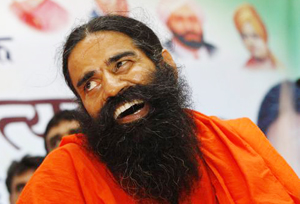
DRDO today entered into licensing agreements with Ramdev's company for transfer of Seabuckthorn technology based products developed by Defence Institute of High Altitude Research (DIHAR).

The technology has been transferred under the DRDO FICCI ATAC (Accelerated Technology Assessment&Commercialisation) programme that has been established to identify spin-off technologies for commercial markets within India and abroad, with a special focus on social benefit technologies, an official statement said.

DIHAR, a frontier laboratory of DRDO which is located in Leh with detachments in the strategic Siachen sector has pioneered cold arid-agro animal technologies for augmenting local availability of fresh food in the region.

The laboratory, through its translational laboratory to land approach, develops technologies for fresh food cultivation, poultry, goat and dairy farming and green house cultivation which are disseminated to the local farmers.

Speaking on the occasion, Defence Minister Manohar Parrikar said seabuckthorn is a unique product. "Apart from what has been commercialised, there are many more applications which Patanjali Ayurveda could explore to exploit the full potential of Seabuckthorn," he said.

Parrikar wanted Patanjali Ayurveda to bring many more health products to exploit the full potential of the technologies beyond what DIHAR has found out.

He added that DRDO in collaboration with FICCI under DRDO FICCI ATAC programme is striving to commercialise more and more spin off technologies for the benefit of society at large.

DRDO Chief S Cristopher mentioned that DIHAR has been relentlessly working for development of products which in addition to their usefulness for Armed Forces has tremendous commercial potential in India and abroad.

"The benefits of the research done by DIHAR will help the local population to derive the economic benefits," he said.

While giving an overview, Bhuvnesh Kumar, Director, DIHAR said that the farmers adopt the technologies developed by his scientists and sell their produce to the army.

"This unique approach not only results in local availability of fresh food but also results in socio-economic development of Ladakh and stronger civil-military cooperation in this strategically important region," the statement quoted him as saying.

Comments

Abe
 - 
Friday, 17 Jun 2016

This iis the reaso why smokers are trying to
find a way to stop smoking- at least. Technological advancements
today have led to the creation of the new electronic cigarette, a device that aims to help
even the most seemingly hopleless smoker to quit. When you opt
to make a purchase online, you will bbe able to review different
variieties to find the electronic cigarettes and accessories that are suitable tto you and
are within youur budget.

Taake a look at my web blog - elektronik sigara ovale: http://www.samuraiweapons.org/go.php?url=http://www.pusha.se/excellent-…

Jackson
 - 
Thursday, 19 May 2016

It is a conhstant process in each moment tto focus your thoughts and subsequent actionss into happiness, juyst like itt is a process in each moment to fokcus your thoughtts and subsequent actions to be in line with
enlightenment. It uses the excess fat from oour body
as a source of fuel and manages appetite and excessive food cravings.
this is by far the most common beneftit people know about green coffee bean extracts.

Here is my web-site ... yesil kahve kullananlar: http://www.tederojones.com/?option=com_k2&view=itemlist&task=user&id=45…

Add new comment

  • Coastaldigest.com reserves the right to delete or block any comments.
  • Coastaldigset.com is not responsible for its readers’ comments.
  • Comments that are abusive, incendiary or irrelevant are strictly prohibited.
  • Please use a genuine email ID and provide your name to avoid reject.
News Network
January 5,2020

Mangaluru, Jan 5: To keep an hawk's eye on the city, 15 prominent and crowded junctions in the city will have the most advanced CCTV cameras installed under the Smartcity project.

The junctions are-- Bejai KSRTC, Pumpwell, Vamanjoor, Padil, Mullikatte, Bejai, Bendoor, Falnir, Morgans Gate, Kulashekara-Shakthinagar Cross, Kottara Chowki, Kuntikan, Rao & Rao Circle, Padavinangady and Kavoor junctions.

According to top police officials, these junctions will receive approximately 75 cameras to check crime and aid in solving the cases of murder and robbery in the city.

A ‘smartpole’ will be installed there with each pole containing about five cameras along with a 360 degree swivelling camera.

Comments

Angry Indian
 - 
Sunday, 5 Jan 2020

One camera need inside the poilce cabin..


this will revel whom the police meet 

nidhin
 - 
Sunday, 5 Jan 2020

Better to install in Police station itself, at least it can reveal undisclosed Bhaithak. 

Add new comment

  • Coastaldigest.com reserves the right to delete or block any comments.
  • Coastaldigset.com is not responsible for its readers’ comments.
  • Comments that are abusive, incendiary or irrelevant are strictly prohibited.
  • Please use a genuine email ID and provide your name to avoid reject.
News Network
February 6,2020

Kalaburagi, Feb 6: The State government will take steps to ensure that Kannada as a language is taught in all private schools, Chief Minister B.S. Yediyurappa announced today at the 85th Akhila Bharata Kannada Sahitya Sammelana in Kalaburagi.

This comes in the wake of the demand by some Kannada activists for making Kannada medium compulsory in all schools in the State. Sammelana president H.S. Venkatesh Murthy, who spoke after the Chief Minister, also made this demand.

The Chief Minister said “We are committed to putting in place a series of steps to see that Kannada is taught in all schools, aided and private, as a language. Kannada should be taught as the first or second language. We will also take steps to strengthen government schools. However, the government alone cannot do much. The community and parents should offer support to make sure that government schools provide quality education to all.”

To inculcate the spirit of scientific inquiry, the State government is setting up mobile planetariums. This will increase the interest of children in space technology and India’s efforts in space exploration.

The government is committed to protecting the interests of the State in Mahadayi and other river water disputes. It will take the border row issue, based on the Mahajan Commission report pending in the Supreme Court, to its logical end.

The government will also address backwardness and related issues. It will make sure that adequate funds are allocated to the development of Kalyana Karnataka. Among other things, it will establish a hostel for students from Kalaburagi region in Bengaluru. Land has been allotted in Nagarabavi for the hostel that can accommodate around 200 students. The government has decided to celebrate Kalyana Karnataka Utsav once every two years. This will showcase the culture of the region.

“We are working towards forging sentimental and emotional unity of the State other than unity based on language or administration. Our dream is to see that Karnataka remains a homogeneous unit with equality and equal opportunity for all,’’ the Chief Minister added.

Kambar bats for technology

Chandrashekar Kambar, Sahitya Akademi president and former president of the Akhila Bharata Kannada Sahitya Sammelana, favoured effective implementation of technology in administration and for universal use of Kannada in computing and e-governance.

Speaking at the Sammelana inauguration, he said “Several years ago, at the insistence of writer Poornachandra Tejaswi, I appealed to the State government to give a push to Kannada computing. We were convinced that no language can survive without the use of modern technology and use of the language in computers. The Department of Kannada and Culture, headed by then director Manu Baligar, released ₹2 crore for the project. The work began in earnest and teams of technologists came up with software and fonts. Some departments started using Kannada software. But this work has stopped or slowed down at some level. I appeal to Chief Minister B.S. Yediyurappa to continue the work and ensure that computerised Kannada is used at all levels of government and in e-governance.’’

Supports dubbing

Mr. Kambar batted for content dubbing of informative TV channels in Kannada. Channels such as Discovery and History produce good quality content that can be educative and informative. They are very useful for children. These channels are now available in Tamil, Telugu and Hindi and some other Indian languages. But they are not available in Kannada. That is because some people in the film industry are opposing dubbing. Such opposition is not good. Informative channels are our window to the world and allowing dubbing will enhance our knowledge base. There is no merit in not allowing dubbing. I appeal to C.T. Ravi, Minister for Kannada and Culture, to allow dubbing in Kannada, he said.

Mr. Kambar favoured primary education in the mother tongue of the child and urged the State government to introduce universal and compulsory education in Kannada medium in all schools. “This will help preserve our culture. Nothing else can,’’ he said.

He blamed the East India Company administration for inculcating a craze for English education among the people. “The introduction of English education by the British was strongly welcomed by the masses in India as they had been denied the opportunity for education for millenia. The deprived classes and Dalits who had not been exposed to education till then, were excited about the opportunity. However, along with English education, the British were successful in introducing inferiority in our minds. We are yet to escape from this inferiority complex.”

Quoting from Greek mythology, Mr. Kambar said that Hercules had killed his children and relatives in a fit of alcohol-induced rage. “We should not behave like that. We may be very strong, but we should not kill our mother tongue, in our power-induced rage,’’ he said.

Comments

Add new comment

  • Coastaldigest.com reserves the right to delete or block any comments.
  • Coastaldigset.com is not responsible for its readers’ comments.
  • Comments that are abusive, incendiary or irrelevant are strictly prohibited.
  • Please use a genuine email ID and provide your name to avoid reject.
News Network
March 5,2020

Mar 5: The Karnataka government on Thursday proposed to increase rate of tax on petrol and diesel by three per cent which would make the fuel dearer by Rs 1.60 and Rs 1.59 per litre, respectively.

Presenting the 2020-21 budget in the Legislative Assembly, Chief Minister B S Yediyurappa proposed to increase rate of tax on petrol from 32 per cent to 35 per cent and diesel from 21 per cent to 24 per cent, as part of additional resource mobilisation measures.

Yediyurappa, who also holds the finance portfolio, increased excise duty on Indian Made Liquor (KML) across 18 slabs by six per cent.

However, to promote affordable housing, the government proposed to reduce stamp duty on first time registration of new apartments/flats costing less than Rs 20 lakh from existing five per cent to two per cent.

This is the first budget of the BJP government after coming to power last year; it's the seventh presented by Yediyurappa.

"For the year 2020-21, a total amount of Rs 55,732 crore is provided for stimulating economic growth sector", the Chief Minister said.

He said the revenue collection target for the Commercial Taxes department for the year 2020-21 is fixed at Rs 82,443 crore.

Stating the government had fixed a revenue target of Rs 20,950 crore for the excise department for the year 2019- 20, he said at the end of February Rs 19,701 crore had been collected.

"We hope to achieve the budget target."

He also hoped with the increase in rates and effective enforcement and regulatory measures, the Excise department would be achieving the target of Rs 22,700 crore fixed for the financial year 2020-21.

On the transport sector, Yediyurappa said it is proposed to levy motor vehicle tax on contract carriages having seating capacity to carry more than 12 passengers, but not more than 20 passengers at the rate of Rs 900 per seat per quarter.

He said it is also proposed to levy vehicle tax on new model sleeper coaches which are granted permits under section 88 (9) of MV Act 1988 at the rate of Rs 4,000 per sleeper per quarter.

Noting that a target of Rs 7,100 crore revenue collection is expected to be achieved in 2019-20 in transport sector, he said for 2020-21 revenue collection target has been fixed at Rs 7,115 crore.

He said the revenue collection target for 2019-20 under stamps and registration was fixed at Rs 11,828 crore and against this Rs 10,248 crore has been collected till the end of February 2020 which is 87 per cent of full year target.

While the revenue collection target for 2020-21 under stamps and registration is fixed at Rs 12,655 crore.

Comments

Add new comment

  • Coastaldigest.com reserves the right to delete or block any comments.
  • Coastaldigset.com is not responsible for its readers’ comments.
  • Comments that are abusive, incendiary or irrelevant are strictly prohibited.
  • Please use a genuine email ID and provide your name to avoid reject.