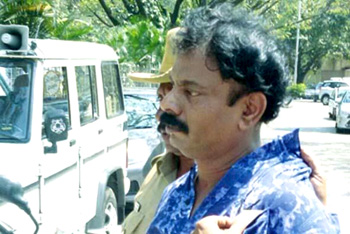
Drunk man hurls chocolate bomb' at Karnataka CM

[email protected] (News Network)
February 22, 2016

Bengaluru, Feb 22: An inebriated man hurled a chocolate packet at chief minister Siddaramaiah at Ravindra Kalakshetra on Sunday morning, setting off a bomb scare.

chocolatesReports said the man in his late 30s cried 'bomb' as he aimed the packet at the CM. The chief minister's security personnel seized the cover and opened it, only to find a few pieces of chocolates inside. They detained the man, identified as B H J Prasad, a BBMP forest wing employee. The incident took place during the golden jubilee celebration of Udayabhanu Kala Sangha.

Sources said the trouble started when Prasad, from the balcony of the auditorium, interrupted the CM's speech asking him to list what he has done for his community. As the CM enquired Prasad about his community, the man threw an object towards him.

The crowd panicked initially, but it was soon found that the packet sealed with red tape contained chocolates. SJ Park police detained Prasad and released him on bail in the evening.

According to police, Prasad, said to be from Savita Samaja, was aggrieved as he couldn't enter active politics.

Siddaramaiah termed the incident part of a democracy and said he would look into the issues raised by Prasad's community.

Deputy commissioner of police (central) Sandeep Patil said Prasad was making incoherent statements during questioning. "We haven't pressed charges against him. We're trying to ascertain if he's psychologically fit. We've summoned his wife to get more details about him," he said.

He has been booked for public nuisance under IPC Section 290 and Section 92 of the Karnataka Police Act.

Comments

karthik
 - 
Monday, 22 Feb 2016

would have thrown really bomb.

SOCIAL
 - 
Monday, 22 Feb 2016

he is drunk or mentaly loose,becouse his name is ravindra,,,,

Add new comment

  • Coastaldigest.com reserves the right to delete or block any comments.
  • Coastaldigset.com is not responsible for its readers’ comments.
  • Comments that are abusive, incendiary or irrelevant are strictly prohibited.
  • Please use a genuine email ID and provide your name to avoid reject.
Agencies
January 19,2020

Bengaluru, Jan 19: Technology hub Hyderabad has edged out 129 other cities in the world to emerge as the world's most dynamic city, according to the seventh edition of the City Momentum Index by global real estate services firm JLL.

The city has pushed Bengaluru to second place to regain the top position after a gap of one year. Chennai is at fifth and Delhi is at sixth place.

While Hyderabad and Bengaluru are the top two cities globally for socio-economic momentum, a more active real estate market helped elevate Hyderabad to first position in the overall ranking, says the report released by the US-based Jones Lang Lasalle (JLL) on Saturday night.

Hyderabad recorded the highest office net absorption in 2019 (as a proportion of existing stock) of any city globally, while it is also among the world's best-performing cities for prime office rental growth.

While all seven major Indian cities feature in this year's Global Top 20, cities in south India in particular - Hyderabad, Bengaluru and Chennai (5th) "are ahead of their northern peers, supported by favourable demographics and business climates".

"Their expanding tech industries and start-up cultures make them a magnet for young and ambitious talent from across the country, with Bengaluru having one of the world's largest concentrations of 'engine room' population (20-40-year-olds), typically the most dynamic and productive age cohort," says the report.

Kolkata and Mumbai made it to the top 20 and stood at the 16th and 20th positions. Despite an economic slowdown, India leads the 2020 Index with seven Indian cities in the top 20.

"Commercial real estate in south Indian cities is growing at a rapid pace. Hyderabad has seen tremendous growth in 2019 in line with that of Bengaluru. The city has actively embraced technology-driven economic growth and attracted large tech giants and e-commerce players. The state government's focus on business-friendly policies and provision of high-quality infrastructure along with availability of quality talent pool and superior quality business parks has given Hyderabad a competitive edge," said Ramesh Nair, CEO and Country Head - India, JLL.

Telangana's Minister for Information Technology and Industry K T Rama Rao said he was thrilled over Hyderabad not only regaining the top slot but also over the fact that it was competing with cities like Shenzhen and Shanghai in innovation economy.

The minister said 50 percent weightage from socio-economic indicators beside the remaining 50 percent from commercial and real estate was also heartening.

KTR, as the minister is popularly known, noted that in 2014 when Telangana attained statehood, Hyderabad was not even in the list. He recalled that when Telangana was formed there were many doubts as to what would happen to Hyderabad. "It entered the top 20 in 2015 and rose to fifth place in 2016 and third position in 2017. Hyderabad topped the list in 2018 and finished second the last year. This year it is back at the top," he said.

The JLL City Momentum Index identifies a number of key growth drivers, including talent attraction, the expansion of innovation hubs and better urban planning, that cities can employ to meet the challenges faced by rapid momentum.

Several cities in the top 20 stand out as they transform their urban environments in pursuit of a low-carbon future. In India, Hyderabad is looking at technology to reduce the demand for air conditioning with cool roofs that reflect sunlight and absorb less heat, it said.

"The growth of "micro-mobility" is another positive step, illustrated by Hyderabad's introduction of smart bikes and electric cars. Smart city solutions, such as bike rentals, improved quality of life, help increase inclusion and aid in the transition to a low carbon environment."

Comments

Add new comment

  • Coastaldigest.com reserves the right to delete or block any comments.
  • Coastaldigset.com is not responsible for its readers’ comments.
  • Comments that are abusive, incendiary or irrelevant are strictly prohibited.
  • Please use a genuine email ID and provide your name to avoid reject.
News Network
July 12,2020

Bengaluru, Jul 12: KCTET 2020: Attention candidates, the Karnataka Deputy Chief Minister has confirmed the exam dates for Karnataka Common Entrance Test, KCET 2020.

As per information, KCET 2020 will be held between July 30 and July 31.

Karnataka Common Entrance Test or KCET is an examination which is held for admission to BTech courses in the state’s institutes.

The Higher Education Minister C N Ashwathnarayan, took to twitter to confirm the KCET dates. The Minister tweeted:

“The K-CET 2020 examinations will be held on the decided dates of July 30 & July 31. All the best to all the students!”

Details regarding KCET exam centers, time, and schedule will be mentioned in the admit card. Candidates can download their admit card fro the official website of KEA i.e. cetonline.karnataka.gov.in.

KCET 2020 was earlier scheduled to be held from April 22 to April 24, 2020, however, due to the ongoing coronavirus outbreak, KEA postponed KCET 2020 exams.

Comments

Add new comment

  • Coastaldigest.com reserves the right to delete or block any comments.
  • Coastaldigset.com is not responsible for its readers’ comments.
  • Comments that are abusive, incendiary or irrelevant are strictly prohibited.
  • Please use a genuine email ID and provide your name to avoid reject.
Agencies
May 8,2020

Washington D.C., May 8: The prime time for brain development in a child's life is the first year, where the infant spends most of the time asleep. It is the time when neural connections form and sensory memories are encoded.

However, when sleep is disrupted, as occurs more often among children with autism, brain development may be affected, too.

New research led by the University of Washington finds that sleep problems in a baby's first 12 months may not only precede an autism diagnosis but also may be associated with altered growth trajectory in a key part of the brain, the hippocampus.

The study, which was published in the American Journal of Psychiatry, researchers report that in a sample of more than 400 taken of 6- to 12-month-old infants, those who were later diagnosed with autism were more likely to have had difficulty falling asleep.

It also states that this sleep difficulty was associated with altered growth trajectories in the hippocampus.

"The hippocampus is critical for learning and memory, and changes in the size of the hippocampus have been associated with poor sleep in adults and older children.

As many as 80 per cent of the children with autism spectrum disorder have sleep problems," said Annette Estes, director of the UW Autism Center and senior author of the study.

"In our clinical experience, parents have a lot of concerns about their children's sleep, and in our work on early autism intervention, we observed that sleep problems were holding children and families back," added Estes, who is also a UW professor of speech and hearing sciences.

"It could be that altered sleep is part-and-parcel of autism for some children. One clue is that behavioural interventions to improve sleep don't work for all children with autism, even when their parents are doing everything just right. This suggests that there may be a biological component to sleep problems for some children with autism," said Estes.

To consider links among sleep, brain development, and autism, researchers at the IBIS Network looked at MRI scans of 432 infants, surveyed parents about sleep patterns, and measured cognitive functioning using a standardized assessment.

At the outset of the study, infants were classified according to their risk for developing autism: Those who were at higher risk of developing autism -- about two-thirds of the study sample -- had an older sibling who had already been diagnosed.

Infant siblings of children with autism have a 20 per cent chance of developing autism spectrum disorder -- a much higher risk than children in the general population.

In the current study, 127 of the 432 infants were identified as "low risk" at the time the MRI scans were taken because they had no family history of autism.

They later evaluated all the participants at 24 months of age to determine whether they had developed autism. Of the roughly 300 children originally considered "high familial risk," 71 were diagnosed with autism spectrum disorder at that age.

Problems with sleep were more common among the infants later diagnosed with an autism spectrum disorder, as were larger hippocampi. No other subcortical brain structures were affected, including the amygdala, which is responsible for certain emotions and aspects of memory, or the thalamus, a signal transmitter from the spinal cord to the cerebral cortex.

The authors note that while parents reported more sleep difficulties among infants who developed autism compared to those who did not, the differences were very subtle and only observed when looking at group averages across hundreds of infants.

Sleep patterns in the first years of life change rapidly as infants transition from sleeping around the clock to a more adult-like sleep/wake cycle. Until further research is completed, Estes said, it is not possible to interpret challenges with sleep as an early sign of increased risk for autism.


Comments

Add new comment

  • Coastaldigest.com reserves the right to delete or block any comments.
  • Coastaldigset.com is not responsible for its readers’ comments.
  • Comments that are abusive, incendiary or irrelevant are strictly prohibited.
  • Please use a genuine email ID and provide your name to avoid reject.