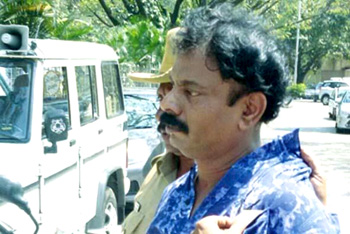
Drunk man hurls chocolate bomb' at Karnataka CM

[email protected] (News Network)
February 22, 2016

Bengaluru, Feb 22: An inebriated man hurled a chocolate packet at chief minister Siddaramaiah at Ravindra Kalakshetra on Sunday morning, setting off a bomb scare.

chocolatesReports said the man in his late 30s cried 'bomb' as he aimed the packet at the CM. The chief minister's security personnel seized the cover and opened it, only to find a few pieces of chocolates inside. They detained the man, identified as B H J Prasad, a BBMP forest wing employee. The incident took place during the golden jubilee celebration of Udayabhanu Kala Sangha.

Sources said the trouble started when Prasad, from the balcony of the auditorium, interrupted the CM's speech asking him to list what he has done for his community. As the CM enquired Prasad about his community, the man threw an object towards him.

The crowd panicked initially, but it was soon found that the packet sealed with red tape contained chocolates. SJ Park police detained Prasad and released him on bail in the evening.

According to police, Prasad, said to be from Savita Samaja, was aggrieved as he couldn't enter active politics.

Siddaramaiah termed the incident part of a democracy and said he would look into the issues raised by Prasad's community.

Deputy commissioner of police (central) Sandeep Patil said Prasad was making incoherent statements during questioning. "We haven't pressed charges against him. We're trying to ascertain if he's psychologically fit. We've summoned his wife to get more details about him," he said.

He has been booked for public nuisance under IPC Section 290 and Section 92 of the Karnataka Police Act.

Comments

karthik
 - 
Monday, 22 Feb 2016

would have thrown really bomb.

SOCIAL
 - 
Monday, 22 Feb 2016

he is drunk or mentaly loose,becouse his name is ravindra,,,,

Add new comment

  • Coastaldigest.com reserves the right to delete or block any comments.
  • Coastaldigset.com is not responsible for its readers’ comments.
  • Comments that are abusive, incendiary or irrelevant are strictly prohibited.
  • Please use a genuine email ID and provide your name to avoid reject.
News Network
January 15,2020

Davangere, Jan 15: Karnataka Chief Minister B S Yediyurappa on January 14 threatened to resign when the seer of 'Panchamasali Guru Peetha' warned that the community will leave him, if a BJP MLA from the community is not made the minister during the upcoming cabinet expansion.

The chief minister, who is awaiting the BJP high command's nod to expand his cabinet, amid intense lobbying by the aspirants, wanted the seer Vachanananda swamiji and the 'Panchamasali' community to understand his "situation." Yediyurappa pointed out that he has come to power because of the Congress-JD(S) legislators who rebelled against the then coalition government.

The incident took place when Vachanananda swamiji, while addressing an event at Harihara, near here, said "chief minister, you are a good person, Murugesh Nirani (BJP MLA)has helped you a lot, he has stood by you..if you leave his hands this time, the united Panchamasali community will leave your hands." As the swamiji was making this statement, Yediyurappa, who was seated next to him, rose and threatened to leave the stage.

"If you speak like this I will go away...what are you speaking...kindly pardon me, I will leave, you should not speak like this, if you speak like this I can't work..you can give me suggestions, you cannot threaten me," he said, as the swamiji tried to convince Yediyurappa and asked him to take his seat.

As Yediyurappa acceded to his request, the seer said he was not threatening him but was putting forward the rights of the community. The chief minister, who was visibly upset, was seen talking to Home minister Basavaraj Bommai next to him, who even tried to convince the seer not to continue with the topic. Nirani, a MLA from Bilgi who was Industries minister in the previous Yediyurappa government, was seated on the stage when the incident occurred.

Later addressing the event, Yediyurappa said he was not "selfish" and was even ready to resign.

"Vachanananda swamiji has spoken, through you I request him to understand my situation also. If 17 legislators (Congress-JDS), few even as ministers, had not resigned and stayed away, Yediyurappa could not have occupied this Chief Minister position.

You (swamiji) need not make people raise their hands on any demand, if you tell me, I'm ready to listen to you," he said.

Stating that he was ready to take suggestions from the swamiji on all issues, including on how to run the administration for the next 3 years, Yediyurappa said "I'm ready to bow my head and listen to it, if you don't want I'm even ready to resign and go home, I'm not someone who wants to stick to the chair."

Further noting that if he says that the financial condition of the state is not good it will become headline in papers tomorrow, he said he will have to wait till March for the situation to improve.

"I dont have selfishness, I'm aware that if the Panchamasali-Lingayat community had not stood by me, I could have not sat on this chair (CM)... but kindly understand my situation also," he added.

Yediyurappa is expected to expand his ministry later this month after discussing with BJP national president Amit Shah during his visit to the state on January 18.

As the chief minister has already made it clear that 11 of the disqualified JDS-Congress MLAs who got re-elected in the bypolls on BJP tickets will be made ministers, lobbying has been on within the party for the remaining ministerial berths.

Currently there are 18 Ministers, including the chief minister in the cabinet that has a sanctioned strength of 34.

The cabinet expansion will not be an easy task for the chief minister as he will have to strike a balance by accommodating the victorious disqualified legislators as promised and also make place for the old guard, upset at being "neglected" in the first round of the induction exercise.

He also has to give adequate representation to various castes and regions in his cabinet and also deal with allocation of key portfolios.


Comments

Add new comment

  • Coastaldigest.com reserves the right to delete or block any comments.
  • Coastaldigset.com is not responsible for its readers’ comments.
  • Comments that are abusive, incendiary or irrelevant are strictly prohibited.
  • Please use a genuine email ID and provide your name to avoid reject.
News Network
July 21,2020

Bengaluru,  Jul 21: The salaries of doctors under the National Health Mission (NHM) has been hiked to Rs 45,000 in Karnataka, according to Medical Education Minister Dr K Sudhakar.

Addressing the media on Monday, Dr Sudhakar said that the state government will bear the cost of the hike in salaries of the doctors and added that ASHA workers too will get a hike in their pay soon.

Regarding the COVID-19 management in the state, he further said that testing will be increased in the containment zones.

During a meeting chaired by Chief Minister BS Yediyurappa, the Education Minister said that it had been decided that booth level committees will conduct door to door survey for early detection of influenza-like illness (ILI) and severe acute respiratory infections (SARI), and vulnerable persons.

He also implored private hospitals to admit and treat COVID-19 patients and asked them to not be hesitant in admitting pregnant women.

Karnataka on Monday reported 3,648 COVID-19 cases taking the tally to 67,420, informed the state health department.

According to a bulletin issued by the department, the state recorded 72 more deaths due to COVID-19 with the toll at 1,403 while six patients who tested positive for the infection have died due to non-COVID causes, as of Monday. There are 42,216 active cases in the state.

Comments

Prakash Salins
 - 
Tuesday, 21 Jul 2020

What about the nurses???

Add new comment

  • Coastaldigest.com reserves the right to delete or block any comments.
  • Coastaldigset.com is not responsible for its readers’ comments.
  • Comments that are abusive, incendiary or irrelevant are strictly prohibited.
  • Please use a genuine email ID and provide your name to avoid reject.
Ram Puniyani
January 14,2020

In the beginning of January 2020 two very disturbing events were reported from Pakistan. One was the attack on Nankana Sahib, the holy shrine where Sant Guru Nanak was born. While one report said that the place has been desecrated, the other stated that it was a fight between two Muslim groups. Prime Minister of Pakistan Imran Khan condemned the incident and the main accused Imran Chisti was arrested. The matter related to abduction and conversion of a Sikh girl Jagjit Kaur, daughter of Pathi (One who reads Holy Guru Granth Sahib in Gurudwara) of the Gurudwara. In another incident one Sikh youth Ravinder Singh, who was out on shopping for his marriage, was shot dead in Peshawar.

While these condemnable attacks took place on the Sikh minority in Pakistan, BJP was quick enough to jump to state that it is events like this which justify the Citizenship Amendment Act (CAA). Incidentally CAA is the Act which is discriminatory and relates to citizenship with Religion, which is not as per the norms of Indian constitution. There are constant debates and propaganda that population of Hindus has come down drastically in Pakistan and Bangla Desh. Amit Shah, the Home minister stated that in Pakistan the population of Hindus has come down from 23% at the time of partition to 3.7% at present. And in Bangla Desh it has come down from 22% to present 8%.

While not denying the fact that the religious minorities are getting a rough deal in both these countries, the figures which are presented are totally off the mark. These figures don’t take into consideration the painful migrations, which took place at the time of partition and formation of Bangla Desh later. Pakistan census figures tell a different tale. Their first census was held in 1951. As per this census the overall percentage of Non Muslim in Pakistan (East and West together) was 14.2%, of this in West Pakistan (Now Pakistan) it was 3.44 and in Eat Pakistan it was 23.2. In the census held in Pakistan 1998 it became 3.72%. As far as Bangla Desh is concerned the share of Non Muslims has gone down from 23.2 (1951) to 9.6% in 2011.

The largest minority of Pakistan is Ahmadis, (https://minorityrights.org/country/pakistan/) who are close to 4 Million and are not recognised as Muslims in Pakistan. In Bangla Desh the major migrations of Hindus from Bangla Desh took place in the backdrop of Pakistan army’s atrocities in the then East Pakistan.

As far as UN data on refugees in India it went up by 17% between 2016-2019 and largest numbers were from Tibet and Sri Lanka.  (https://www.un.org/en/development/desa/population/migration/publication…)

The state of minorities is in a way the index of strength of democracy. Most South Asian Countries have not been able to sustain democratic values properly. In Pakistan, the Republic began with Jinnah’s classic speech where secularism was to be central credo of Pakistan. This 11th August speech was in a way what the state policy should be, as per which people of all faiths are free to practice their religion. Soon enough the logic of ‘Two Nation theory” and formation of Pakistan, a separate state for Muslim took over. Army stepped in and dictatorship was to reign there intermittently. Democratic elements were suppressed and the worst came when Zia Ul Haq Islamized the state in collusion with Maulanas. The army was already a strong presence in Pakistan. The popular formulation for Pakistan was that it is ruled by three A’s, Army, America and Allah (Mullah).

Bangla Desh had a different trajectory. Its very formation was a nail in the coffin of ‘two nation theory’; that religion can be the basis of a state. Bangla Desh did begin as a secular republic but communal forces and secular forces kept struggling for their dominance and in 1988 it also became Islamic republic. At another level Myanmar, in the grip of military dictatorship, with democratic elements trying to retain their presence is also seeing a hard battle. Democracy or not, the army and Sanghas (Buddhist Sang has) are strong, in Myanmar as well. The most visible result is persecution of Rohingya Muslims.

Similar phenomenon is dominating in Sri Lanka also where Budhhist Sanghas and army have strong say in the political affairs, irrespective of which Government is ruling. Muslim and Christian minorities are a big victim there, while Tamils (Hindus, Christians etc.) suffered the biggest damage as ethnic and religious minorities. India had the best prospect of democracy, pluralism and secularism flourishing here. The secular constitution, the outcome of India’s freedom struggle, the leadership of Gandhi and Nehru did ensure the rooting of democracy and secularism in a strong way.

India so far had best democratic credentials amongst all the south Asian countries. Despite that though the population of minorities rose mainly due to poverty and illiteracy, their overall marginalisation was order of the day, it went on worsening with the rise of communal forces, with communal forces resorting to identity issues, and indulging in propaganda against minorities.

While other South Asian countries should had followed India to focus more on infrastructure and political culture of liberalism, today India is following the footsteps of Pakistan. The retrograde march of India is most visible in the issues which have dominated the political space during last few years. Issues like Ram Temple, Ghar Wapasi, Love Jihad, Beef-Cow are now finding their peak in CAA.

India’s reversal towards a polity with religion’s identity dominating the political scene was nicely presented by the late Pakistani poetess Fahmida Riaz in her poem, Tum bhi Hum Jaise Nikle (You also turned out to be like us). While trying to resist communal forces has been an arduous task, it is becoming more difficult by the day. This phenomenon has been variously called, Fundamentalism, Communalism or religious nationalism among others. Surely it has nothing to do with the religion as practiced by the great Saint and Sufi traditions of India; it resorts mainly to political mobilization by using religion as a tool.

Comments

Ashi
 - 
Tuesday, 14 Jan 2020

If Malaysia implement similar NRC/CAA, India and China are the loser.

Add new comment

  • Coastaldigest.com reserves the right to delete or block any comments.
  • Coastaldigset.com is not responsible for its readers’ comments.
  • Comments that are abusive, incendiary or irrelevant are strictly prohibited.
  • Please use a genuine email ID and provide your name to avoid reject.