Dubai: Can anyone help these NRI sisters trace their mother?

January 11, 2016

Hyderabad, Jan 11: Two sisters from Dubai made an unusual request on Saturday when they called on V Satyanarayana, deputy commissioner of Hyderabad Police’s south zone. Could the police help them find their mother, whom they hadn’t met for 27 years? The only lead they could provide the officer was a faded photograph and an Indian passport, issued in 1981 and barely legible.
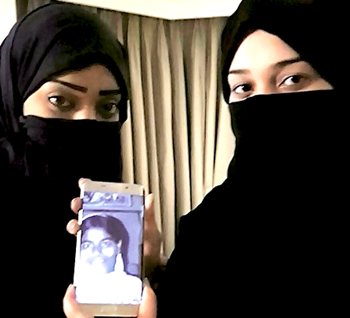
DubaiAyesha and Fatima, 33 and 32, last saw their mother when their father divorced her in 1988 and sent her back to Hyderabad, her hometown. They said they knew nothing else about her, because their father while alive had allegedly forbidden them to talk about her.

Their father Rasheed Obaid Masmary, a Dubai businessman, had married their mother Razia Sayeed in 1981, the marriage arranged by brokers. Rasheed arranged for his bride’s passport, issued by the erstwhile Madras Passport Office, and the couple settled in Dubai.

Ayesha was born a year after the marriage, Fatima the following year. After Rasheed divorced Razia in 1988, allegedly without legal proceedings, the daughters stayed with their father in Dubai. A couple of years later, Rasheed married a second time — the bride was again a Hyderabadi woman — and she settled with him in Dubai.

Ayesha and Fatima never saw their mother since 1988, when they were six and five, too young to remember much about her now. This is their first visit to Hyderabad. Their father never travelled here again although their stepmother would visit home sometimes. Rasheed died a few years ago, apparently without telling his two daughters who or where their mother was.

“Our father had cut off all contact with our mother and never told us anything about her,” said Ayesha. The sisters, fluent in Arabic, are communicating in broken English with people in Hyderabad.

“Except for a photo and a vague, almost illegible handwritten address on her passport, we know nothing about our mother. We don’t even know which part of Hyderabad she was from, or if she has any family here,” Ayesha said. “Our stepmother possibly knows about her but she has refused to tell us anything. We saw some posts on social media about the work done by Hyderabad police in tracing people, so we thought we will try too. Years have passed but we are hopeful we will get to meet her.”

Ayesha, who is married in Dubai, said her businessman husband supported her effort to search for their mother. The sisters flew to Hyderabad last week. They had made calls to police from Dubai earlier but, in the absence of local contacts, they could not make much headway. In Hyderabad, they came in touch with a local activist, Mohammed Abrar Sharif, who took them to the DCP.

The photo has been circulated among police stations. Police said they will try to trace the old address from the passport office in Chennai if those records are still available.

Comments

Naren kotian
 - 
Tuesday, 12 Jan 2016

result of contract marriages as per prefect manual :) hahaha ...pay 2 lakhs , marry 16 year old gal and stay with her for 2-3 months and later escape by giving talakh ... munchene sign bere ...shake bandre shake hand kottu airport nalle welcome maadi karkondu hogi hudugi na kottu madwe maadsi shake baby annistha idranthe howda ... hahahaha .. these saudis exploit innocent women from one particular community and sexcual abuse is very much high .. I have seen many ... papa hudugirna nodidre ayyo papa annisthade ...ummah gang help maadri ...

aharkul
 - 
Monday, 11 Jan 2016

Allahu Musta'an. Allah knows the best. We all pray for you sister to get your mother soon...

Add new comment

  • Coastaldigest.com reserves the right to delete or block any comments.
  • Coastaldigset.com is not responsible for its readers’ comments.
  • Comments that are abusive, incendiary or irrelevant are strictly prohibited.
  • Please use a genuine email ID and provide your name to avoid reject.
News Network
July 18,2020

Dubai, July 18: An NRI student who passed away in Dubai shortly after shortly after attempting his Central Board of Secondary Education (CBSE) Grade 12 papers in March, has scored an impressive 91.4 per cent on his board examinations, including 100 in his media studies paper.

Ahmed Ziyad, a student of GEMS Our Own Indian School in Al Qouz, Dubai, died on March 19, suffered a heart condition called Hypertrophic cardiomyopathy (HCM) that stopped him from being active in sporting activities.

Ziyad's parents, teachers, and classmates remember him as a very ambitious pupil, who wanted to launch his own business and achieve great things in his life. His board results are - mass media studies 100, Marketing 97, English 84, Entrepreneurship 82, and Home Science 94.
 
Ziyad's father, Shanavaz Manangath, a real estate professional who has been a resident of Dubai for over two decades said, "Six months ago, he had collapsed while playing with his friends. Since there was an irregularity in his heartbeat, he could not take part in any strenuous activities." He added, "Ziyad had just started playing with his friends on March 19 when he suddenly collapsed and died shortly after. My family has not been able to overcome his loss."

Unable to hold back his tears, an emotional Manangath said Ziyad wanted to do his BBA and launch his own business, "He was very ambitious. Honestly, I haven't looked into his board exam results, but, I know he had studied very hard for the exams."

Comments

Add new comment

  • Coastaldigest.com reserves the right to delete or block any comments.
  • Coastaldigset.com is not responsible for its readers’ comments.
  • Comments that are abusive, incendiary or irrelevant are strictly prohibited.
  • Please use a genuine email ID and provide your name to avoid reject.
News Network
April 11,2020

Dubai, Apr 11: Saudi Arabia has reported another 382 new cases of coronavirus, bringing the total number of infections in the country to 4,033, the Ministry of Health announced on Saturday.

The ministry also confirmed five more deaths from the virus, pushing the death toll in Kingdom to 52.

A total of 35 people has made full recovery from the deadly disease, taking the tally of patients recovered to 720.

Comments

Add new comment

  • Coastaldigest.com reserves the right to delete or block any comments.
  • Coastaldigset.com is not responsible for its readers’ comments.
  • Comments that are abusive, incendiary or irrelevant are strictly prohibited.
  • Please use a genuine email ID and provide your name to avoid reject.
Agencies
August 2,2020

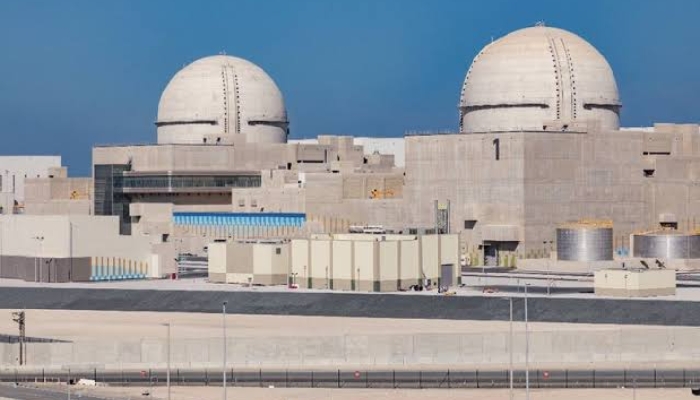
Dubai, Aug 2: The United Arab Emirates (UAE) announced on Saturday that it has started operations in the first of four reactors at the Barakah nuclear power station - the first nuclear power plant in the Arab world.

Emirates Nuclear Energy Corporation (ENEC), which is building and operating the plant with Korea Electric Power Corporation (KEPCO) said in a press release that its subsidiary Nawah Energy Company "has successfully started up Unit 1 of the Barakah Nuclear Energy Plant, located in the Al Dhafrah Region of Abu Dhabi".

That signals that Unit 1, which had fuel rods loaded in March, has achieved "criticality" - a sustained fission chain reaction.

"The start-up of Unit 1 marks the first time that the reactor safely produces heat, which is used to create steam, turning a turbine to generate electricity," said ENEC.

Barakah, which was originally scheduled to open in 2017, has been dogged by delays and is billions of dollars over budget. It has also raised myriad concerns among nuclear energy veterans who are concerned about the potential risks Barakah could visit upon the Arabian Peninsula, from an environmental catastrophe to a nuclear arms race.

Paul Dorfman, an honorary senior research fellow at the Energy Institute, University College London and founder and chair of the Nuclear Consulting Group, has criticised the Barakah reactors' "cheap and cheerful" design that he says cuts corners on safety.

Dorfman authored a report (PDF) last year detailing key safety features Barakah's reactors lack, such as a "core catcher" to literally stop the core of a reactor from breaching the containment building in the event of a meltdown. The reactors are also missing so-called Generation III Defence-In-Depth reinforcements to the containment building to shield against a radiological release resulting from a missile or fighter jet attack.

Both of these engineering features are standard on new reactors built in Europe, says Dorfman.

There have been at least 13 aerial attacks on nuclear facilities in the Middle East - more than any other region on earth.

The vulnerability of critical infrastructure in the Arabian Peninsula was further laid bare last year after Saudi Arabia's oil facilities at Abqaiq and Khurais were attacked by 18 drones and seven cruise missiles - an assault that temporarily knocked out more than half of the kingdom's oil production.

On Saturday, Dorfman reiterated his concern that there is no regional protocol in place to determine liability should an accident or incident at Barakah result in radioactive contamination spreading from the UAE to its neighbours. 

"Given Barakah has started up, because of all the well-rehearsed nuclear safety and security problems, it may be critically important that the Gulf states collectively evolve a Nuclear Accident Liability Convention, so that if anything does go wrong, victim states may have some sort of redress," Dorfman told Al Jazeera. 

The UAE has substantial oil and gas reserves, but it has made huge investments in developing alternative energy sources, including nuclear and solar.

Experts though have questioned why the UAE - which is bathed in sunlight and wind - has pushed ahead with nuclear energy - a far more expensive and riskier option than renewable energy sources.

When the UAE first announced Barakah in 2009, nuclear power was cheaper than solar and wind. But by 2012 - when the Emirates started breaking ground to build the reactors - solar and wind costs had plummeted dramatically.

Between 2009 and 2019, utility-scale average solar photovoltaic costs fell 89 percent and wind fell 43 percent, while nuclear jumped 26 percent, according to an analysis by the financial advisory and asset manager Lazard.

There are also concerns about the potential for Barakah to foment nuclear proliferation in the Middle East - a region rife with geopolitical fault lines and well-documented history of nuclear secrecy.

The UAE has sought to distance itself from the region's bad behaviour by agreeing not to enrich its own uranium or reprocess spent fuel. It has also signed up to the United Nation's nuclear watchdog's Additional Protocol, significantly enhancing inspection capabilities, and secured a 123 Agreement with the United States that allows bilateral civilian nuclear cooperation.

Comments

Add new comment

  • Coastaldigest.com reserves the right to delete or block any comments.
  • Coastaldigset.com is not responsible for its readers’ comments.
  • Comments that are abusive, incendiary or irrelevant are strictly prohibited.
  • Please use a genuine email ID and provide your name to avoid reject.