


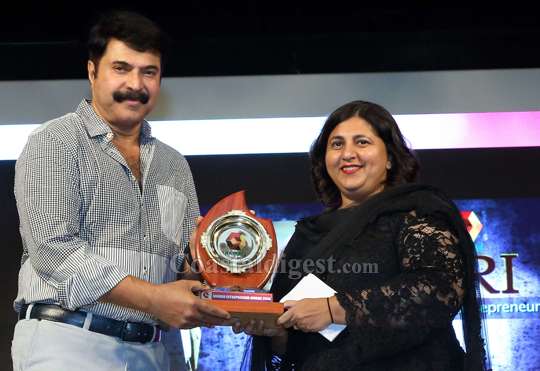
Dubai: Mangalurean Shabana Faizal receives NRI entrepreneur award

[email protected] (CD Network)
March 25, 2016

Dubai, Mar 25: Recognizing her commitment to responsible business in the UAE and India, Kairali TV has conferred the NRI Woman Entrepreneur Award to Shabana Faizal, Chief Corporate Officer (CCO) and Vice-Chairperson of KEF Holdings at their first-ever business excellence awards. KEF Holdings is a UAE-based multinational diversified group that specializes in innovative offsite construction technology.
006

Hailing from the city of Mangalore ,Shabana started her entrepreneurial career in 1995, when she set up Sophiya's World - luxury and special items studio - in Calicut, following her marriage to Faizal E Kottikollon, Chairman of KEF Holdings and the Faizal and Shabana Foundation.

In her dual role at KEF Holdings, Shabana oversees the corporate functions at KEF Holdings including the HR & Administration, Corporate Communications, IT and Legal functions; she is keenly involved in strategizing KEF's foray across infrastructure, healthcare, and education domains in India and the UAE. Shabana also holds the position of Co-Founder & Vice-Chairperson of the company's corporate social responsibility (CSR) arm - the Faizal and Shabana Foundation.

The Kairali TV NRI Entrepreneur Awards ceremony, which was held at the Indian Consulate Hall, Dubai, was headlined by prominent non-resident Indians. The Awards were chaired and juried by Ashraf Ali, Issac John, Senior Business Correspondent at Khaleej Times and Mr. C.K. Menon, Chairman and CEO of Behzad Corporation.

Shabana has a driving passion to make a difference in the lives of the underprivileged, which led to the setting up the Faizal and Shabana Foundation, which serves as the core of KEF's Corporate Philosophy. The Foundation carries out campaigns to improve education, healthcare, sustainable livelihood, humanitarian assistance, youth development and housing in India and the UAE. Her most recent passion project wasthe revamp and enhancement of the GVHSS in Nadakkavu, Kerala which has empowered more than 2400 young girls to believe in themselves and their dreams, and impacted the lives of more than 69,000 students across 65 schools in Kerala.

In 2015, KEF Holdings also completed a residential complex for staff and students of Yenepoya University in Mangalore in a short nine months. This facility was India's first wholly offsite manufactured building complex, a project that Shabana was closely involved with.

Accepting the award, Shabana Faizal said: “I am extremely honored to receive the NRI Entrepreneur Award from Malayalam Communications Ltd and Kairali TV. As Steve Jobs once said, half of what separates the successful entrepreneurs from the non-successful ones is pure perseverance. That is one quality that has defined me and my work over the last few years. I have had an adventurous entrepreneurial journey over the last 20 years, and I am very proud of the good work that we have been able to do over this time.”

She added, “Our philosophy at KEF Holdings can be defined through our commitment to make a difference that counts, and this is what is at the core of all our initiatives. I am grateful for this recognition for my work, and I will continue to move forward on the same path.”

Shabana Faizal is the daughter of prominent Mangaluru businessman, B Ahmed Hajee Mohiudeen Thumbey, Founder and Chairman of B A Group and is a psychology graduate of St Agnes College, Mangaluru.

Comments

Mohammed
 - 
Saturday, 26 Mar 2016

congratulations Mrs.Faizal

Add new comment

  • Coastaldigest.com reserves the right to delete or block any comments.
  • Coastaldigset.com is not responsible for its readers’ comments.
  • Comments that are abusive, incendiary or irrelevant are strictly prohibited.
  • Please use a genuine email ID and provide your name to avoid reject.
News Network
May 1,2020

Bengaluru, May 1: Chief Minister BS Yediyurappa on the occasion of International Labour Day has appealed to migrant workers in the state to stay back and co-operate with it in resuming economic activities once the Central government issues further directions.

"It is my sincere request to all the migrant workers to stay back in the state and co-operate with us to resume the economic activities once we receive directions from Union Government," Yediyurappa said in a release issued by the CMO.

"COVID-19 situation in India is much better than other countries because of people's cooperation.

We intend to resume economic activities soon. The government has already held a meeting with representatives of associations of commerce and industry in this regard. The government has also appealed to the employers to protect the interest of their workers and pay salaries," he added.

The ongoing nationwide lockdown, imposed to contain the coronavirus spread, is scheduled to end on May 3.

Comments

Add new comment

  • Coastaldigest.com reserves the right to delete or block any comments.
  • Coastaldigset.com is not responsible for its readers’ comments.
  • Comments that are abusive, incendiary or irrelevant are strictly prohibited.
  • Please use a genuine email ID and provide your name to avoid reject.
News Network
June 19,2020

Puttur, June 19: A 32-year-old woman in Puttur taluk of Dakshina Kannada district died due to complications caused by dengue yesterday.

The deceased is Naseema (32), wife of Nazeer Master, a resident of Parpunja village in the taluk.

She was not well for past few weeks and she was diagnosed with dengue fever with chills a week ago.

Initially she underwent treatment at a hospital in Puttur. After her condition worsened, she was shifted to a private hospital in Deralakatte.

However, she breathed her last without responding to any treatment last night.

Naseema is the second victim of the mosquito-borne infection in Puttur taluk this month. Last week, dengue had claimed the life of a woman in Bettampady village in the same taluk.

Comments

Add new comment

  • Coastaldigest.com reserves the right to delete or block any comments.
  • Coastaldigset.com is not responsible for its readers’ comments.
  • Comments that are abusive, incendiary or irrelevant are strictly prohibited.
  • Please use a genuine email ID and provide your name to avoid reject.
Ram Puniyani
February 10,2020

Noam Chomsky is one of the leading peace workers in the world. In the wake of America’s attack on Vietnam, he brought out his classic formulation, ‘manufacturing consent’. The phrase explains the state manipulating public opinion to have the public approve of it policies—in this case, the attack of the American state on Vietnam, which was then struggling to free itself from French colonial rule.

In India, we are witness to manufactured hate against religious minorities. This hatred serves to enhance polarisation in society, which undermines India’s democracy and Constitution and promotes support for a Hindu nation. Hate is being manufactured through multiple mechanisms. For example, it manifests in violence against religious minorities. Some recent ghastly expressions of this manufactured hate was the massive communal violence witnessed in Mumbai (1992-93), Gujarat (2002), Kandhamal (2008) and Muzaffarnagar (2013). Its other manifestation was in the form of lynching of those accused of having killed a cow or consumed beef. A parallel phenomenon is the brutal flogging, often to death, of Dalits who deal with animal carcasses or leather.

Yet another form of this was seen when Shambhulal Regar, indoctrinated by the propaganda of Hindu nationalists, burned alive Afrazul Khan and shot the video of the heinous act. For his brutality, he was praised by many. Regar was incited into the act by the propaganda around love jihad. Lately, we have the same phenomenon of manufactured hate taking on even more dastardly proportions as youth related to Hindu nationalist organisations have been caught using pistols, while police authorities look on.

Anurag Thakur, a BJP minster in the central government recently incited a crowd in Delhi to complete his chant of what should happen to ‘traitors of the country...” with a “they should be shot”. Just two days later, a youth brought a pistol to the site of a protest at Jamia Millia Islamia university and shouted “take Azaadi!” and fired it. One bullet hit a student of Jamia. This happened on 30 January, the day Nathuram Godse had shot Mahatma Gandhi in 1948. A few days later, another youth fired near the site of protests against the CAA and NRC at Shaheen Bagh. Soon after, he said that in India, “only Hindus will rule”.

What is very obvious is that the shootings by those associated with Hindu nationalist organisations are the culmination of a long campaign of spreading hate against religious minorities in India in general and against Muslims in particular. The present phase is the outcome of a long and sustained hate campaign, the beginning of which lies in nationalism in the name of religion; Muslim nationalism and Hindu nationalism. This sectarian nationalism picked up the communal view of history and the communal historiography which the British introduced in order to pursue their ‘divide and rule’ policy.

In India what became part of “social common sense” was that Muslim kings had destroyed Hindu temples, that Islam was spread by force, and that it is a foreign religion, and so on. Campaigns, such as the one for a temple dedicated to the Hindu god Rama to be built at the site where the Babri masjid once stood, further deepened the idea of a Muslim as a “temple-destroyer”. Aurangzeb, Tipu Sultan and other Muslim kings were tarnished as the ones who spread Islam by force in the subcontinent. The tragic Partition, which was primarily due to British policies, and was well-supported by communal streams also, was entirely attributed to Muslims. The Kashmir conflict, which is the outcome of regional, ethnic and other historical issues, coupled with the American policy of supporting Pakistan’s ambitions of regional hegemony, (which also fostered the birth of Al-Qaeda), was also attributed to the Muslims.

With recurring incidents of communal violence, these falsehoods went on going deeper into the social thinking. Violence itself led to ghettoisation of Muslims and further broke inter-community social bonds. On the one hand, a ghettoised community is cut off from others and on the other hand the victims come to be presented as culprits. The percolation of this hate through word-of-mouth propaganda, media and re-writing of school curricula, had a strong impact on social attitudes towards the minorities.

In the last couple of decades, the process of manufacturing hate has been intensified by the social media platforms which are being cleverly used by the communal forces. Swati Chaturvedi’s book, I Am a Troll: Inside the Secret World of the BJP’s Digital Army, tells us how the BJP used social media to spread hate. Whatapp University became the source of understanding for large sections of society and hate for the ‘Other’, went up by leaps and bounds. To add on to this process, the phenomenon of fake news was shrewdly deployed to intensify divisiveness.

Currently, the Shaheen Bagh movement is a big uniting force for the country; but it is being demonised as a gathering of ‘anti-nationals’. Another BJP leader has said that these protesters will indulge in crimes like rape. This has intensified the prevalent hate.

While there is a general dominance of hate, the likes of Shambhulal Regar and the Jamia shooter do get taken in by the incitement and act out the violence that is constantly hinted at. The deeper issue involved is the prevalence of hate, misconceptions and biases, which have become the part of social thinking.

These misconceptions are undoing the amity between different religious communities which was built during the freedom movement. They are undoing the fraternity which emerged with the process of India as a nation in the making. The processes which brought these communities together broadly drew from Gandhi, Bhagat Singh and Ambedkar. It is these values which need to be rooted again in the society. The communal forces have resorted to false propaganda against the minorities, and that needs to be undone with sincerity.

Combating those foundational misconceptions which create hatred is a massive task which needs to be taken up by the social organisations and political parties which have faith in the Indian Constitution and values of freedom movement. It needs to be done right away as a priority issue in with a focus on cultivating Indian fraternity yet again.

Comments

Add new comment

  • Coastaldigest.com reserves the right to delete or block any comments.
  • Coastaldigset.com is not responsible for its readers’ comments.
  • Comments that are abusive, incendiary or irrelevant are strictly prohibited.
  • Please use a genuine email ID and provide your name to avoid reject.