


Dubai: Mangalurean Shabana Faizal receives NRI entrepreneur award

[email protected] (CD Network)
March 25, 2016

Dubai, Mar 25: Recognizing her commitment to responsible business in the UAE and India, Kairali TV has conferred the NRI Woman Entrepreneur Award to Shabana Faizal, Chief Corporate Officer (CCO) and Vice-Chairperson of KEF Holdings at their first-ever business excellence awards. KEF Holdings is a UAE-based multinational diversified group that specializes in innovative offsite construction technology.
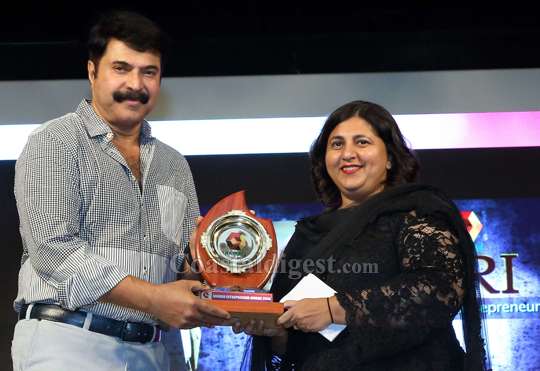
006

Hailing from the city of Mangalore ,Shabana started her entrepreneurial career in 1995, when she set up Sophiya's World - luxury and special items studio - in Calicut, following her marriage to Faizal E Kottikollon, Chairman of KEF Holdings and the Faizal and Shabana Foundation.

In her dual role at KEF Holdings, Shabana oversees the corporate functions at KEF Holdings including the HR & Administration, Corporate Communications, IT and Legal functions; she is keenly involved in strategizing KEF's foray across infrastructure, healthcare, and education domains in India and the UAE. Shabana also holds the position of Co-Founder & Vice-Chairperson of the company's corporate social responsibility (CSR) arm - the Faizal and Shabana Foundation.

The Kairali TV NRI Entrepreneur Awards ceremony, which was held at the Indian Consulate Hall, Dubai, was headlined by prominent non-resident Indians. The Awards were chaired and juried by Ashraf Ali, Issac John, Senior Business Correspondent at Khaleej Times and Mr. C.K. Menon, Chairman and CEO of Behzad Corporation.

Shabana has a driving passion to make a difference in the lives of the underprivileged, which led to the setting up the Faizal and Shabana Foundation, which serves as the core of KEF's Corporate Philosophy. The Foundation carries out campaigns to improve education, healthcare, sustainable livelihood, humanitarian assistance, youth development and housing in India and the UAE. Her most recent passion project wasthe revamp and enhancement of the GVHSS in Nadakkavu, Kerala which has empowered more than 2400 young girls to believe in themselves and their dreams, and impacted the lives of more than 69,000 students across 65 schools in Kerala.

In 2015, KEF Holdings also completed a residential complex for staff and students of Yenepoya University in Mangalore in a short nine months. This facility was India's first wholly offsite manufactured building complex, a project that Shabana was closely involved with.

Accepting the award, Shabana Faizal said: “I am extremely honored to receive the NRI Entrepreneur Award from Malayalam Communications Ltd and Kairali TV. As Steve Jobs once said, half of what separates the successful entrepreneurs from the non-successful ones is pure perseverance. That is one quality that has defined me and my work over the last few years. I have had an adventurous entrepreneurial journey over the last 20 years, and I am very proud of the good work that we have been able to do over this time.”

She added, “Our philosophy at KEF Holdings can be defined through our commitment to make a difference that counts, and this is what is at the core of all our initiatives. I am grateful for this recognition for my work, and I will continue to move forward on the same path.”

Shabana Faizal is the daughter of prominent Mangaluru businessman, B Ahmed Hajee Mohiudeen Thumbey, Founder and Chairman of B A Group and is a psychology graduate of St Agnes College, Mangaluru.

Comments

Mohammed
 - 
Saturday, 26 Mar 2016

congratulations Mrs.Faizal

Add new comment

  • Coastaldigest.com reserves the right to delete or block any comments.
  • Coastaldigset.com is not responsible for its readers’ comments.
  • Comments that are abusive, incendiary or irrelevant are strictly prohibited.
  • Please use a genuine email ID and provide your name to avoid reject.
coastaldigest.com news network
June 24,2020

Riyadh, June 24: Thousands of expatriates who managed to return to their home countries from Saudi Arabia during covid-19 lockdown are now in a dilemma as the Kingdom has clarified that it will not allow their re-entry till the end of the corona crisis. 

The Directorate General of Passports (Jawazat) announced on Tuesday that the mechanism to resume extension of the exit and re-entry visas for expatriates who are outside the Kingdom will be announced only after the end of the pandemic crisis.

The Jawazat stated this on its Twitter account while responding to queries from a number of expatriates who are currently outside the Kingdom and whose exit and re-entry visas have expired.

They inquired about the possibility of returning to the Kingdom after the resumption of international flight service. 

The Jawazat reiterated that the return of expatriates who left Saudi Arabia will be only after the end of the pandemic and in accordance with the process to obtain a valid re-entry visa.

The directorate said that in the event of any new decisions or instructions in this regard, they will be announced through the official channels.

It is noteworthy that the Jawazat had previously confirmed that its electronic services are continuing through the Absher and Muqeem online portals of the Ministry of Interior and that the service for messages and requests is still available and continuing through Absher for all the beneficiaries of its services.

Comments

Add new comment

  • Coastaldigest.com reserves the right to delete or block any comments.
  • Coastaldigset.com is not responsible for its readers’ comments.
  • Comments that are abusive, incendiary or irrelevant are strictly prohibited.
  • Please use a genuine email ID and provide your name to avoid reject.
coastaldigest.com web desk
July 2,2020

When the black and white photos of the ‘London to Calcutta (Kolkata) bus service’ went viral on social media recently, the response of some of the netizens was “stop spreading fake news!” But, it isn’t a fake news. The late 1950s indeed offered people a lavish bus trip from London to Kolkata. 

While one of the viral images shows passengers at the Victoria Coach Station, London, boarding 'Albert', the other image show the same bus travelling through a valley. In another image the bus is stationed at a tourist spot. All these photos were captured during the bus’ maiden international journey in 1957.  

An image of the bus ticket is also making rounds on social media, that shows the route of the bus — London, Belgium, West Germany, Austria,Yugoslavia, Bulgaria, Turkey, Iran, Afghanistan, West Pakistan, India. The route in India followed Delhi, Agra, Allahabad, Banaras and finally Calcutta.

The ticket shows that a one side travel cost 145 pounds (13,644 Rupees at the present day) back then, and it was inclusive of all the luxury provided during the run.

The luxurious bus provided the facilities of reading, individual sleeping bunks, radio/taped music for parties and pleasure and fan heaters, among other things. The brochure reads, "Your complete home while you travel."

Some of the tour highlights included Banaras on the Ganges, The Taj Mahal, The Raj Path, The Rhine Valley and The Peacock Throne. Passengers reportedly got free shopping days in New Delhi, Tehran, Salzburg, Kabul, Istanbul and Vienna.

Comments

Add new comment

  • Coastaldigest.com reserves the right to delete or block any comments.
  • Coastaldigset.com is not responsible for its readers’ comments.
  • Comments that are abusive, incendiary or irrelevant are strictly prohibited.
  • Please use a genuine email ID and provide your name to avoid reject.
Agencies
July 8,2020

The Central Board of Secondary Education (CBSE) has rationalised by up to 30 per cent the syllabus for classes 9 to 12 for the academic year 2020-21 to reduce course load on students amid the COVID-19 crisis, Union HRD Minister Ramesh Pokhriyal 'Nishank' announced on Tuesday.

The curriculum has been rationalised while retaining the core elements, the Human Resource Development said.

Among the chapters dropped after the rationalisation exercise are lessons on democracy and diversity, demonetisation, nationalism, secularism, India's relations with its neighbours and growth of local governments in India, among others.

"Looking at the extraordinary situation prevailing in the country and the world, CBSE was advised to revise the curriculum and reduce course load for the students of classes 9 to 12.

"To aid the decision, a few weeks back I also invited suggestions from all educationists on the reduction of syllabus for students and I am glad to share that we received more than 1.5K suggestions. Thank you, everyone, for the overwhelming response," Nishank tweeted.

"Considering the importance of learning achievement, it has been decided to rationalise syllabus up to 30 per cent by retaining the core concepts," he added.

The Union minister said the changes made in the syllabi have been finalised by the respective course committees with the approval of the curriculum committee and the Governing Body of the Board.

"The heads of schools and teachers have been advised by the board to ensure that the topics that have been reduced are also explained to the students to the extent required to connect different topics. However, the reduced syllabus will not be part of the topics for internal assessment and year-end board examination.

"Alternative academic calendar and inputs from the NCERT on transacting the curriculum using different strategies shall also be part of the teaching pedagogy in the affiliated schools," a senior official of the HRD ministry said.

For classes 1 to 8, the National Council of Education Research and Training (NCERT) has already notified an alternative calendar and learning outcomes.

According to the updated curriculum, among the chapters deleted from class 10 syllabus are-- democracy and diversity, gender, religion and caste, popular struggles and movement, challenges to democracy

For class 11, the deleted portions included chapters on federalism, citizenship, nationalism, secularism, growth of local governments in India.

Similarly, class 12 students will not be required to study chapters on India's relations with its neighbours, changing nature of India's economic development, social movements in India and demonetisation, among others.

Universities and schools across the country have been closed since March 16 when the central government announced a nationwide classroom shutdown as one of the measures to contain the COVID-19 outbreak.

A nationwide lockdown was announced on March 24, which came into effect the next day. While the government has eased several restrictions, schools and colleges continue to remain closed.

Comments

Add new comment

  • Coastaldigest.com reserves the right to delete or block any comments.
  • Coastaldigset.com is not responsible for its readers’ comments.
  • Comments that are abusive, incendiary or irrelevant are strictly prohibited.
  • Please use a genuine email ID and provide your name to avoid reject.