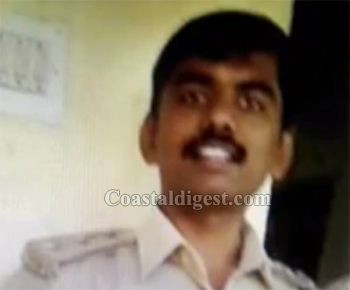
Dy.SP accused of kidnapping youth with the help of Bajrang Dal activist

[email protected] (CD Network)
July 5, 2016

kallappaChikkamagaluru, Jul 5: In a blatant case of a senior police official taking to crime, the Deputy Superintendent of Police, Chikkamagaluru sub-division, is accused of being involved in the kidnapping of a youth for ransom. A Bajrang Dal activist was said to be his accomplice in the alleged act.

The Basavanahalli police in Chikkamagaluru have registered a case against Dy.SP Kallappa Handibag and four others, including Bajrang Dal activist Praveen Khandya, on the charge of kidnapping Chikkamagaluru resident Tejas Gowda on June 28 and extracting Rs. 10 lakh as ransom for his release.

The accused is now missing, and the police have launched a manhunt. The policeman was on duty till Sunday and the incident came to light only on Monday when Mr. Gowda filed a complaint with the police, naming the police officer as the person to whom the ransom money was handed over.

Comments

NAWAZ Saad
 - 
Tuesday, 5 Jul 2016

Cop's name itself indicates ( KALLA & HANDI ) his character, so it is foolishness to expect anything good from him.

Satyameva jayate
 - 
Tuesday, 5 Jul 2016

When is the time to ban these goony senaas and dals

Add new comment

  • Coastaldigest.com reserves the right to delete or block any comments.
  • Coastaldigset.com is not responsible for its readers’ comments.
  • Comments that are abusive, incendiary or irrelevant are strictly prohibited.
  • Please use a genuine email ID and provide your name to avoid reject.
News Network
January 21,2020

Bengaluru, Jan 21: A private hospital in Bengaluru, the capital of Karnataka, on Tuesday claimed that it has successfully performed a live liver transplant on a Jehovah's Witness from Nigeria, by not using blood or blood products, in order to protect the patient's religious beliefs.

It is said that Jehovah's Witnesses are followers of a Christian faith that prohibits the use of blood or blood products during their treatment. Gehojadak (37), a Jehovah's Witness follower, had developed decompensated liver disease and visited more than three countries seeking treatment over the last four years but was turned away by most doctors due to the highly risky nature of surgery, Aster CMI Hospital said.

The surgery was challenging compared to a normal liver transplant because in order to protect the patient's religious beliefs, the medical team could not use blood or blood products (Fresh frozen plasma, Cryoprecipitate, Platelets etc), it said in a release, adding that very few such surgeries have been successfully conducted worldwide.

The patient's brother was the donor, the hospital said, adding, without a liver transplant, Gehojadak's chances of survival were less than 10 per cent over the next two years. A team of liver specialists from the Hospital thoroughly reviewed the patient's medical history before recommending a bloodless liver transplant and charted out a feasible pathway to make the surgery a success.

"This transplant was especially challenging as we did not have the safety net (of using blood) even if the patient's life was at risk due to their advance directive. We have performed other non-transplant liver surgeries in Jehovah's Witnesses and this gave us the confidence to take on Gehojadak's transplant," Dr Rajiv Lochan, Consultant Liver Transplant Surgeon, said.

The critical surgery took a 12-hour period to complete where two teams of specialists with close to 25 doctors including anaesthetists, intensivists worked in absolute sync with each other and Gehojadak finally received a life-saving liver transplant, the Hospital said. In a period of two weeks, the patient and his brother were fit enough to go home and were discharged from the hospital.

"Even if their haemoglobin levels dropped to life-threatening levels, the patients were clear that they would not accept a blood transfusion. Keeping the limitations in mind, the most effective treatment path was planned, and we spent close to two months preparing the patients for surgery," Arun V, Consultant Anesthesiologist said. The hospital arranged customised artificial products like synthetic drug molecules, to conduct a bloodless liver transplant, he added.

Comments

Add new comment

  • Coastaldigest.com reserves the right to delete or block any comments.
  • Coastaldigset.com is not responsible for its readers’ comments.
  • Comments that are abusive, incendiary or irrelevant are strictly prohibited.
  • Please use a genuine email ID and provide your name to avoid reject.
News Network
March 28,2020

Bengaluru, Mar 28: Sun Tsu, in 'The Art of War' speaks of a skilful general who can subdue his enemy without any fighting. This constitutes the ultimate triumph which is referred to as stratagem. Today, we would need one such when we are faced with the '21-day corona challenge' for India.
Nearly four weeks back, Dr Jyothsna Rao, Dr Gururaj Rao and I sat across the OPD in the afternoon at HCG Bengaluru discussing our ongoing cancer immunology research. While on this topic, we drifted into the discussion on the coronavirus. During this engaging discussion, we wondered the similarity of the enigma between the virus and cancer. I paused to ask Dr Jyothsna and Dr Guru - how we wish we could do something against this virus.
Dr Jyothsna is a PhD from NCBS and had worked under Dr Ralph Steinman, physician and researcher from Rockefeller University, who won the Nobel Prize for his discovery of the dendritic cell and its role in adaptive immunity in 2011. Dr Gururaj is a molecular and cell biologist who did his PhD at the Chapel Hill, University of North Carolina and is the Director of iCrest.
Jyothsna while hearing our perplexing conversation on the covid intervened, "Yes, surely. I think we should take a break from cancer and focus on the innate and adaptive immunity role in COVID-19."
Thus began this sincere attempt to relook the human immune system from the eyes of the COVID-19.
We have 10 types of immune cells at the least which are widely dispersed in millions across the body. When our body is invaded by a foreign organism (bacteria, fungi or virus), these cells work with each other to destroy the invader.
Now, the question is - how do the immune cells talk to each other? They use small-molecule substances called cytokines (cyto means cells; kine means movement). There are many cytokines that are involved in work on the immune system. The most relevant for viruses are interferons.
Interferons (IFN) as the name reflects have an ability to interfere with the viral activity and stop their multiplication. These specialised signal proteins are released by our cells in response to a viral attack to forewarn other cells. They help build the antiviral proteins within the cells to kill the virus as it tries to invade the new cells.
Historically, interferons are a group of cytokines known to be potent antiviral agents against viruses and a hallmark cytokine induced by the host upon viral infections. Interferons possess unique immunoregulatory activities and are signature cytokines released by (TH1) T immune cells, which are crucial in viral infections.
As the outbreak of COVID-19 grapples us, an urgent need for finding strategies to combat the virus is growing. Coronaviruses (CoVs) are a group of RNA viruses. In patients infected with coronavirus, it was indicated that the activation of the IFN does not occur until 48 hours post-infection. Thus the delayed IFN-related antiviral response by the healthy cells leads to coronavirus evade the immune response.
Numerous studies have presented the success in defeating CoVs by the direct administration of IFNs. In a combination as a concoction, it was shown to synergistically inhibit the virus replication in vitro.
Moreover, it is understood that the earlier induction of IFNs in children although they have a less developed immune system could be the reason behind the children being least affected.
The key to success in reducing the disease fatality might be the stimulation of the immune responses to trigger IFN production at the very early stages of the disease, which might be done through the administration of IFN. Despite the evidence for the efficacy of IFNs in treating CoV-induced infections, the proper dosing and ideal timing for such interventions needs to be verified in clinical trials.
For the later stages of the diseases in advance stages where patients are on ventilator and have developed respiratory distress, we propose to utilise the mesenchymal cells derived from donor bone marrow that have been known to treat acute respiratory syndrome. Mesenchymal cells are known to possess anti-inflammatory activity and thus used often in autoimmune diseases.
With this scientific background, we have activated T cells from healthy donors, in a cGMP facility at iCrest - HCG hospital with an enriched cocktail of cytokines rich in Interferons. Injections of this cocktail we believe will result in a surge of cytokines in the body of the infected person and will boost his ability to fight the virus in the early phases. We are in the initial phases of this study and hope to be ready in the coming weeks with meaningful data on its potential utility.
Currently, it awaits government approvals (Union and state) and we have applied to central drugs authority for their initial evaluation and further directions.
As my Guru often expounded the philosophy of 'Seva' - the goal of education is knowledge, the end goal of knowledge is service. In this attempt to serve our fellow humans at this brink of unprecedented crisis, medical fraternity stands with you and promises to do our best for your safety.
We assure to exhaust every bit of our spirit in this fight against coronavirus. We have lost the sight of shores and travelled thus far, but that is the mandatory first step to cross the ocean. Are we going to succeed in this battle, is something only time will answer. 

Comments

Add new comment

  • Coastaldigest.com reserves the right to delete or block any comments.
  • Coastaldigset.com is not responsible for its readers’ comments.
  • Comments that are abusive, incendiary or irrelevant are strictly prohibited.
  • Please use a genuine email ID and provide your name to avoid reject.
News Network
July 21,2020

Bengaluru, Jul 21: Karnataka Chief Minister B S Yediyurappa on Tuesday said that everyone has to fight COVID-19 while maintaining a stable economy and lockdown is not the solution.

While briefing the media after a meeting with Health Minister B Sriramulu and officials here, CM Yediyurappa said, "There will be no lockdown from tomorrow, people need to get back to work, the economy is also very important. We have to fight COVID-19 while maintaining a stable economy. Lockdown is not the solution, now restrictions will be placed only in containment zones."

"People who came from Maharastra and Tamil Nadu added to the COVID-19 cases in Karnataka. Experts have suggested a 5T strategy - Trace, Track, Test, Treat and Technology. Our COVID warriors are working day and night to safeguard the people of the state, we have to maintain social distance, wear a mask while going out," he added.

CM Yediyurappa further said that more than 80 per cent COVID-19 cases in the state are asymptomatic.

"Five five per cent need ICU or ventilators, 11,230 beds are kept ready for the use of people including private hospitals, medical colleges. The real-time dashboard is ready to serve the people. Now onwards, test report will be given within 24 hours. SSLC exams were conducted successfully. More than 8 lakh students wrote exams in such a situation," he said.

Commenting upon the allegations of COVID-19 mismanagement labelled by opposition leaders, CM Yediyurappa said, "I request all the opposition leaders not to make unnecessary comments. I request Siddaramaiah, D K Shivakumar and others to suggest us valuably to fight corona together."

"We will give all the details which are required to D K Shivakumar, Siddaramaih, H D Kumaraswamy. Not even one-rupee corruption is done in COVID-19 management. We will give you all details. No official misused any funds, being opposition leaders, you have all rights to check documents, we will provide them," he added.

Taking to Twitter, Health Minister B Sriramulu said that the decision to raise the salary of 2,000 AYUSH doctors to Rs 45,000 was taken in the meeting.

"The decision to raise the salary of 2000 AYUSH doctors to Rs 45,000 was taken at a meeting chaired by our Hon. Chief Minister Shri @BSYBJP. Assurance has been given that the demand of private AYUSH doctors too will be reviewed and a decision regarding the same will be taken at the earliest. All doctors who were protesting for the same have withdrawn their resignations and reported to work," he tweeted.


Comments

Add new comment

  • Coastaldigest.com reserves the right to delete or block any comments.
  • Coastaldigset.com is not responsible for its readers’ comments.
  • Comments that are abusive, incendiary or irrelevant are strictly prohibited.
  • Please use a genuine email ID and provide your name to avoid reject.