EC bars Guj BJP from using 'Pappu' in electronic advertisement

November 15, 2017

Ahmedabad, Nov 15: The Election Commission has barred the ruling BJP in Gujarat from using the word "Pappu" in an electronic advertisement, which apparently targeted Congress vice-president Rahul Gandhi, calling it "derogatory".

"Pappu" is perceived as a social media slur coined to target Gandhi.

Confirming the development, sources in the BJP said the script of the advertisement did not link the word to any individual.

According to BJP sources, the media committee under the Gujarat Chief Electoral Officer (CEO) objected to the word mentioned in the script of the advertisement which was submitted by the party for approval last month.

"Before making any election-related advertisement, we have to submit a script to the committee to get a certificate. However, they raised an objection to the word 'Pappu', saying it is derogatory. They asked us to remove or replace it," a senior BJP leader said.

He said the party will replace the word and submit a new script for the EC's approval.

"Since there was no direct mention or linkage with any person while mentioning 'Pappu' in the entire script, we had appealed to the committee to reconsider their decision, but they rejected it. Now, we will change that word and submit a new script for approval," he said.

When contacted, Gujarat CEO BB Swain said he was not aware of any such development and can comment only after getting the details.

Comments

syed
 - 
Wednesday, 15 Nov 2017

Replace it with FEKU instead of PAPPU. 

Add new comment

  • Coastaldigest.com reserves the right to delete or block any comments.
  • Coastaldigset.com is not responsible for its readers’ comments.
  • Comments that are abusive, incendiary or irrelevant are strictly prohibited.
  • Please use a genuine email ID and provide your name to avoid reject.
News Network
February 9,2020

New Delhi, Feb 8: Arvind Kejriwal is set to return as Delhi chief minister and his Aam Aadmi Party (AAP) will virtually sweep the assembly elections, exit polls predicted Saturday.

As polling came to a close at 6 pm, with the Election Commission of India (ECI) projecting a voter turnout at 60.24% (as of 9:50 pm), a poll of polls covering 10 exit polls gave 52 seats to AAP, 17 to the Bharatiya Janata Party and one to the Indian National Congress.

The polls, which are sample surveys conducted among voters exiting polling booths, signalled that the Delhi voter responded to AAP’s campaign that focused on “kaam”, or getting work done.

Kejriwal, a former civil servant and activist who stormed into electoral politics with an anti-corruption campaign in 2013, led a campaign focusing on the development work his government did in Delhi, especially in education and healthcare, as well as sops such as lower electricity bills and free bus rides for women.

The exit polls gave AAP between 47 and 68 seats in the 70-member Assembly.

They predicted an absolute rout for Congress, which ruled Delhi for three terms between 1998 and 2013. The maximum seats to AAP were given by India Today TV-Axis exit poll, which predicted 59-68 seats for the party, while giving 2-11 for the BJP and none to the Congress.

If these figures hold, the results will come as a disappointment for the BJP, which had hoped its sweep in the Lok Sabha elections in 2019 would reflect in the assembly polls.

Delhi’s voter turnout saw a sharp fall over the 2015 elections. According to the Election Commission of India, voter turnout till 9 pm was projected at 60.24% — lower than 67.12% in 2015.

Traditionally, a lower voter turnout is read as a vote for the incumbent.

The voter turnout in Delhi has been similar during the Congress regime under Sheila Dikshit, when she won consecutive terms. In 2003, when Delhi voted a second time for the Dikshit government, the voter turnout was 53.42%, and a comparable 57.58% was the turnout in 2008.

Later, in two consecutive elections — 2013 and 2015 — voters turned out in big numbers to vote Dikshit out of power. In 2013, 65.63% of Delhi turned out and the percentage increased further to 67.12% in 2015.

Across constituencies, Matia Mahal in Central Delhi registered the highest voter turnout of 68.36%, whereas Bawana assembly constituency in North district saw the lowest turnout at 41.95%. Among districts, North East district registered the highest (62.75%) voter turnout, while the lowest turnout was recorded in South East district (54.15%), according to the ECI app.

Comments

Add new comment

  • Coastaldigest.com reserves the right to delete or block any comments.
  • Coastaldigset.com is not responsible for its readers’ comments.
  • Comments that are abusive, incendiary or irrelevant are strictly prohibited.
  • Please use a genuine email ID and provide your name to avoid reject.
News Network
February 22,2020

Feb 22: A 20-year-old Chinese woman from Wuhan, the epicentre of the coronavirus outbreak, travelled 400 miles(675 km) north to Anyang where she infected five relatives, without ever showing signs of infection, Chinese scientists reported on Friday, offering new evidence that the virus can be spread asymptomatically.

The case study, published in the Journal of the American Medical Association, offered clues about how the coronavirus is spreading, and suggested why it may be difficult to stop.

"Scientists have been asking if you can have this infection and not be ill? The answer is apparently, yes," said Dr. William Schaffner, an infectious disease expert at Vanderbilt University Medical Center, who was not involved in the study.

China has reported a total of 75,567 cases of the virus known as COVID-19 to the World Health Organization (WHO) including 2,239 deaths, and the virus has already spread to 26 countries and territories outside of mainland China.

Researchers have reported sporadic accounts of individuals without any symptoms spreading the virus. What's different in this study is that it offers a natural lab experiment of sorts, Schaffner said.

"You had this patient from Wuhan where the virus is, travelling to where the virus wasn't. She remained asymptomatic and infected a bunch of family members and you had a group of physicians who immediately seized on the moment and tested everyone."

According to the report by Dr Meiyun Wang of the People's Hospital of Zhengzhou University and colleagues, the woman travelled from Wuhan to Anyang on Jan. 10 and visited several relatives. When they started getting sick, doctors isolated the woman and tested her for coronavirus. Initially, the young woman tested negative for the virus, but a follow-up test was positive.

All five of her relatives developed COVID-19 pneumonia, but as of Feb. 11, the young woman still had not developed any symptoms, her chest CT remained normal and she had no fever, stomach or respiratory symptoms, such as cough or sore throat.

Scientists in the study said if the findings are replicated, "the prevention of COVID-19 infection could prove challenging."

Key questions now, Schaffner said, are how often does this kind of transmission occur and when during the asymptomatic period does a person test positive for the virus.

Comments

Add new comment

  • Coastaldigest.com reserves the right to delete or block any comments.
  • Coastaldigset.com is not responsible for its readers’ comments.
  • Comments that are abusive, incendiary or irrelevant are strictly prohibited.
  • Please use a genuine email ID and provide your name to avoid reject.
Agencies
August 2,2020

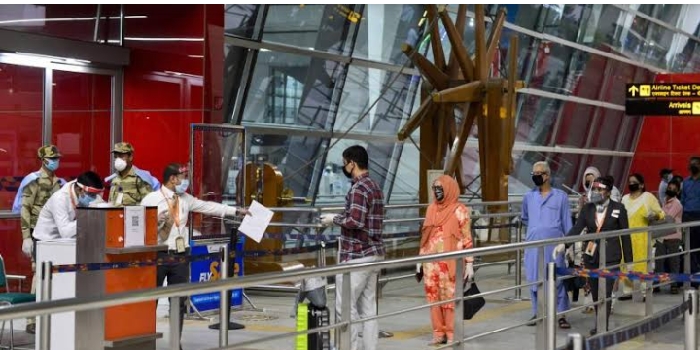
New Delhi, Aug 2: The Ministry of Health and Family Welfare on Sunday issued fresh guidelines for international passengers coming to India amid the COVID-19 pandemic. The new guidelines will be implemented from 12:01 am on August 8.

The ministry has also asked all passengers to submit a self-declaration form online at least 72 hours before travel.

"All travellers should submit self-declaration form on the on the online portal (www.newdelhiairport.in) at least 72hours before the scheduled travel," the guidelines said.

It also said that those coming to India must give an undertaking that they would undergo mandatory quarantine for 14 days as prescribed by the government. "They should also give an undertaking on the portal that they would undergo mandatory quarantine for 14 days i.e. 7 days paid institutional quarantine at their own cost, followed by 7 days isolation at home with self-monitoring of health," it added.

Giving exemptions in some cases, the guidelines mentioned, "Only for compelling reasons/cases of human distress such as pregnancy, death in the family. Serious illness and parent (s) with children of 10 years or below, home quarantine may be permitted for 14 days."

"If they wish to seek such exemption, they shall apply to the online portal at least 72 hours before boarding. The decision taken by the government as communicated on the online portal will be final," it said further.

The guidelines further said that travellers could request for exemption from institutional quarantine by submitting a negative RT-PCR test report on arrival.

"This test should have been conducted within 96 hours prior to undertaking the journey. The test report should be uploaded on the portal for consideration," it added.

Passengers have also been asked to download the Aarogya Setu app on their mobile phones.

Comments

Add new comment

  • Coastaldigest.com reserves the right to delete or block any comments.
  • Coastaldigset.com is not responsible for its readers’ comments.
  • Comments that are abusive, incendiary or irrelevant are strictly prohibited.
  • Please use a genuine email ID and provide your name to avoid reject.