ED files charge sheet against Mallya, others in KFA-IDBI PMLA case

Agencies
June 14, 2017

Lucknow, Jun 14: The Enforcement Directorate (ED) on Wednesday filed a charge sheet against absconding liquor baron Vijay Mallya and others in connection with the Rs 900-crore money laundering case in the IDBI Bank-Kingfisher Airlines loan case.

mallya copy

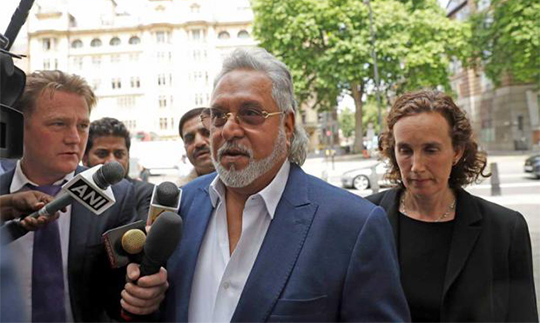
The development comes a day after the now London-based 61-year-old Mallya, before Westminister Magistrate Court, claimed that he had “enough evidence” to defend himself in the extradition case brought by the Indian government. “Keep dreaming about billions of pounds,” he even taunted outside the courtroom.

The Indian government is seeking his extradition from United Kingdom in loan default to the tune of Rs 9,000 crore involving several banks in connection with the money that he reportedly raised for the now defunct Kingfisher Airlines (KFA). In India, he is being probed by the ED and the CBI on charges of violation the Prevention of Money Laundering Act (PMLA).

However, on Wednesday, when the ED filed the charge sheet, it comes as a jolt to him.

The 57-page charge sheet with voluminous annexures has provided details of the manner in which the loan was approved and subsequently diverted for money-laundering purposes violating norms.

According to the ED, in October 2009, the IDBI had granted a short-term loan of Rs.150 crore to the KFA, followed by another loan of Rs.750 crore, including a bridge loan of Rs.200 crore, without adequate collateral and flouting norms and procedures.

The charge sheet also mentioned the role of KFA and IDBI executives who were probed by the ED and they had criminally conspired to obtain funds to the tune of Rs 860.92 crore despite weak financials, negative net-worth, non-compliance of corporate credit policy of new client, non-quality collateral security and low credit rating of the borrower. Out of which Rs 807.82 crore of principal amount remains unpaid, according to the investigations.

Comments

Add new comment

  • Coastaldigest.com reserves the right to delete or block any comments.
  • Coastaldigset.com is not responsible for its readers’ comments.
  • Comments that are abusive, incendiary or irrelevant are strictly prohibited.
  • Please use a genuine email ID and provide your name to avoid reject.
News Network
July 26,2020
Bhopal, Jul 26: BJP MP Pragya Singh Thakur on Saturday appealed people to recite the Hanuman Chalisa five times a day till August 5, which she believes will rid the world of the coronavirus pandemic.
`Bhoomi pujan’ or the ground-breaking ceremony for the construction of Ram temple at Ayodhya is to take place on August 5.
“Let us all of us together make a spiritual effort to wish people good health and end the coronavirus epidemic.
Recite ‘Hanuman Chalisa’ five times a day at your home from July 25 to August 5,” the Bhopal MP tweeted.
“Conclude this ritual by lighting lamps on August 5 and offering ‘aarti’ to Lord Ram at home,” she added.
She also shared a video on Twitter, in which she said the BJP government in Madhya Pradesh is making efforts to contain the spread of coronavirus by imposing lockdown in Bhopal till August 4.
“Though the lockdown will be over on August 4, this ritual (recitation of the Hanuman Chalisa, a hymn in praise of Lord Hanuman) will end on August 5, when ‘bhoomi pujan’ for Ram temple in Ayodhya will be performed. We will celebrate that day like Diwali,” she added.
“When people... Hindus from across the country recite the ‘Hanuman Chalisa’ in one voice, it will definitely work and we will be free from coronavirus...This is your prayer to Lord Ram,” said Thakur.

Comments

Add new comment

  • Coastaldigest.com reserves the right to delete or block any comments.
  • Coastaldigset.com is not responsible for its readers’ comments.
  • Comments that are abusive, incendiary or irrelevant are strictly prohibited.
  • Please use a genuine email ID and provide your name to avoid reject.
News Network
January 1,2020

Jan 1: The ban on the practice of instant triple talaq, making it a penal offence and the increase in the strength of Supreme Court judges were two of the major achievements of the law ministry in 2019.

In July, Parliament gave its nod to The Muslim Women (Protection of Rights on Marriage) Bill, 2019. The new law makes talaq-e-biddat or any other similar form of talaq having the effect of instantaneous and irrevocable divorce pronounced by a Muslim husband void and illegal.

It makes it illegal to pronounce talaq three times in spoken, written or through SMS or WhatsApp or any other electronic chat in one sitting.

According to the new law, any Muslim who pronounces the illegal form of talaq upon his wife shall be punished with imprisonment for a term which may extend to three years, and shall also be liable to fine.

During the year, four new judges were appointed to the Supreme Court in September, taking its strength to 34, the highest-ever.

However, vacancies in high courts and lower courts are on the rise and convincing state governments and the 25 high courts to come on board to create an all-India judicial service to recruit judges for the subordinate courts tops the agenda of the Law Ministry in 2020.

Besides creating a consensus on setting up the All-India Judicial Services, the ministry will also have to focus on filling up vacancies in the high court. On an average, the vacancies stood at 400 throughout this year.

With more than 5,000 positions of judicial officers in district and subordinate courts lying vacant, the Law Ministry has pitched for setting up all-India judicial services.

The sanctioned strength of the judicial officers in district and subordinate courts was 22,644. The number of judicial officers in position and vacant posts is 17,509 and 5,135, respectively.

The government has proposed that while states and high courts can recruit judicial officers, the Union Public Service Commission (UPSC) can hold pan-India entrance tests.

The ministry has made it clear that such services would not encroach on the powers of the states.

As of now, the selection and appointment of judges in subordinate courts is the responsibility of the high courts and state governments concerned.

The Narendra Modi government has given a fresh push to the long-pending proposal to set up the new service to have a separate cadre for the lower judiciary in the country.

But there is a divergence of opinion among state governments and respective high courts on the constitution of the All India Judicial Service (AIJS).

One of the problems cited is that since several states have used powers under Code of Criminal Procedure (CrPC) and Code of Civil Procedure (CPC) to declare that the local language would be used in lower courts even for writing orders, a person say selected from Tamil Nadu may find it difficult to hold proceedings in states like Uttar Pradesh and Bihar.

The other point of opposition is that an all India service may hamper the career progression of state judicial services officers.

Another key issue the ministry has to handle in 2020 is vacancies in the 25 high courts.

Throughout 2019, on an average, the high courts faced a shortage of 400 judges.

According to Law Ministry data, as on September 1, the high courts had 414 vacant positions as compared to the sanctioned strength of 1,079 judges. The figure was 409 in August and 403 in July, as per the data.

A three-member Supreme Court collegium recommends the names of candidates for appointment as high court judges. In case of appointments to the Supreme Court, the collegium consists of five top judges of the top court.

High court collegiums shortlist candidates for their respective high courts and send the names to the law ministry.

The ministry, along with background check reports by the Intelligence Bureau, forwards it to the Supreme Court collegium for a final call.

The government has maintained that appointment of judges in the high courts is a "continuous collaborative process" between the Executive and the Judiciary, as it requires consultation and approval from various Constitutional authorities.

Vacancies keep arising on account of retirement, resignation or elevation of judges and increase in judges' strength. In June last year, the vacancy position stood at 399, while it was 396 in May.

In April, 399 posts of judges were vacant, while the figure was 394 in March. The vacancy position in February stood at 400 and in January, it was 392, according to the data collated by the Department of Justice.

Over 43 lakh cases are pending in the 25 high courts.

Another priority would be the finalisation of the memorandum of the procedure to guide the appointment and transfer of the Supreme Court and high court judges. The issue had now been pending for over two years now with the SC collegium and the government failing to reach a consensus.

Successive governments have also been working on making India a hub of international arbitration. It has taken several steps to change laws dealing with commercial disputes.


Comments

Add new comment

  • Coastaldigest.com reserves the right to delete or block any comments.
  • Coastaldigset.com is not responsible for its readers’ comments.
  • Comments that are abusive, incendiary or irrelevant are strictly prohibited.
  • Please use a genuine email ID and provide your name to avoid reject.
News Networkwork
May 14,2020

Bengaluru, May 14: ABB India has posted a profit after tax of Rs 66 crore during the first quarter (January to March) due to lower volumes including service revenue and unfavourable mix.

In Q1 CY19, it had reported a profit after tax of Rs 89 crore. ABB India follows calendar year as its fiscal year.

The company reported a profit including exceptional items and before tax of Rs 87 crore. The resultant under-absorption and mark-to-market impact due to forex volatility were partly offset by refund incomes and a one-time gain on sale of solar business during the quarter.

Revenues for the first quarter stood at Rs 1,522 crore, impacted by lower sales, non-receipt of delivery clearance, lower service revenue in the nationwide lockdown due to the COVID-19 pandemic. This impact primarily occurred in March, the company said in a statement.

ABB India said it continues to maintain a stable cash position of Rs 1,464 crore as on March 31 in a market where cash collection continues to be a challenge.

Besides, despite many activities coming to a standstill in March, the quarter was marked by commissioning for a mining major at Raigarh in Chhattisgarh, electrical and automation systems for a cement major and port and electrics, drives and automation for a leading mill in Bangladesh.

Terminal installation and commissioning for LPG, power management electrical control system for a leading refinery and commissioning of two units of a power plant in Kerala are some of the other projects where ABB's involvement ensured continuity and safe operations, it said.

On a global scale, the impact of COVID-19, as well as the fall in oil prices, has significantly impacted the short-term outlook. The global economy is expected to contract in 2020 after a rapid deterioration in outlook driven by the pandemic.

Despite unprecedented stimuli by governments and central banks around the world and initial signs of recovering economic activity in China, macro-indicators point to a global recession of uncertain duration as many countries continue to face restrictions with anticipated long-term economic consequences, said ABB India.

While the company is taking prompt action to adapt its operations and cost base to safeguard profitability, it expects the results in the coming quarter to be impacted due to the loss of volumes.

Comments

Add new comment

  • Coastaldigest.com reserves the right to delete or block any comments.
  • Coastaldigset.com is not responsible for its readers’ comments.
  • Comments that are abusive, incendiary or irrelevant are strictly prohibited.
  • Please use a genuine email ID and provide your name to avoid reject.