



ED files charge sheet against Mallya, others in KFA-IDBI PMLA case

Agencies
June 14, 2017

Lucknow, Jun 14: The Enforcement Directorate (ED) on Wednesday filed a charge sheet against absconding liquor baron Vijay Mallya and others in connection with the Rs 900-crore money laundering case in the IDBI Bank-Kingfisher Airlines loan case.
mallya copy

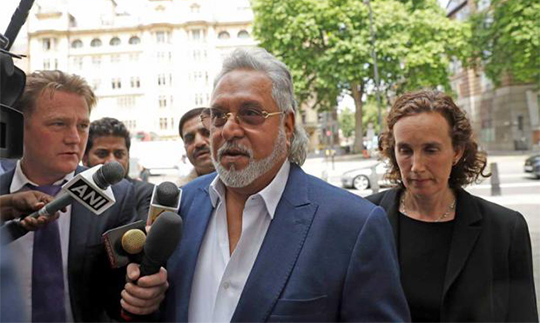
The development comes a day after the now London-based 61-year-old Mallya, before Westminister Magistrate Court, claimed that he had “enough evidence” to defend himself in the extradition case brought by the Indian government. “Keep dreaming about billions of pounds,” he even taunted outside the courtroom.

The Indian government is seeking his extradition from United Kingdom in loan default to the tune of Rs 9,000 crore involving several banks in connection with the money that he reportedly raised for the now defunct Kingfisher Airlines (KFA). In India, he is being probed by the ED and the CBI on charges of violation the Prevention of Money Laundering Act (PMLA).

However, on Wednesday, when the ED filed the charge sheet, it comes as a jolt to him.

The 57-page charge sheet with voluminous annexures has provided details of the manner in which the loan was approved and subsequently diverted for money-laundering purposes violating norms.

According to the ED, in October 2009, the IDBI had granted a short-term loan of Rs.150 crore to the KFA, followed by another loan of Rs.750 crore, including a bridge loan of Rs.200 crore, without adequate collateral and flouting norms and procedures.

The charge sheet also mentioned the role of KFA and IDBI executives who were probed by the ED and they had criminally conspired to obtain funds to the tune of Rs 860.92 crore despite weak financials, negative net-worth, non-compliance of corporate credit policy of new client, non-quality collateral security and low credit rating of the borrower. Out of which Rs 807.82 crore of principal amount remains unpaid, according to the investigations.

Comments

Add new comment

  • Coastaldigest.com reserves the right to delete or block any comments.
  • Coastaldigset.com is not responsible for its readers’ comments.
  • Comments that are abusive, incendiary or irrelevant are strictly prohibited.
  • Please use a genuine email ID and provide your name to avoid reject.
News Network
June 23,2020

New Delhi, Jun 23: In an unexpected development, the pump price of diesel is all set to surpass the petrol price in the capital, making it the most expensive transport fuel for the first time in a long time.

Globally, diesel is priced slightly above petrol prices due to the very nature of the product that has a higher cost of production. But in India, due to the lopsided taxation structure, diesel attracts lesser of the tax between the two auto fuels keeping its prices lower than petrol for last several years.

Diesel is currently priced at Rs 79.40 a litre in the Capital, just 36 paise short of petrol price that is being retailed at Rs 79.76 a litre. Going by the trend of price movement in the two products for the last few days where diesel prices have consistently increased by 50-60 paise per litre while the daily increase in petrol prices have fallen to just 20 paise on Tuesday, it is set to surpass petrol prices in next few days.

"Diesel price movement is sharper in international market and if oil companies follow the global price trend, diesel prices will surpass that of petrol later this week. It will be after many years that this would happen and is expected to sustain for some time unless government changes the tax structure of the petroleum products again," said an oil sector expert from one of the big four audit and advisory firms asking not to be named.

Interestingly, even in India the base price of diesel is expensive than petrol. According to the Indian Oil Corporation (IOC), while the base price of petrol in Delhi currently comes to Rs 22.11 per litre, the same for diesel is higher at Rs 22.93 per litre (effective from June 16, 2020). This has been the case for a long time, but retail price of petrol can be higher than diesel due to central and state taxes.

What has now brought diesel prices to a whisker of petrol prices in the capital is the Delhi government's decision early May to increase the Value Added Tax on diesel from 16.75 per cent to 30 per cent and on petrol from 27 per cent to 30 per cent. This increased the retail price of diesel and petrol in Delhi by Rs 7.10 and Rs 1.67 a litre respectively. With Central taxes on the two products already reaching identical levels, the Delhi governments move hastened price parity between petrol and diesel.

Currently, the Central excise on petrol is Rs 32.98 a litre while that on diesel it is Rs 31.83 a litre. The VAT on petrol in Delhi is Rs 17.71 a litre and that on diesel is Rs 17.60 a litre.

While the movement of retail pricing is being seen with a sigh of relief by vehicle owners whose cars run on petrol, those buying the relatively expensive diesel cars are now repenting on their decision. The development is also being seen with caution by automobile companies who have spent millions to ramp up their facilities for diesel run vehicles. The expectation is that demand for such cars will now fall, causing more damage to companies where sales are already impacted due to persistent economic slowdown and now the spread of COVID-19 pandemic.

"The pricing development would push automobile companies to strategies being followed by companies in the western markets where diesel run cars are not sold on fuel pricing differential, but on overall make and quality that puts them ahead of petrol run cars," the expert quoted earlier.

Yes, but for commercial vehicle sector the rising price of diesel had not been welcomed. In fact, the commercial transport sector had time an again threatened strike against the move to raise fuel prices.

With petrol and diesel retail prices closing, the case for adultering fuel has also gone down much to the relief of vehicle owners.

Comments

Add new comment

  • Coastaldigest.com reserves the right to delete or block any comments.
  • Coastaldigset.com is not responsible for its readers’ comments.
  • Comments that are abusive, incendiary or irrelevant are strictly prohibited.
  • Please use a genuine email ID and provide your name to avoid reject.
Agencies
June 30,2020

Seventy-seven per cent children below five years of age in Jammu and Kashmir were not able to access basic healthcare services like immunisation during the lockdown imposed to curb the spread of COVID-19, CRY said on Monday citing a study.

The 'Rapid Online Perception Study about the Effects of COVID-19 on Children' was conducted during the first and second phases of the lockdown based on responses of parents and primary caregivers from all across the country, including Jammu and Kashmir, the NGO said in a statement.

It said a total of 387 respondents from Jammu and Kashmir participated in the study.

"Seventy-seven per cent children of age 0-5 years were not able to access basic healthcare services such as immunisation during lockdown - necessarily imposed to curb the spread of COVID-19 pandemic in Jammu and Kashmir," Child Rights and You (CRY) said.

It said as immunisation programmes witnessed a major setback during the lockdown across the country, the results of the survey across 23 states and Union Territories found nearly 50 per cent of parents with children below five years of age unable to access immunisation services.

"Worryingly, the figure was considerably high in Jammu and Kashmir with 77.14 per cent children below five years unable to get immunisation services," it added.

According to the study, in Jammu and Kashmir, nearly 35 per cent of the respondents said their children did not receive medical help during the lockdown, resulting in difficulties to cope with their children's illnesses and health hazards.

The study also talks about more systemic arrangements and logistical preparedness to ensure that children with no or compromised digital reach are not deprived from their Right to Education.

With online classes introduced as a substitute of schools during the lockdown, access to education for children remained a major issue of concern, as many of them, especially the ones from marginalised and financially poorer backgrounds found it difficult without smartphones and internet access.

The survey's findings revealed that nationally only 41 per cent households with children of school-going age could access online classes on a regular basis.

"Almost 90 per cent parents and primary caregivers reported that the lockdown has increased the screen time of their child to great or some extent. About half of the households recorded an increase of children's exposure to online activities during lockdown," it said.

The NGO said around 76 per cent parents agreed that they could keep a watch of their children's online activity to some extent.

Comments

Add new comment

  • Coastaldigest.com reserves the right to delete or block any comments.
  • Coastaldigset.com is not responsible for its readers’ comments.
  • Comments that are abusive, incendiary or irrelevant are strictly prohibited.
  • Please use a genuine email ID and provide your name to avoid reject.
Agencies
July 30,2020

Kochi, Jul 30: The Kerala High Court on Thursday refused to grant the extension for the stay of a 74-year-old US citizen, Johnny Paul Pierce, who had earlier said that he felt safer to remain in India than in the United States amid the COVID-19 pandemic.

The single-judge bench of Justice CS Dias, which considered the writ petition, observed that the grant or extension of visa to foreign nationals fall exclusively within the domain of the Government of India (GoI) and that judicial review in such matters is minimal.

The power of the GoI to expel foreigners is absolute and unlimited, the bench said.

"In view of the categoric declaration of law by the Supreme Court, the plea of the petitioner to permit him to stay back in India cannot be accepted, as it falls within the purview of the guidelines and the discretion of the Government of India," the order said.

"The petitioner cannot be heard that the guidelines/policies/regulations formulated by the Government of India, that an American national though has been granted a visa having validity of five years has to leave India within 180 days, is irrational or unreasonable," it added.

The High Court, which was hearing a plea to permit the US citizen to stay in India for a further period of six months, said that the petitioner does not have a case that there is an infraction of Article 21 of the Constitution of India.

"The petitioner was well aware of the visa conditions when he arrived in India, and it is too late in the day for him to raise a grievance on the visa conditions," the bench said noting that the petitioner's love for India was heartening.

The High Court also directed the Foreigners Registration Officer to consider the petitioner's representation within a period of two weeks in accordance with the applicable guidelines and policies.

Comments

Add new comment

  • Coastaldigest.com reserves the right to delete or block any comments.
  • Coastaldigset.com is not responsible for its readers’ comments.
  • Comments that are abusive, incendiary or irrelevant are strictly prohibited.
  • Please use a genuine email ID and provide your name to avoid reject.