



Eid al-Fitr: A festival of unity and thanksgiving

Heraa Hashmi
June 25, 2017

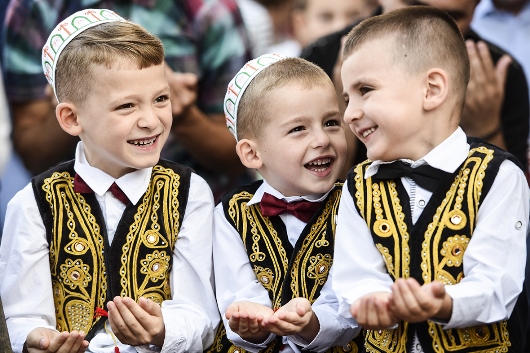
Today as the first rays of sunlight appeared, Muslims in many countries wake for Eid al-Fitr, the festival of the breaking of the fast. It marks the end of Ramadan, a month in which every Muslim (who is able to) fasts from food and water from dawn to dusk. The Qur’an, Islam’s holy book, was believed to have been revealed during this month.
eidulfitr

Eid al-Fitr is one of two annual festivals in Islam, different from Eid al-Adha, oft used interchangeably due to the similar names. This Eid, Eid al-Fitr, celebrates the completion of Ramadan, while Eid al-Adha, the feast of sacrifice, marks the end of Hajj, the annual pilgrimage to Makkah.

The exact date of Eid al-Fitr is difficult to predict as it’s dependent on the Islamic lunar-based calendar. The dates are decided according to the phases of the moon so it moves 10 to 11 days back each year in respect to the solar-based Gregorian calendar. Eid al-Fitr is observed when the new moon is sighted in the region, signifying the end of the 9th month of the Islamic calendar, Ramadan, and the start of the 10th month, Shawwal. This year it is on the 25th of June, but many countries around the world will be celebrating it on the 26th or 27th.

The significance of Eid al-Fitr is primarily spiritual. The month of Ramadan is seen as the holiest month of the year, culminating in Eid. The Prophet Muhammad (peace be upon him) said, “Whoever spends the nights of Ramadaan in prayer out of faith and in the hope of reward, his previous sins will be forgiven” (Sahih Muslim and Bukhari).

Muslims thank Allah for enabling them the health and capacity to fast and worship throughout the month. It is not a celebration of the end of Ramadan, but rather of the happiness of remaining steadfast through a blessed time. In fact, the day of Eid al-Fitr is one of the only days of the year on which fasting is prohibited, as the day is reserved for celebration. Many Muslims feel sorrow at the passing of Ramadan, counting the days until the next year arrives.

Eid al-Fitr is observed a public holiday in many Muslim countries, with school and work taking vacation days. In non-Muslim majority countries, this is not the case, but many employers and schools will make allowances for Muslims to take time off for their celebration.

Muslims celebrate Eid al-Fitr by spending time with loved ones and contributing to the community. It is obligatory upon Muslims, provided they are financially stable, to begin the day by paying Zakat al-Fitr (a special alms given at the end of Ramadan) to the poor and needy so they may have the means to celebrate the day along with others. Zakat al-Fitr is a special form of charity, given in addition to the annual zakat of 2.5% of one’s economic surplus. Charity is a vital aspect of Islam as one of its pillars. If one is not financially able to give zakat, they are eligible as a recipient instead.

Once the religious duty is fulfilled, Muslims gather to offer Eid Prayer, a special prayer only done twice a year. The prayer is usually offered early in the morning. Muslims greet each other by saying “Eid Mubarak, translated as “have a blessed Eid”.

The prayer is followed by a short sermon to remind people of the blessings of God, to reflect on the holy month that’s been completed. While the entire month was a time of spirituality and developing good habits, the day of Eid marks the beginning of a goal to maintain those habits throughout the year.

After the prayer, there are other traditions of Eid, such as wearing one’s best clothes and visiting family and friends. Sweets are exchanged, women and children adorn their hands with mehendi, and luncheons and dinners are often held with a spread of a variety of food. Kids are given Eidi, gifts of money, from the elders in the community. In Ramadan, one of the recommended ways to break fast is with the community, and this carries into the Eid celebrations. Muslims are encouraged to share meals with their neighbors, coworkers, and classmates.

Celebrations last long into the night and even throughout the week. It’s seen as a time of unity and giving thanks to Allah (God) for enabling them to complete the month of spiritual cleansing, forgiveness, and compassion.

Heraa Hashmi

The author, Heraa Hashmi, is a 19 year old University student at Boulder, Colorado. She’s studying Molecular Biology and is the president of Muslim Student Association. Recently she founded Muslims Condemn, a spreadsheet with over 5000 instances of Muslims condemning terrorism and is a part of the Bridge Initiative at Georgetown University, an initiative dedicated to tackling Islamophobia through education. This is her first article for coastaldigest.com

Comments

Add new comment

  • Coastaldigest.com reserves the right to delete or block any comments.
  • Coastaldigset.com is not responsible for its readers’ comments.
  • Comments that are abusive, incendiary or irrelevant are strictly prohibited.
  • Please use a genuine email ID and provide your name to avoid reject.
News Network
April 24,2020

Kasaragod, Apr 24:  Stricter measures have been enforced in more places in this district, as part of intensifying efforts aimed at containing the spread of Covid19.

According to District Collector Dr Sajith Babu, the new norms of intensified lockdown would be enforced in Kumbala, Mogral-Puthur, Chemmanad, Madhur, Muliyar and Kumbala grama panchayats, being identified as new hotspots in the district.

Earlier, door-to-door police patrolling at regular intervals have been implemented in Thalankeri, Choori, Kalanad and Nellikkunnu, where more positive cases of Covid-19 has been reported.

Comments

Add new comment

  • Coastaldigest.com reserves the right to delete or block any comments.
  • Coastaldigset.com is not responsible for its readers’ comments.
  • Comments that are abusive, incendiary or irrelevant are strictly prohibited.
  • Please use a genuine email ID and provide your name to avoid reject.
News Network
January 19,2020

Bengaluru, Jan 19: Karnataka Chief Minister B S Yediyurappa on Sunday said he has had detailed discussions with BJP National President Amit Shah on the cabinet expansion and that the exercise would be carried out after his return from Davos.

The Chief Minister told reporters before leaving for Davos to attend the World Economic Forum meet that he hoped his visit would help bring in large-scale investments to the state. "On cabinet expansion, I had detailed discussions for about half-an-hour (with Amit Shah on Saturday), got a good response... one or two days after I come from Davos, I will expand the cabinet. There are no stumbling blocks for it", Yediyurappa said.

He also rubbished media reports about a lack of clarity on the Ministry expansion. "It is not right... there are no issues", he said.

Asked whether he would travel to Delhi to meet Shah after returning from Davos, Yediyurappa merely said, "It is natural for me to meet Amit Shah." According to the Chief Minister's tour programme, he will be back in the city on January 24.

Yediyurappa, along with Union ministers Piyush Goyal and Mansukh Mandaviya, as well as Chief Ministers Amarinder Singh of Punjab and Kamal Nath of Madhya Pradesh, are among those expected to join over 100 Indian CEOs at Davos in the coming days for the WEF's 50th annual meeting.

Stating that he was leaving on a four day trip for Davos with an aim to bring investments to the state, he said interactions have been fixed with 38 industrialists and investors. "There is a large possibility of investments coming to the state from meetings during the WEF meet. I will assure industrialists and investors that the government will give all necessary facilities within our limits and also clear all the doubts that they have," the Chief Minister said. He said employment opportunities in Karnataka would increase due to all these efforts.

Claiming that the economic situation in Karnataka was stable despite the global economic slowdown, he said the state was also organising the Global Investors Meet in November to attract industries and create employment opportunities.

The delegation led by Yediyurappa includes Industries Minister Jagadish Shettar, Chief Secretary T M Vijaya Bhaskar and top officials of the state government. The Chief Minister, who was anxiously waiting for the high command's nod to expand his ministry amid intense lobbying by the aspirants, was keen on getting approval for it from Shah, but was asked to visit Delhi after returning from Davos, party sources said.

They also said that with J P Nadda all set to take over as BJP National President, he would have final discussions with Yediyurappa on the Ministry expansion exercise. S R Vishwanath, Political Secretary to the Chief Minister too said that Yediyurappa would go to Delhi after his return from Davos and immediately expand the Ministry.

He said the Chief Minister has been asked to hold discussions with Nadda, who is currently BJPs National Working President and finalise things.

As the Chief Minister has already made it clear that 11 of the disqualified JDS-Congress MLAs who got re-elected in the bypolls on BJP tickets will be made ministers, lobbying has been on in the party for the remaining ministerial berths. Currently, there are 18 Ministers, including the Chief Minister in the cabinet that has a sanctioned strength of 34.

However, with some reports that the high command may not be keen on making all the 11 re-elected legislators, whom Yediyurappa has given assurance, as Ministers, it remains to be seen how things turn out. Cabinet expansion will not be an easy task for the Chief Minister as he will have to strike a balance by accommodating the victorious disqualified legislators as promised and also make a place for old guards, upset at being "neglected" in the first round of the induction exercise.

He also has to give adequate representation to various castes and regions in his cabinet and also deal with the allocation of key portfolios. Also, disqualified legislators who lost on a BJP ticket during the bypolls like A H Vishwanath (Hunsur) openly expressing their ministerial aspirations has added to the Chief Minister's worry.

Comments

Add new comment

  • Coastaldigest.com reserves the right to delete or block any comments.
  • Coastaldigset.com is not responsible for its readers’ comments.
  • Comments that are abusive, incendiary or irrelevant are strictly prohibited.
  • Please use a genuine email ID and provide your name to avoid reject.
News Network
June 30,2020

Bengaluru, Jun 30: To instill confidence among its commuters, the Karnataka State Road Transport Corporation (KSRTC) has decided to put stamp on hand of all passengers before they are allowed to board the buses.

In a statement issued here on Tuesday, The decision was taken in the wake of a sudden jump in the number of COVID-19 cases reported from Bengaluru.

The round stamp is, however, different from 'home-quarantine' stamp applied to infected and they were not allowed to travel. Officials said that the measure is aimed at reassuring passengers that those travelling with them do not have symptoms. The left hand will be stamped with an ink which can be washed away by the time they reach home.

Comments

Add new comment

  • Coastaldigest.com reserves the right to delete or block any comments.
  • Coastaldigset.com is not responsible for its readers’ comments.
  • Comments that are abusive, incendiary or irrelevant are strictly prohibited.
  • Please use a genuine email ID and provide your name to avoid reject.